After examining all 188 images of the Montecheroux BMD records from 1740 to 1790 multiple times, I believed my five years of French and basic Latin had allowed me to extract all relevant information about my ancestors, their siblings, and their close descendants. Nevertheless, a few unanswered questions lingered: I wondered about the purpose of the annual French declaration introducing each year, the reason behind alternating between Latin and French for different BMD entries, and the specific roles or community standing of my ancestors who frequently appeared as witnesses. Discovering errors in the historical data that I or other researchers had previously documented was completely unexpected.
My methodology involved downloading batches of four to five images to have Google’s AI chatbot, Gemini, transcribe and translate them. I initially sought to understand why my 7th great-grandfather, Jacques Ignace Voysard (1687–1743), signed various records as a witness between 1740 and his death in 1743. While the ultimate reason remained unclear, a significant pattern emerged: his signature was exclusively present on Catholic records written in Latin, rather than the Lutheran entries written in French. Following this, I uncovered an error regarding the marriage of my 6th great-grandparents, Jean Pierre Lachat and Marie Anne Labbe. The existing documentation placed their marriage in 1738 in Esclavolles-Lurey, France—an improbable location given that Esclavolles-Lurey sits roughly 320 kilometers north-west of Montecheroux in what is now the outskirts of Paris.With Gemini’s assistance, I identified the genuine marriage record written in 1743 within the Montecheroux files, a finding firmly supported by multiple corroborating details.
I wonder if had not supplied multiple images for examination would Gemini have uncovered the following genealogical gem:
“Double Wedding: Entries 2 on Image 14 and Entry 1 on Image 15 record a double wedding celebrated on February 5, 1743, in the chapel at Saint-Hippolyte. Two brothers (Jean-Pierre and François-André Lachat) married two sisters (Marie-Anne and Anne-Françoise Labe from nearby Trévillers).”
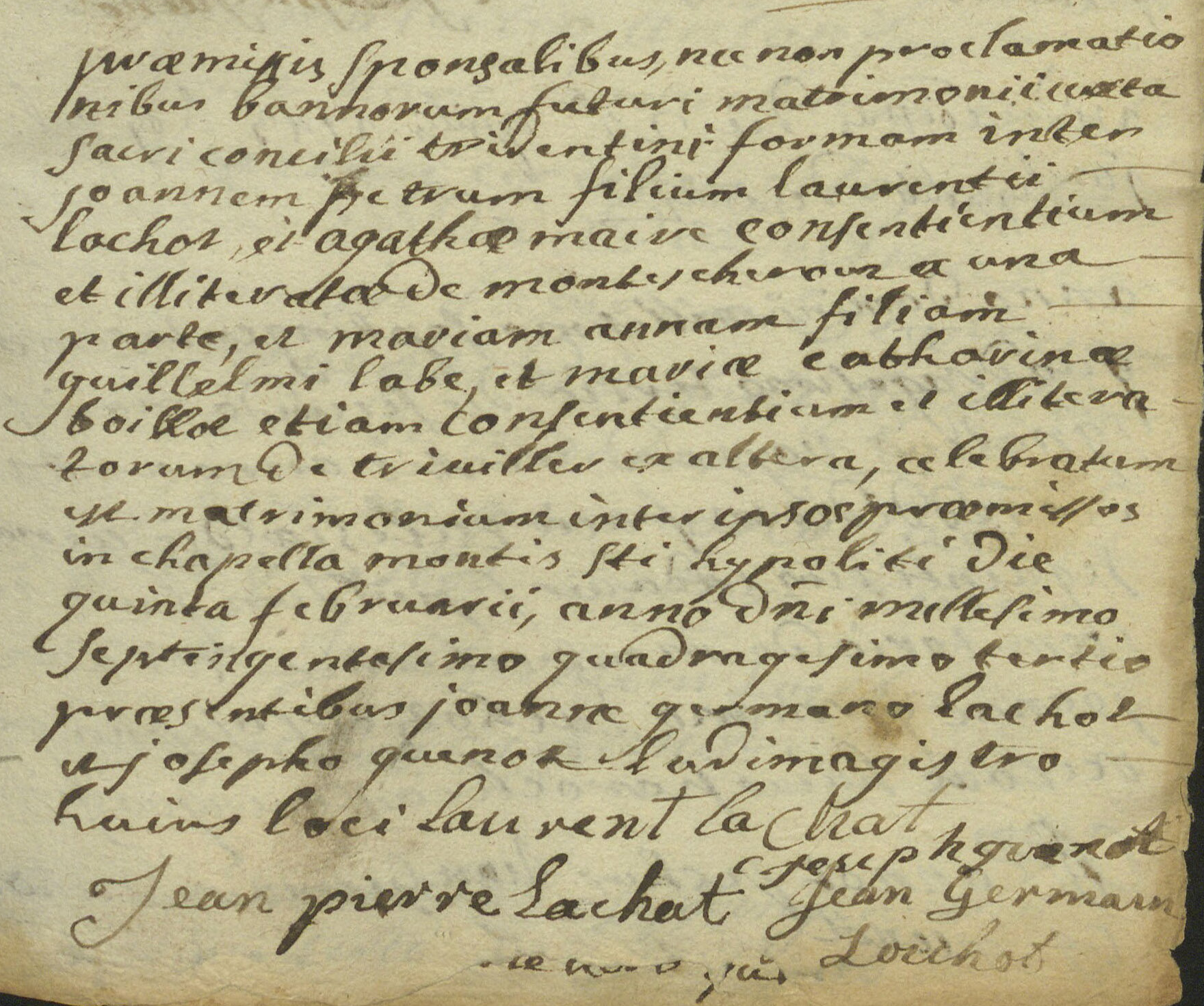
Here is the translation from Latin of the second entry on image #14:
Entry 2: Marriage
The betrothals having been entered into, as well as the proclamations of the banns of future marriage according to the form of the Sacred Council of Trent between Jean-Pierre, son of Laurent Lachot [Lachat] and Agathe Maire (consenting and illiterate), of Montchéroux, on the one part; and Marie-Anne, daughter of Guillaume Labe and Marie-Catherine Boillot (also consenting and illiterate), of Trévillers, on the other part; marriage was celebrated between the aforementioned parties in the chapel of the mountain of Saint-Hippolyte on the fifth day of February, in the year of our Lord 1743, in the presence of Jean-Germain Lachot and Joseph Guenot, schoolmaster (ludimagister) of this place.
Signatures: Laurent Lachat | Joseph Guenot | Jean Pierre Lachat | Jean Germain Loichot
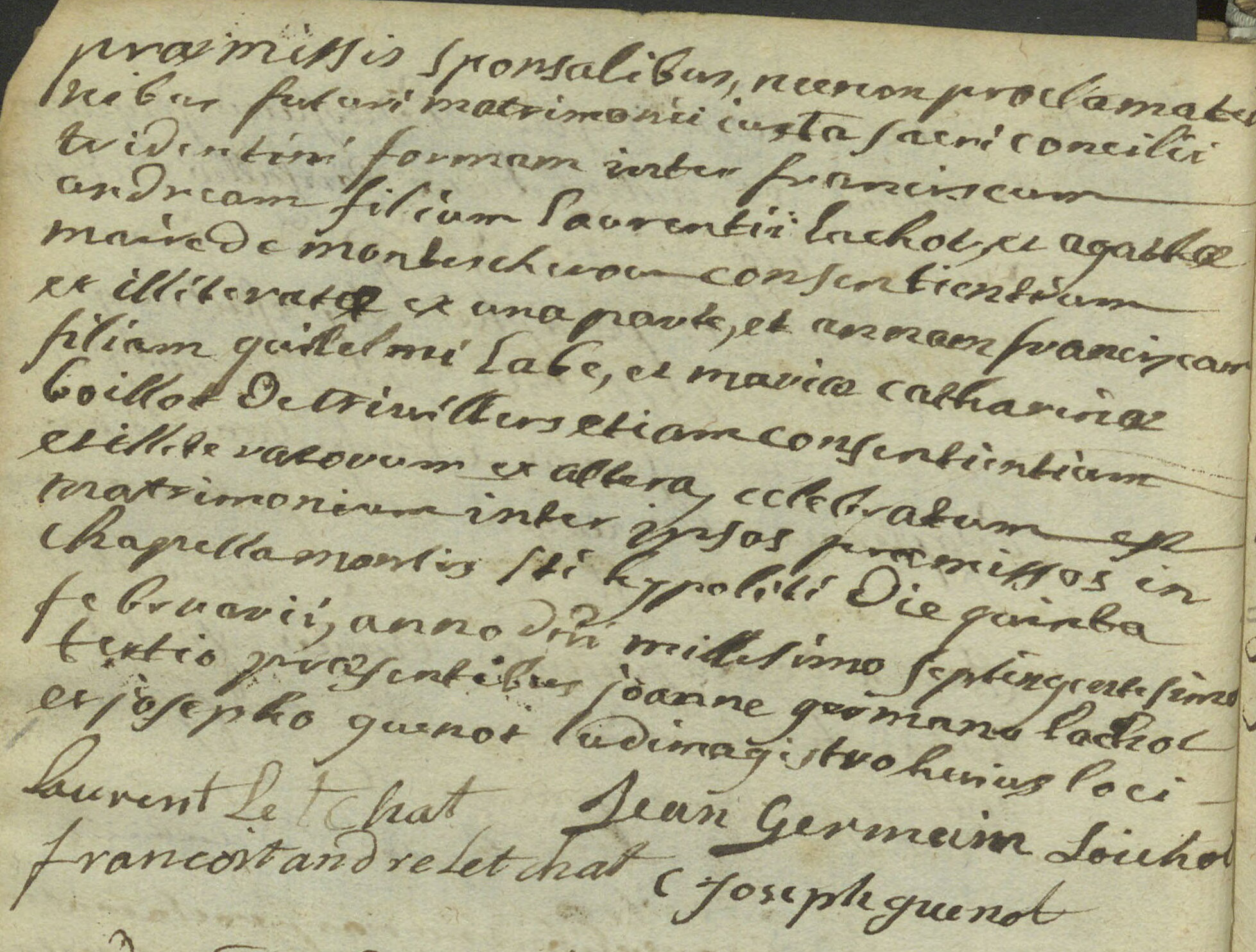
And here is the translation from Latin of the 1st entry appearing on image #15:
Entry 1: Marriage (Double-Wedding Day)
The betrothals having been entered into, as well as the proclamations of future marriage according to the form of the Sacred Council of Trent between François-André, son of Laurent Lachot [Lachat] and Agathe Maire of Montchéroux (consenting and illiterate), on the one part; and Anne-Françoise, daughter of Guillaume Labe and Marie-Catherine Boillot of Trévillers (also consenting and illiterate), on the other part; marriage was celebrated between the aforementioned parties in the chapel of the mountain of Saint-Hippolyte on the fifth day of February, in the year of our Lord 1743, in the presence of Jean-Germain Lachot and Joseph Guenot, schoolmaster of this place.
Signatures: Laurent Lachat | Jean Germain Loichot | François André Lachat | Joseph Guenot
I wondered what genealogical gems Google’s Gemini will uncover next.