I requested a comprehensive textual analysis from Gemini, synthesizing the Montécheroux Birth, Marriage, and Death (BMD) Records spanning an eighty-six-year period from 1740 to 1826. This extensive demographic dataset chronicles the community’s transition across major historical epochs—from the Ancien Régime under King Louis XV and King Louis XVI, through the turbulent secularization and decimal timekeeping of the French First Republic, to the Napoleonic Empire and the Bourbon Restoration.
Beyond documenting basic demographic statistics, these vital registers capture the social fabric, inter-family alliances, occupational shifts, and epidemiological crises of the Jura foothills. They trace the deep intermarriages among prominent regional lineages—including the Voisard, Loichat/Lachat, Jourot, Faivre, Monnot, and Jeanin-Gaume families—while highlighting Montécheroux’s dual identity as an agrarian highland settlement and an artisanal hub for watchmaking toolmakers, blacksmiths, tanners, and weavers. Furthermore, the records reveal how local civic leadership endured through shifting regimes, culminating in the long mayoral service of Jean Germain Voisard, who personally recorded and certified decades of births, marriages, and deaths until his passing in 1826.
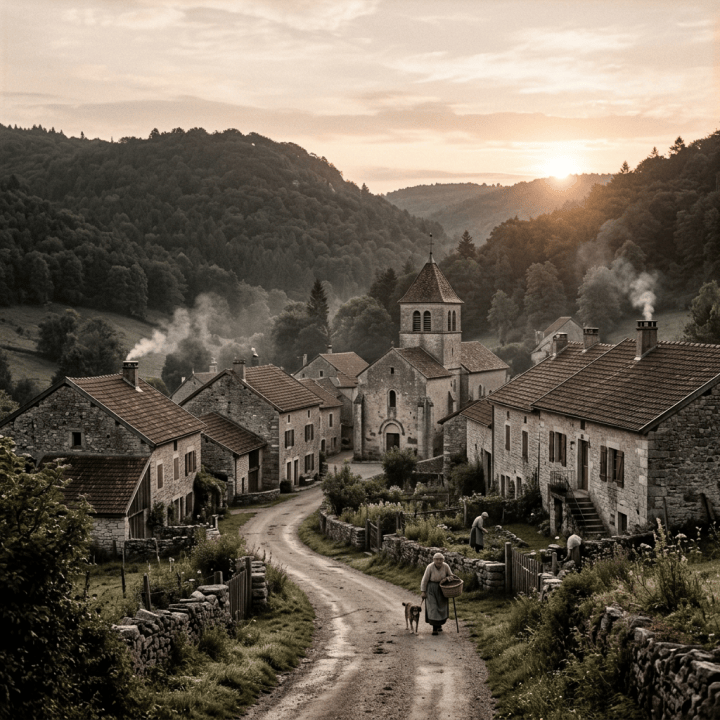
Birth Records (1740–1764)
In the high, limestone foothills of the Jura Mountains, where the breezes from the Swiss border stirred the pine forests of Franche-Comté, the village of Montécheroux lived by the tolling of church bells and the scratch of quill pens. When the official civil and parish registers opened in the winter of 1740, the community’s secular and spiritual life rested in the hands of a few trusted patriarchs.
Among the foremost of these elders was Jacques-Ignace Voisard, the author’s 7th great-grandfather. In the early 1740s, Jacques-Ignace served as the village’s pillar of civic authority, placing his steady mark on nearly every vital record that passed through the parish hall. In July of 1740, he stood by the baptismal font to officially witness the arrival of Marie-Anne Lachat, the author’s 6th great-grandaunt, born to Laurent Loichat (the author’s 7th great-grandfather) and his wife Agathe Maire (the author’s 7th great-grandmother). That same autumn, Jacques-Ignace appeared again and again—attesting the baptisms of the Bonnot, Breschet, and Voirochon infants alongside Jean-Germain Lachat, whose own signature as a town magistrate mirrored the rising standing of the Lachat family.
The village, however, walked a delicate line between two faiths. Under the royal Simultaneum, the stone walls of the parish church sheltered both Roman Catholic masses and the austere rites of Swiss Lutheran refugees who had fled across the border. While the Lutheran register recorded craftsmen, cutlers, and weavers assembling under Pastor Pierre Doriot, the Catholic ledger recorded the foundational alliances of the village’s French kin.
In February 1743, the village celebrated a remarkable double wedding that bound two prominent families together. On a single winter’s day, Jean-Pierre Lachat (the author’s 6th great-grandfather) wed Marie-Anne Labbé (the author’s 6th great-grandmother), while Jean-Pierre’s brother, François-André Lachat (the author’s 6th great-granduncle), took Marie-Anne’s sister, Anne-Françoise Labbé (the author’s 6th great-grandaunt), as his bride. Yet joy was swiftly shadowed by mortality; only three months later, in May 1743, the aged patriarch Jacques-Ignace Voisard drew his last breath at fourscore years, his burial solemnly witnessed by his friend Jean-Germain Lachat.
Spring 1751 brought another pivotal union that forever twined the village’s dominant bloodlines. On May 23, Jacques-Ignace’s son, Jean-Jacques Voisard (the author’s 6th great-grandfather), stepped forward to marry Jeanne-Antoine Jourot (the author’s 6th great-grandmother). Her father, Jean Jourot (the author’s 7th great-grandfather), attended to grant his formal paternal blessing. Over the next four years, their household echoed with new life: a daughter, Jeanne-Marie Voisard (the author’s 5th great-grandaunt), arrived in the summer of 1753, followed in December 1754 by a son, Pierre-Antoine Voisard (the author’s 5th great-granduncle).
Yet tragedy struck the young household when Jean-Jacques Voisard died in August 1755 at just forty years of age, leaving Jeanne-Antoine a widow with infant children in the protective shadow of her father Jean Jourot.
The early 1760s tested the enduring strength of the Lachat household. In September 1761, matriarch Agathe Maire passed away at age seventy, her grieving husband Laurent Loichat and their son François-André attesting her burial. Three years later, in early 1764, a cruel wave of sickness swept through the village: within the span of nine weeks, Jean-Pierre Lachat and Marie-Anne Labbé lost two young children—eight-year-old Claude-Joseph and infant Marie-Thérèse—before the venerable patriarch Laurent Loichat himself died on March 26 at the age of seventy-three, closing an era of pioneering elders.
Birth Records (1765–1789)
Out of the grief of the 1760s arose a new generation of leadership. By 1765, François-André Lachat (the author’s 6th great-granduncle) had been elevated to the esteemed office of Maire du Roy—the Royal Mayor of Montécheroux. For over two decades, his bold signature, Fr. A. Lachat maire, appeared across the town archives, overseeing marriages, settling estates, and maintaining the king’s peace in the valley.
In May 1765, Mayor Lachat proudly presided over the marriage of his sister Marie-Anne Lachat to Claude-Joseph Monnot. A year later, when Marie-Anne gave birth to a son, François-Xavier Monnot, Mayor Lachat stood as godfather to his nephew. Meanwhile, the extended Jourot and Voisard families continued to adapt to life’s shifts; in the autumn of 1770, the widowed Jeanne-Antoine Jourot entered a second marriage with Étienne Chèvre, witnessed by her father Jean Jourot and Mayor Lachat.
Tragic partings continued to temper the village’s joys. In April 1772, Marie-Anne Lachat succumbed to illness at only thirty-two, followed weeks later by her newborn child and Jean Jourot’s second wife, Claudine Poupeney. The following spring, in April 1773, Jean-Pierre Lachat died at age fifty-eight, leaving his widow Marie-Anne Labbé and his surviving children under the care of his mayoral brother.
On May 30, 1774, the two ancient lineages of Montécheroux were forged into a single direct ancestral line. In the presence of Mayor Lachat and the village elders, young Jean-Germain Voisard (the author’s 5th great-grandfather) wed Marie-Angélique Lachat (the author’s 5th great-grandmother).
Their hearth quickly filled with the laughter and tears of a growing family:
In February 1775, they welcomed their firstborn son, Pierre-François Voisard (the author’s 4th great-granduncle), though the fragile boy lived only two years.
In June 1777, a second son, Jean-Joseph Voisard (the author’s 4th great-granduncle), was born.
In March 1779, a third son, Pierre-François-Xavier Voisard (the author’s 4th great-granduncle), arrived, proudly held at the baptismal font by his uncle Pierre-Ignace Lachat.
In November 1780, a daughter, Marie-Agnès (Marie-Anne) Voisard (the author’s 4th great-grandaunt), was baptized.
On February 6, 1783, Jeanne-Angélique Voisard—the author’s 4th great-grandmother and direct maternal link to the eventual American frontier—was born and baptized in the parish church. Later that same autumn, her grandmother Jeanne-Antoine Jourot passed away at age fifty-three, having lived to see her granddaughter cradled in Montécheroux.
As the 1780s drew to a close, Jean-Germain and Marie-Angélique welcomed more sons into their bustling home: François-Victor in 1784, Jean-François in 1786, and Pierre-Louis in 1788 (all 4th great-granduncles to the author).
By 1788, the old Ancien Régime was waning, and the matriarch of the family, Marie-Anne Labbé, died peacefully at age seventy on September 13, surrounded by her children. When Pierre-Claude Lachat placed his signature on the parish register on a freezing January day in 1789, none in the Jura foothills could fully foresee the revolutionary storm gathering over Paris—nor that the descendants of the Voisards and Lachats would one day carry their quiet mountain legacy across the Atlantic to the rolling fields of Ohio.
Death Records (1793–1795)
The secular civil death registers for Montécheroux during 1793 (Year II of French Liberty / Year I of the Republic) and An III (1794–1795) reveal the social, military, and domestic life of the Jura plateau at the height of the French Revolution.
Death Records (1793)
The year 1793 represents the full implementation of civil record-keeping in Montécheroux. The register documents 14 deaths, characterized by heavy military losses among local volunteers and continued bereavement within the direct ancestral line.
19 July 1793 (Declaration of Stillborn Male Infant Voisard):
At 6:00 AM, Marie Angélique Lachat/Loichat (LACH-006 / VOIS-010 / JOUR-010) gave birth to a stillborn son (mort-né). Later that day, Jean Germain Voisard (VOIS-009 / LACH-007 / JOUR-009, aged 41, laboureur) appeared before the municipal officers to formally register the birth and death. He was accompanied by his brother-in-law, Pierre Claude Lachat/Loichat (aged 35, laboureur), who signed the register alongside him. This marks the fourth infant/child loss suffered by Jean Germain and Marie Angélique within thirty months (following Pierre Louis and Jean François in February 1791, and an unnamed boy in May 1791).
27 March 1793 (Death of Prosper Félix Régnier & Monnot Connection):
Two-hour-old Prosper Félix Régnier died in his parents’ home. The declaration was made by the father, Jean François Régnier, and the infant’s maternal uncle, François Xavier Monnot (aged ~25, tisserand / weaver), providing a direct link to the allied Monnot line (LACH-018).
21 August & 10 September 1793 (Fallen Volunteers of the 8th Doubs Battalion):
The realities of the War of the First Coalition struck the village directly when two sons of stonemason George Bourquin—Pierre Bourquin (aged ~20) and Nicolas Bourquin (aged 24)—died at home after falling ill while serving as soldiers (volontaires) in the 8e Bataillon du Doubs.
16 November 1793 (Death of Auguste Frédéric Méquillet):
Another young soldier, Auguste Frédéric Méquillet (aged 25, volontaire au 2e Bataillon du Doubs), died in his father’s house. The death was registered by his father Jean Nicolas (a wheelwright / charronneur) and his brother-in-law George Mélière.
Death Records (1794–1795)
The An III register (comprising 15 death records from Vendémiaire to Fructidor An III / Sept 1794 – Sept 1795) is notable for its strict application of the Republican calendar and decimal time (e.g., recording deaths at 3:75 or 4:30 decimal hours).
17 Ventôse An III / 7 March 1795 (Death of Anne Marie Marthe Monnot):
Fifteen-day-old Anne Marie Marthe Monnot, infant daughter of weaver François Xavier Monnot (age 29), passed away at 4:30 decimal hours in the afternoon. Jean Germain Voisard (VOIS-009, recorded as a 42-year-old laboureur and neighbor) stepped forward to serve as the official witness and declarant alongside Monnot, cementing the close neighborly and kinship ties between the families.
9 Thermidor An III / 27 July 1795 (Death of Marianne Gourant):
When 69-year-old Marie Anne Gourant died in the home of Marie Geneviève Lanoir, Jean Germain Voisard once again served as the primary independent witness before Mayor Jean Nicolas Abram, demonstrating his established civic standing in Montécheroux.
29 Brumaire An III / 19 November 1794 (Death of Marie Joseph Loichot):
Eighteen-month-old Marie Joseph Loichot, daughter of cultivator Pierre François Loichot (age 41) and Catherine Jobin, died in Montécheroux, documenting the collateral Loichot/Lachat branch in the village.
22 Pluviôse An III / 10 February 1795 & 8 Messidor An III / 26 June 1795 (Deaths of the Lanoir Patriarchs):
The village lost Jean Nicolas Lanoir (age 68, former greffier de la municipalité), reported by his son Pierre Joseph Lanoir (P. J. Lanoir, who had married Catherine Hugoniot in May 1792), followed by 78-year-old André Lanoir in June.
Death Records (1795–1797 / An IV – An V)
The secular death registers of Montécheroux for the Republican years An IV (1795–1796) and An V (1796–1797) capture a critical stabilization period following the Reign of Terror. Administration transitioned from temporary public officers (like Pierre Charton) to regularized municipal agents (Frédéric Bouton), assisted by the local Protestant pastor, Frédéric Maeler.
When cross-referenced against the combined descendancy register of the Voisard, Lachat/Loichat, Jourot, and allied families (Monnot, Faivre, Lanoir), these records yield a major genealogical discovery in the Voisard line and further illuminate the social fabric of the village.
Death Records (1795–1796)
The An IV register records 14 deaths, spanning from late 1795 through late summer 1796.
27 Vendémiaire An IV / 19 October 1795 (Death of Jeanne Marie Magnin & Monnot Connection):
Jeanne Marie Magnin (aged 50) died in her home. Her daughter, Marie Joseph Magnin (24), declared the death alongside François Xavier Monnot (aged 27, tisserand / weaver). Monnot—who connects directly to the allied Monnot line (LACH-018)—consistently served as a key village witness alongside Jean Germain Voisard.
12 Frimaire An IV / 3 December 1795 (Death of Catherine Abram, wife of Jacques Faivre):
Catherine Abram (aged 27) died in her husband’s house. Her husband, Jacques Faivre (aged 46, coutelier / cutler), reported the death alongside Jacques Guental. This provides valuable context for the collateral Faivre lines (LACH-013 / VOIS-017) active in metalworking and cutlery across Montécheroux.
19 Thermidor An IV / 6 August 1796 (Death of Susanne Quélet, wife of Jean Jacques Lanoir):
Susanne Quélet (aged 69) passed away. Her husband, Jean Jacques Lanoir (aged 65, laboureur), registered the passing in the presence of Frédéric Maeler (aged 29), the newly active Protestant minister.
Death Records (1796–1797): The Passing of Aunt Claude Ursule Voisard
The An V register contains 14 deaths, including one of the most genealogically significant ancestral entries in the post-revolutionary series.
5 Germinal An V / 25 March 1797 (Death of Claude Ursule Voisard):
On the morning of 5 Germinal, Jean Germain Voisard (VOIS-009 / LACH-007 / JOUR-009, aged 45, laboureur) appeared before Municipal Agent Frédéric Bouton accompanied by his brother-in-law, Pierre Claude Loichot/Lachat (aged 32, laboureur, brother of LACH-006).
Jean Germain declared that Claude Ursule Voisard, his aunt (sa tante), had died the previous evening (4 Germinal / 24 March 1797) at 7:00 PM in her home at the age of 61 (born ~1736).
Genealogical Impact: This entry establishes Claude Ursule Voisard as an uncataloged sibling of Jean Jacques Voisard (VOIS-005) and Françoise Agnès Voisard (VOIS-007), and a daughter of Jacques Ignace Voisard (VOIS-003) and Agathe Pretot (VOIS-004).
Signatures: The record bears the clear original signatures of both family leaders: jg voisard and pierre claudeloichot.
19 Nivôse An V / 8 January 1797 (Death of Jacques Charton):
Four-month-old Jacques Charton died, declared by his father Jean Pierre Charton (fendeur de pierre / stone splitter) and grandfather Jean Jacques Lanoir (aged 68), further documenting the multi-generational family compounds on the plateau.
15 Thermidor An V / 2 August 1797 (Death of Louise Abram):
Ten-year-old Louise Abram passed away, declared by her widowed mother Catherine Faivre Pétré (aged 30) and grandfather Jean Faivre Pétré (aged 56, tisserand), linking the weaving trades of the Faivre and Abram families.
Death Records (1797–1799 / An VI – An VII)
The civil registers of Montécheroux during the French Republican years An VI (1797–1798) and An VII (1798–1799) capture a pivotal transitional window in the High Doubs. Following the secularization decrees of the National Convention, local civil status (état civil) was no longer kept by the parish curate, but administered directly by elected municipal officers (agents municipaux), witnessed by neighbors, kinsmen, and local artisans.
Cross-referencing these 22 death acts against the Unified Voisard–Jourot–Lachat Descendancy Register reveals the tight-knit web of allied families (Lachat/Loichat, Monnot, Faivre, Bouton, Méquillet, and Bourquin) surrounding direct ancestors Jean Germain Voisard (5th Great-Grandfather), Marie Angélique Lachat (5th Great-Grandmother), and their daughter Jeanne Angélique Voisard (4th Great-Grandmother), who was then a teenage girl of 14 to 16 living through the height of the Directoire period.
Death Records for Republican Year VI (September 22, 1797 – September 21, 1798)
Municipal Agent in charge: Frédéric Bouton
Key Witnesses: Frédéric Mauler (Protestant Minister / Schoolmaster), Pierre Nicolas Renoir (Schoolmaster).
During Year VI, 11 deaths were inscribed. The village economy—revolving around watchmaking tool assembly (faiseurs d’outils d’horlogerie), charcoal burning, limestone masonry, and hillside farming—is vividly reflected in the declarations:
9 Brumaire an VI (Oct 30, 1797) — Anne Marie Malblanc (age 57), wife of Jean Nicolas Bruot:
Declared by her husband and Pastor Frédéric Mauler. Demonstrates the Protestant presence and the pastoral oversight still maintained by Mauler under the civil guise of “ministre du culte” and citizen witness.
18 Frimaire an VI (Dec 8, 1797) — Jean Nicolas Bourquin (age 52):
Declared by his widow, Anne Marie Reine Châtelain, assisted by Pierre Nicolas Renoir, the village schoolmaster. The Bourquin family formed an enduring allied branch with the Voisards and Jourots across Montécheroux and Saint-Hippolyte.
11 Pluviôse an VI (Jan 30, 1798) & 2 Ventôse an VI (Feb 19, 1798) — Childhood Mortality:
Marie Reine Françoise Besançon (age 4), daughter of David Besançon, charcoal burner (charbonnier).
Pierre Billon (age 17), adolescent son of George Billon (cultivateur).
23 Ventôse an VI (Mar 13, 1798) — Anne Guental (age 22 days):
Daughter of Jean Nicolas Guental, horological toolmaker (faiseur d’outils d’horlogerie).
29 Germinal an VI (Apr 18, 1798) — Mariane Jaqueline Méquillet (age 23 months):
Daughter of Jacques Méquillet (age 28) and niece of Pierre Méquillet (age 51). The Méquillets were intermarried with the Lachat and Voisard lines.
7 Prairial an VI (May 26, 1798) — Catherine Mélier (age 12y 4m):
Daughter of Pierre Mélier, witnessed by his brother George Mélier.
3 Messidor an VI (Jun 21, 1798) — Elisabeth Charton (age 7):
Daughter of Jean Nicolas Charton, witnessed by Pierre Vernier, innkeeper (cabaretier).
7 Messidor an VI (Jun 25, 1798) — Susanne Vernier (age 55), wife of Jean George Cellerot:
Witnessed by her mason husband and their son Jean Nicolas Cellerot.
12 Thermidor an VI (Jul 30, 1798) — Henri Aimé Bumbert / Humbert (age 40y 4m):
Declared by his brother-in-law Jacques Méquillet and Victor Humbert Droz, clockmaker (horloger).
20 Thermidor an VI (Aug 7, 1798) — Françoise Faivre (age 59), wife of Jean George Bouvier:
Allied Family Connection: The Faivre lineage was closely allied with the Voisard line; within a decade, Joseph Faivre (4th Great-Grandfather) would marry Jeanne Angélique Voisard (4th Great-Grandmother).
Death Records for Republican Year VII (September 22, 1798 – September 22, 1799)
Municipal Agents in charge: Frédéric Bouton (early Year VII) succeeded by Pierre Nicolas Méquillet (mid-to-late Year VII).
Year VII records notable ancestral collisions, including the direct appearance of the Loichot (Lachat) and Monnot collateral lines as sworn legal declarants:
29 Vendémiaire an VII (Oct 20, 1798) — Pierre Joseph Xavier Monnot (age 9 months):
Son of François Xavier Monnot, weaver (tisserand, age 33).
Allied Connection: The Monnot and Labbe families connect directly into the maternal ancestry of Marie Angélique Lachat (5th Great-Grandmother) via LACH-018 (Claude Josephe Monnot) and LACH-004 (Marie Anne Labbe).
14 Brumaire an VII (Nov 4, 1798) — Jean Jacques Bourquin (age 59):
Declared by his son-in-law Étienne Guental, clockmaker’s toolmaker, and Jacques Bourquin, cutler (coutelier).
16 Nivôse an VII (Jan 5, 1799) — Jean Nicolas Guental (age 34):
A dramatic entry recording that Guental died between 3:00 and 4:00 AM “from a severe head wound sustained the previous evening during a brawl” (d’une blessure qu’il avoit reçue à la tête la veille dans une querelle).
15 Ventôse an VII (Mar 5, 1799) — Anne Dusanci (age 73), wife of Claude Joseph Beaufils:
Direct Collateral Witness: Sworn and signed by Pierre Claude Loichot (Loichat), cultivateur, age 40. Pierre Claude Loichot represents the living collateral branch of Laurent Loichat (7th Great-Grandfather, LACH-001) and Jean Pierre Lachat (6th Great-Grandfather, LACH-003).
17 Germinal an VII (Apr 6, 1799) — Jean Claude Beaufils (age 64):
Declared jointly by François Xavier Monnot (weaver/farmer, age 33) and Pierre Claude Loichot (Loichat) (age 43). This act unites the two core collateral cousin lines (Monnot and Loichat) in the same municipal chamber before Agent Pierre Nicolas Méquillet.
1 Floréal an VII (Apr 20, 1799) — Jean Pierre Bourgoin (age 80), day laborer (manœuvre):
Husband of Catherine Billon; declared by his son Pierre Bourgoin (horloger, age 30) and Pierre Auguste Guental (horloger, age 33).
3 Floréal an VII (Apr 22, 1799) — Pierre Joseph Jenin (age 12y 3m):
Son of Jean Baptiste Jenin and Françoise Hette, declared by his older brother Charles Louis Jenin (toolmaker, 21) and friend François Xavier Monnot.
Allied Connection: The Jenin family later converged directly with the author’s direct line through Jean Baptiste François Xavier Jeanin-Gaume (3rd Great-Grandfather, IND-036), who married Marie Elise Faivre (IND-035).
23 Floréal an VII (May 12, 1799) — Susanne Abram (age 42), widow of Jonas Frédéric Brand:
Declared by her son David Pierre Brand (22) and brother Jean Nicolas Abram (44).
8 Prairial an VII (May 27, 1799) — Marguerite Duboisé / Dubois (age 84):
Wife of Jean Pierre Bouton (manouvrier, 66); witnessed by Frédéric Bouton (55).
23 Messidor an VII (Jul 11, 1799; declared 26 Fructidor) — George Billon, day laborer:
Delayed declaration attested by Jacques Charton, shoemaker, and François Guillemot.
25 Fructidor an VII (Sept 11, 1799) — Daniel Guillemot, day laborer:
Witnessed by Pierre Bourgoin and François Guillemot.
Births (1793–1797)
The newly digitized civil registers of Montécheroux capture a pivotal transition in French history: the secularization of vital statistics during the French First Republic under the Law of 20 September 1792. Across this five-year period (1793–1797 / An I through An V), the community’s domestic milestones played out against the backdrop of decimal timekeeping, revolutionary calendar adoption, wartime conscription into the 8e bataillon du Doubs, and tight-knit artisan-agrarian alliances.
Birth Records 1793 / Year I & II (L’An I & II de la République)
The civil registration in Montécheroux opened under Public Officer Louis Christophe Cuvier on sheets initialed by Pierre-François Morey, Vice-President of the District of Saint-Hippolyte.
The Monnot & Loichot Circles: On 3 January 1793, the first civil record registered the birth of Aimable Benjamin Monnot to François Xavier Monnot (weaver) and Marie Clémence Villaume. Among the official witnesses was farmer Pierre Claude Loichot (aged 35–41), a kinsman of the author’s 5x-great-grandmother Marie Angélique Lachat/Loichat (IND-024).
Wartime Realities: The shadow of the War of the First Coalition is vividly captured on 8 February 1793 in the declaration of Daniel Henri Bourquin. His mother, Marie Reine Chatelain, was represented by his grandmother Esther Chatelain née Jaquot because his father, stonecutter Nicolas Bourquin, was away serving on the front lines in the 8e bataillon du Doubs within the Army of the Rhine. A second soldier, volunteer Alexandre Juillerot (21), appeared on 20 March 1793 on leave to witness the birth of his unwed teenage sister Jeanne Claude’s child.
Direct Ancestral Appearance (IND-021): On 28 February 1793, the author’s 5x-great-grandfather Jean Germain Voisard (IND-021), recorded as Jean Germain Poifard/Froissard/Voisard (40, laboureur), appeared in the town hall alongside Pierre Claude Loichot to formally attest the birth of Marie Joseph Loichot, daughter of Pierre François Loichot and Catherine Goben. This act cements the close neighborhood kinship between the Voisard and Loichat families in the village center.
Birth Records 1794 / Year II & III (L’An II & III de la République)
Year II saw the deepening of Revolutionary reforms, with registers certified at the district seat under its radicalized place-name, Doubs-Marat (the Revolutionary moniker for Saint-Hippolyte).
Craftsmen and Watchmakers: The village’s specialized economy is heavily represented by the families of watchmaking-lathe makers (faiseurs de tours d’horlogerie) and toolmakers, including Jean Nicolas Abran (41), François Guillemot (36), and Swiss immigrant watchmakers Victor Humbert-Droz and Frédéric Sandoz from La Chaux-de-Fonds.
Collateral Births & Twin Deliveries: On 24 Messidor An II (12 July 1794), cordwainer Pierre Juillard registered the birth of twin boys, Pierre (born 9:00 AM) and Jaques Frédéric (born 9:30 AM), with Marianne Hugoniot.
Decimal Time Implementation: By Autumn 1794 (Vendémiaire–Frimaire An III), Officer Cuvier began recording vital events using the mandatory French Revolutionary decimal clock (dividing the day into 10 decimal hours of 100 decimal minutes). For instance, Marianne Baudroit was registered at 3:30 decimal morning (~8:24 AM) on 22 Vendémiaire An III, and Christophe Faivre was recorded at 3:60 decimal morning on 4 Brumaire An III.
Birth Records 1795 / Year III & IV (L’An III & IV de la République)
In early 1795, the municipal registrar position transitioned from Louis Christophe Cuvier to shoemaker Pierre Charton. Charton’s entries are marked by phonetic, vernacular Franche-Comté spelling (“montes cherouce”, “desimal”, “anfant semelle”), providing linguistic texture to the village records.
Jean Germain Voisard (IND-021) as Regular Witness:
On 9 Ventôse An III (27 February 1795), Jean Germain Voisard (IND-021), recorded as Germain Voisard (42, laboureur), witnessed the birth of Anne Marie Marthe Monnot alongside Pierre Joseph Loichot (65) for their neighbor François Xavier Monnot.
On 13 Nivôse An IV (3 January 1796), Jean Germain Voisard (IND-021) again stood before Officer Charton with Pierre Claude Loichot (41) to witness the birth of Pierre Melchior Monnot.
The Reformed Ministry of Pastor Maehler: On 23 Pluviôse An IV (12 February 1796), the local Protestant minister, Pierre Conrad Frédéric Maehler (27), presented his own newborn son, Jaque Frédéric Maehler, born to Marie Catherine Gueutal. Pastor Maehler became a mainstay of village civil life, appearing frequently as an educated attestor on subsequent records.
Late Registration Rectification: On 22 Fructidor An III (8 September 1795), François Guillemot the younger formally came forward to rectify an omitted birth from Year II. He acknowledged that due to unfamiliarity with the secularized laws, he had failed to declare his daughter Susanne Catherine in 1794, prompting the officer to append a special legal addendum into the Year III book.
Birth Records 1796 / Year IV & V (L’An IV & V de la République)
Under the Constitution of the Year III (Directory), local government reorganized, and Frédéric Bouton took office as the Agent municipal.
The Lachat & Loichot Kinsmen: On 20 Vendémiaire An IV (12 October 1795), Pierre François Loichot registered daughter Marie Loichot, witnessed by Claude Bournot and Ignace Juillerot. Kinship networks between the Loichat, Hugoniot, and Fréterot families continued across multiple declarations, including mason Jean Nicolas Fréterot and watchmaker Pierre Frédéric Bourquin.
Artisanal Vitality: Entries throughout Year IV reflect the village’s dual agrarian and horological base, documenting births to toolmaker Jean Nicolas Abram and Anne Charton (Mariane Julie, 29 August 1796) and blacksmith Pierre Gueutal and Sophie Méquillet (Susanne Sophie, 22 August 1796).
Birth Records 1797 / Year V (L’An V de la République)
The Year V registers solidify connections directly into the author’s collateral lines and neighboring holdings.
Jeanne Marie Voisard (IND-022) and the Brisechoux Family: On 17 Floréal An V (6 May 1797), farmer Ursanne Brisechoux (55) presented his newborn daughter, Marie Joseph Brisechoux (IND-049). The mother is identified as the author’s 5x-great-grandaunt Jeanne Marie Voisard (IND-022), daughter of Jean Jacques Voisard (IND-010) and Jeanne Antoine Jourot (IND-012). The declaration was signed in clear script by veteran soldier Jean Pierre Charton (50) and cutler George Lanoir (38).
The Anabaptist/Mennonite Outlier at Les Essarts: On 13 Messidor An V (1 July 1797), Pierre Graber (36), documented specifically as the owner-tenant of the gratterie des Essarts (the outlying agricultural estate of Les Essarts), declared the birth of his son Daniel Graber with Marie Liechti (Liechtie). This entry captures the distinct Mennonite farming enclave settled on the high pastures above Montécheroux, integrating into the communal civil rolls alongside Pastor Maehler.
The Republican Years (Marriages 1793–1797)
The civil marriage registers of Montécheroux spanning Year I through Year V of the French Republic document the communal life, alliances, and craft traditions of the village during the French Revolution.
Marriage Records 1793 (Year I & Year II of the Republic)
January 1, 1793 (Year I): Jacques Huguoniot (36, widower, tanner) marries Marie-Anne Guental (23), daughter of the late cutler Jean-Jacques Guental and Catherine Guioh. Witnessed by clockmakers Jacques and Étienne Guental, farmer Jacques Méquillet, and schoolmaster/farmer Jean-Nicolas Lanoir.
May 21, 1793 / 21 May 1793 (Year II): Jean-Nicolas Frélerot (30, mason, b. 30 May 1763) marries Catherine Conraut (26, b. 22 Apr 1767). Witnesses include father Jean-George Frélerot (63), uncle Pierre Frélerot (48), father Pierre Conraut (62), and Frédéric Doriot (48, grenadier in the 8th Battalion of Doubs).
June 25, 1793 / 25 June 1793 (Year II): Daniel Quélet (30, farmer, b. 15 Jan 1763), son of Jean-Jacques Quélet the elder (71, tanner) and Élisabeth Méquillet (68), marries Marie-Élisabeth Heer (18, b. 28 Jul 1775 at Seloncourt), daughter of Nicolas Heer (former Swiss captain in the Castella Regiment) and Catherine-Marguerite Fléri (47).
Marriage Records 1794 (Year III of the Republic)
December 23, 1794 / 3 Nivôse An III: Jean-Nicolas Gueutal (30, clock-turner maker, b. 27 Nov 1763 at Liebvillers), son of the late Jean-Jacques Gueutal and Catherine Guioh (64), marries Anne Bernard (22, b. 23 Oct 1773 at Pierrefontaine), daughter of the late Pierre Bernard and Marguerite Mouge (69). Witnessed by Jacques Gueutal (33), Jacques Hugoniot (45), Jean-Jacques Mathiot (43), and Pierre-Nicolas Beaudroit (22).
Marriage Records 1795 (Year III of the Republic)
July 23, 1795 / 5 Thermidor An III: David-Pierre Brandt (18, toolmaker, b. 18 Aug 1777 at Le Locle / La Chaux-de-Fonds, Switzerland), son of the late Jonas-Frédéric Brandt and Susanne Abram, marries Françoise-Louise Bourrelier (22, b. 10 Sep 1773 at Raynans), daughter of Pierre Bourrelier (44) and Élisabeth Crotet. Witnessed by Mayor Jean-Nicolas Abram and toolmaker J.N. Bouvier (47).
August 4, 1795 / 17 Thermidor An III: Daniel Petit (44, clock-turner maker, b. 6 Dec 1751) marries Catherine Gueutal (28, b. 16 Nov 1767), daughter of the late Jacques Gueutal and Catherine Bertholet. Witnessed by Pierre Petit (64), Ggreffier (clerk) Jean-Nicolas RidleyRidey (47), Pierre Gueutal (30), and Jacques Bertholet (58).
August 13, 1795 / 26 Thermidor An III: Henry Burquier / Bürgi (25, locksmith, b. 27 Jan 1771 at Zollikon, Zurich, Switzerland), son of late Conrad Burquier and Verena Bleuler, marries Catherine Bourquin (24, b. 12 Oct 1770), daughter of the late Étienne Bourquin and Judith-Marie Robert.
August 14, 1795 / 27 Thermidor An III: Nicolas Renaud (30, farmer, b. 26 Jan 1765 at Chagey) marries Anne-Marie Gueutal (35, b. 31 Mar 1760), daughter of late George Gueutal and Anne Méquillet (61).
September 15, 1795 / 29 Fructidor An III: Pierre-Jacques Bourlier (24, farmer, b. 1 Feb 1772 at Raynans) marries Marie-Anne Méquillet (23, b. 22 Jul 1772), daughter of the late Jean-Jacques Méquillet and Rose Méquillet.
Marriage Records 1796 (Year IV of the Republic)
January 11, 1796 / 21 Nivôse An IV: Jean-Nicolas Ridey (48, schoolmaster, b. 12 Sep 1747 at Allenjoie), son of Jean-Christophe Ridey and Susanne Hugoniot, marries Susanne Petit (40, b. 8 Jan 1756), daughter of Daniel Petit (60) and Susanne Beaudroit.
January 19, 1796 / 29 Nivôse An IV: Pierre-Claude Leichot / Lachat (40, farmer, b. 12 May 1755), son of the late Jean-Pierre Lachat (6x Great-Grandfather) and late Marie-Anne Labbe/Laibe (6x Great-Grandmother), marries Marie-Josèphe Magnin (23, b. 16 Nov 1772). The groom is the 5x Great-Granduncle of the author and a direct brother to Marie-Angélique Lachat (5x Great-Grandmother). The marriage is witnessed by his brothers Pierre-Joseph Leichot (38) and Pierre-François Leichot (44) [both 5x Great-Granduncles], and by Germain Voisard (44, 5x Great-Grandfather), husband of Marie-Angélique Lachat.
February 4, 1796 / 15 Pluviôse An IV: Claude Vocqué (42, laborer of Moriville/Morivécourt) marries Geneviève Lenoir (42, b. 14 Oct 1754). Witnessed by newly married 5x Great-Granduncle Pierre-Claude Lachat (40) and 5x Great-Grandfather Germain Voisard (44).
May 9, 1796 / 20 Floréal An IV: Jean-Ignace Tuillerot (27, farmer of Saint-Julien) marries Jeanne-Marie Mairot (22, b. 10 Feb 1774). Witnessed by 5x Great-Granduncle Pierre-Claude Lachat, schoolmaster Jean-Nicolas Ridey, and Protestant Pastor Pierre-Conrad-Frédéric Maeler (28).
Marriage Records 1797 (Year V of the Republic)
January 7, 1797 / 18 Nivôse An V: Pierre Vannier-Ruhier (23, grenadier, b. 8 May 1773) marries Catherine Faivre-Petré (31, widow of Pierre Abram, b. at Pierrefontaine to Jean Faivre-Petré and Françoise Bernard). Witnessed by Jacques Faivre (44, cutler), connecting into the broader Faivre kin network of Joseph Faivre (4x Great-Grandfather).
April 17, 1797 / 28 Germinal An V: Jean-Pierre Mélière (37, cutler, b. 14 Jun 1760) marries Marie-Catherine Bataillard (35, b. 18 Mar 1762 at Écurcey).
April 18, 1797 / 29 Germinal An V: Jacques Bourquin (26, grenadier in the 8th Battalion, b. 10 Jan 1771) marries Marianne-Auguste Lanoir (31, b. 17 Apr 1766), daughter of late schoolmaster Jean-Nicolas Lanoir and Rose Mettetal.
August 3, 1797 / 16 Thermidor An V: David-Jacques Poulignot (26, cutler, b. 5 Apr 1771 at Le Locle) marries Susanne-Catherine Doriot (23, b. 16 Sep 1773).
August 8, 1797 / 21 Thermidor An V: Étienne Gueutal (31, clock-turner maker, b. 19 Mar 1766 at Liebvillers) marries Élisabeth Bourquin (20, b. 31 Dec 1776).
The Republican Years (Deaths 1799–1802)
Detailed Year-by-Year Narrative & Epidemiological Analysis (1799–1802 / An VIII – An X)
Between late 1799 and early 1802 (covering the French Republican years An VIII, An IX, and early An X), Montécheroux experienced a profound institutional transformation alongside one of the most devastating localized demographic crises in its modern history.
This period spans the fall of the French Directoire, the establishment of the Napoleonic Consulate, and the local implementation of reformed municipal governance—transitioning from elected cantonal agents municipaux (like Pierre Antoine Tournoux) to constitutionally appointed maires (beginning with Jean Nicolas Abram).
Cross-referencing the 45 civil death registrations against the Unified Voisard–Jourot–Lachat Descendancy Register illuminates the exact relational fabric of the village, identifying direct ancestors, collateral kin, and allied cousin lines.
1. Republican Year VIII (September 23, 1799 – September 22, 1800)
Civil Administration: Administered primarily by Pierre Antoine Tournoux (Agent municipal), with the final act overseen by the newly appointed Mayor, Jean Nicolas Abram (Maire).
Total Registered Deaths: 9 acts.
Demographic Profile:
The mortality pattern of Year VIII represents a typical, stable pre-industrial agrarian baseline.
Adult & Elderly Mortality (Winter/Spring): Deaths were concentrated among elderly day laborers and craftspeople, such as Catherine Billon née Capperoniere (26 Vendémiaire / Oct 18), Susanne Chauverdot (age 78, 4 Brumaire / Oct 26), Susanne Billon (age 71, 4 Pluviôse / Jan 24), Susane Crélerot (age 67, 24 Pluviôse / Feb 13), Pierre Étienne Bourlier (farmer, age 48, 8 Ventôse / Feb 27), George Bouton (wheelwright, age 62, 16 Ventôse / Mar 7), and Germain Braichet (age 66, 7 Floréal / Apr 27).
Infant Mortality: Only a single infant death was inscribed all year—six-month-old Jacques Huguoniot (8 Fructidor / Aug 26), son of cutler Pierre Huguoniot.
Witness & Kinship Dynamics:
The witness network shows intense civic solidarity among the village schoolmasters (Pierre Nicolas Lanoir/Renoir, age 48–56, and Jacques Frédéric Perdrizet, age 25), who assisted illiterate neighbors and certified entries alongside master horologists like Étienne Guental and Pierre Bourgoin.
2. Republican Year IX (September 23, 1800 – September 22, 1801): The Great Summer Epidemic
Civil Administration: Jean Nicolas Abram (Maire), with ministerial assistance from Protestant Pastor Jacques Frédéric Perdrizet (Ministre du culte).
Total Registered Deaths: 35 acts (a massive 388% increase over Year VIII).
Epidemiological Breakdown:
The Baseline Months (Vendémiaire – Germinal / Oct 1800 – Apr 1801): The year began normally with isolated passings: Catherine Quélet (age 74, wife of J.N. Huguoniot Sr.), infant Mariane Vernier (3 months), and infant Pierre Nicolas Guental (1 month, grandson of tax collector Jacques Méquillet).
The Outbreak (Floréal & Prairial / May – June 1801): In May, an explosive, highly contagious pediatric pathogen invaded the commune. It struck Mayor Jean Nicolas Abram’s household first: his 7-year-old daughter Anne Abram died on 20 Floréal (May 10), followed five days later by his 2-year-old son Pierre Christophe Abram on 25 Floréal (May 15). Through June (Prairial), 8 more children succumbed in rapid succession (including children of the Poulignot, Bresse, Cuvier, Guental, Guillard, and Huguoniot families).
The July Catastrophe (Messidor an IX / June 19 – July 18, 1801): Over a single 30-day span, 13 deaths were registered (averaging a death every 55 hours). Multiple children perished within the same family clusters:
Mayor Abram lost his third child, David François Abram (age 21, toolmaker), on 16 Messidor.
Pierre Guental and Sophie Méquillet lost Pierre Auguste (age 7) on 21 Messidor and Susanne Sophie (age 5) on 29 Messidor.
Étienne Guental and Élisabeth Bourquin lost Susanne (age 3) on 20 Messidor and Élisabeth (age 2) on 30 Messidor.
The orphan brothers Jean Nicolas Guental (age 2) and Jacques Guental (age 6), whose father had died in the Year VII tavern brawl, both perished within 11 days of each other.
Pierre Bourgoin lost two sons: infant Louis (16 Messidor) and Charles Auguste (age 3½, 24 Messidor).
Thermidor Peak & Direct Voisard Family Impact:
Act MTC-AN09-D26 (1 Thermidor an IX / July 20, 1801): Four-year-old Marie Joséphine Brijéchoux passed away at 9:00 PM. She was the daughter of day laborer Ursanne Brijéchoux and Jeanne Marie Voisard (IND-022). Jeanne Marie was the full sister of the author’s direct ancestor Jean Germain Voisard (IND-021, 5th Great-Grandfather), making little Marie Joséphine a first cousin 5 times removed to the author.
The epidemic continued through August, claiming Jacques Nicolas Crélerot (age 2), Jacques Bourlier (age 2), Ulric Huguoniot (age 3), George Gatzai (age 1), and Pierre Bourquin (age 4).
Subsidence (Fructidor an IX / August – September 1801): In the final month, the contagion burned out after taking toddlers Jacques Huguoniot (2½), Pierre Mélières (3), and Christine Richard (3), alongside 48-year-old innkeeper Daniel Petit.
Etiological Synthesis: Out of 35 deaths in Year IX, 32 victims were infants and children under age 10 (a 91.4% pediatric concentration). This seasonal summer peak, rapid transmission across siblings, and respiratory/fever complications are the classic hallmarks of a severe epidemic of measles (rougeole) or malignant scarlet fever (scarlatine) running through an immunologically naive mountain population.
3. Republican Year X (1801–1802): Mourning & Fragility
Civil Administration: Jean Nicolas Abram (Maire).
Opening Record (21 Nivôse an X / January 11, 1802): Catherine Conraud (age 35), daughter of farmer Pierre Conraud and late Catherine Mélières, and wife of Jean Nicolas Crélerot.
Family Tragedy Cross-Reference: Catherine passed away at 2:00 AM on a freezing winter morning. Just five months earlier, on 5 Thermidor an IX, she and her husband had stood beside the open grave of their two-year-old son, Jacques Nicolas Crélerot. Her death reflects the exhaustion, sorrow, and maternal vulnerability that lingered in the village long after the epidemic had passed.
Death Records (1799–1802 / An VIII – An X)
The death registers of Montécheroux between Vendémiaire an VIII (autumn 1799) and the close of An X (autumn 1802) chronicle a pivotal era in the French Doubs. Locally, this period witnessed the consolidation of the Napoleonic Consulate, the formal establishment of the office of Maire under the Constitution of Year VIII, and the community’s endurance through a devastating pediatric epidemic in the summer of 1801 (Year IX), followed by a return to baseline mortality in Year X.
When cross-referenced against your Unified Voisard–Jourot–Lachat Descendancy Register, these registers document direct ancestral involvement, culminating in the formal joint appearance of direct ancestor Jean Germain Voisard (5th Great-Grandfather) and allied kinsman Pierre Claude Loichot/Loichat before the civic authorities in May 1802.
1. Republican Year VIII (September 23, 1799 – September 22, 1800)
Civil Leadership: Municipal Agent Pierre Antoine Tournoux (Agent municipal), followed by the installation of toolmaker Jean Nicolas Abram as the first constitutional Maire.
Total Registered Deaths: 9 acts.
Demographic Profile:
Typical rural demographic baseline dominated by elderly day laborers and seasoned artisans during the harsh winter months: Catherine Billon née Capperoniere (26 Vendémiaire / Oct 18, 1799), Susanne Chauverdot (age 78, 4 Brumaire / Oct 26, 1799), Susanne Billon (age 71, 4 Pluviôse / Jan 24, 1800), Susane Crélerot (age 67, 24 Pluviôse / Feb 13, 1800), Pierre Étienne Bourlier (farmer, age 48, 8 Ventôse / Feb 27, 1800), George Bouton (wheelwright, age 62, 16 Ventôse / Mar 7, 1800), and Germain Braichet (age 66, 7 Floréal / Apr 27, 1800).
Only a single pediatric death occurred all year: infant Jacques Huguoniot (6 months, 8 Fructidor / Aug 26, 1800).
Witness & Kinship Dynamics:
Close mutual assistance is seen between schoolmasters Pierre Nicolas Lanoir and Jacques Frédéric Perdrizet (acting as civic witnesses and Protestant pastoral guides), who appeared alongside master watch toolmakers Étienne Guental and Pierre Bourgoin.
2. Republican Year IX (September 23, 1800 – September 22, 1801): The Pediatric Contagion
Civil Leadership: Jean Nicolas Abram (Maire).
Total Registered Deaths: 35 acts (representing a catastrophic 388% increase in village mortality).
Epidemic Progression:
Baseline Phase (Vendémiaire – Germinal): Only 3 deaths across six months (Catherine Quélet, age 74; infant Mariane Vernier, 3 months; and infant Pierre Nicolas Guental, 1 month).
Outbreak Phase (Floréal – Prairial / May – June 1801): An acute eruptive fever invaded the valley, striking the Mayor’s home first: Anne Abram (age 7) on 20 Floréal, followed by her brother Pierre Christophe Abram (age 2) on 25 Floréal. Eight more children died across June (Prairial).
Crisis Peak (Messidor an IX / July 1801): 13 deaths in 30 days. The Mayor lost a third child (David François Abram, age 21, toolmaker). The Guental, Bourgoin, and Petitjeune/Méquillet households suffered multiple losses.
Thermidor Peak & Direct Voisard Family Impact:
Act MTC-AN09-D26 (1 Thermidor an IX / July 20, 1801): Four-year-old Marie Joséphine Brijéchoux passed away at 9:00 PM. She was the daughter of day laborer Ursanne Brijéchoux and Jeanne Marie Voisard (IND-022). Because Jeanne Marie was the full sister of direct ancestor Jean Germain Voisard (IND-021, 5th Great-Grandfather), little Marie Joséphine was your first cousin 5 times removed.
Subsidence (Fructidor an IX / August – September 1801): The contagion waned after claiming three additional children (Jacques Huguoniot, Pierre Mélières, Christine Richard) and innkeeper Daniel Petit (age 48).
Epidemiological Finding: 32 of the 35 victims were infants and children under age 10 (a 91.4% child mortality concentration), confirming a malignant epidemic of measles (rougeole) or scarlet fever (scarlatine).
3. Republican Year X (September 23, 1801 – September 22, 1802): Return to Baseline & Ancestral Nexus
Civil Leadership: Jean Nicolas Abram (Maire).
Total Registered Deaths: 7 acts.
Demographic Profile:
Mortality normalized completely back to baseline, with passings occurring primarily among older residents: George Quélet (cutler, age 78, 4 Pluviôse / Jan 24, 1802), Jean George Crélerot (mason, age 72, 8 Pluviôse / Jan 28, 1802), Susanne Vernier (age 17, 29 Pluviôse / Feb 18, 1802), and Catherine Quélet (age 47, 1er Jour Complémentaire / Sep 18, 1802).
Post-Epidemic Maternal Mortality: The register opened on 21 Nivôse an X (Jan 11, 1802) with thirty-five-year-old Catherine Conraud, wife of Jean Nicolas Crélerot, succumbing in the winter cold just five months after the death of her two-year-old son in the summer fever.
The Direct Voisard–Loichot Nexus (Act MTC-AN10-D06):
On 20 Floréal an X (May 10, 1802), seventy-year-old Marie Magdeleine Voisard died at 2:00 AM. She was a daughter of early ancestor Étienne Voisard (IND-001) and paternal aunt to Jean Germain Voisard.
The act was declared in person by her nephew, Jean Germain Voisard (IND-021, 5th Great-Grandfather), described as a Cultivateur residing in Montécheroux, and his friend and allied kinsman Pierre Claude Loichot (Loichat), Laboureur.
Both men personally signed the register before Mayor Abram: Jean Germain using his characteristic signature J G Voisard alongside pierre claude loichot. This record formally binds the living paternal Voisard and maternal Lachat/Loichat ancestral lines on a single leaf of the official civil record.
Marriages (1797–1812)
The civil marriage registers of Montécheroux during the French Republican and Napoleonic periods (An VI through 1812) capture a tightly knit community where artisan dynasties, civic leaders, and agrarian households intermarried across generations. Cross-referencing these BMD records against the combined descendancy register of the Voisard / Voysard, Jourot, Loichat / Lachat, and Faivre lines illuminates both collateral and direct familial ties within Montécheroux and surrounding villages (Pierrefontaine, Raynans, Damvant, and the Swiss border).
Year VI (1797–1798)
6 Frimaire An VI (26 November 1797) — Pierre Joseph Fallot & Marie Angélique Bonnot
Summary: Pierre Joseph Fallot (age 36, farmer from Fleurey), son of Claude Joseph Fallot and Jeanne Guillemette Pillot, married Marie Angélique Bonnot (age 31), daughter of the late Claude Bonnot and the late Marie Agnès Curtil.
Kinship & Community Context: Certified by Municipal Agent Frédéric Bouton and witnessed by former schoolmaster Jean Claude Beaufits (62), weaver François Xavier Monnot (32), the groom’s father Claude Joseph Fallot (78), and the bride’s sister Marianne Bonnot (34).
Year IX (1800–1801)
14 Vendémiaire An IX (6 October 1800) — Jean Jacques Bourquin & Catherine Mélière
Summary: Jean Jacques Bourquin (age 21, farmer), son of the late Jean Jacques Bourquin and Susanne Catherine Doriot, married Catherine Mélière (age 20), daughter of the late Pierre Mélières and Catherine Poulignot.
28 Vendémiaire An IX (20 October 1800) — Charles Ducommun dit Véron & Catherine Beurnier
Summary: Charles Ducommun dit Véron (age 18, day-laborer), son of the late Jean Nicolas Ducommun dit Véron and Catherine Huguoniot, married Catherine Beurnier (age 23, of Blamont), daughter of Jean Beurnier (tailor) and Catherine Vernier.
Kinship Cross-Reference: Witnessed by Pierre Abry (age 47, uncle), whose household directly connects to later Abry–Nicolet and Abry–Hugoniot alliances.
7 Ventôse An IX (26 February 1801) — Jean Pierre Maillot & Catherine Marton
Summary: Jean Pierre Maillot (age 42, customs brigadier from Dole), son of the late Jacques Maillot and Catherine Vitelle, married Catherine Marton (age 38), daughter of the late Jean Pierre Marton and Elisabeth Bitton.
3 Prairial An IX (23 May 1801) — Jean Nicolas Mélières & Catherine Elisabeth Bourlier
Summary: Jean Nicolas Mélières (age 22, cutler), son of the late Pierre Mélières and Catherine Poulignot, married Catherine Elisabeth Bourlier (age 27, native of Raynans), daughter of the late Pierre Étienne Bourlier and Catherine Élisabeth Crotet.
Kinship Cross-Reference: Marks the arrival of the Bourlier branch from Raynans, establishing alliances that link repeatedly into the Bourquin, Véron, and Quélet households.
Year X (1801–1802)
16 Nivôse An X (6 January 1802) — Jacques Petit & Françoise Quélet
Summary: Jacques Petit (age 22, toolmaker), son of Jean Nicolas Petit and Elisabeth Mathey, married Françoise Quélet (age 21), daughter of Jean Jacques Quélet and Catherine Bouvier.
Kinship Cross-Reference: Integrates the toolmaking Petit family with the Quélet line; Jacques Petit serves as a recurring witness and brother-in-law in multiple subsequent town records.
5 Ventôse An X (24 February 1802) — Pierre Christophe Schom & Catherine Quélet
Summary: Pierre Christophe Schom (age 23, tanner), son of Marc Christophe Schom and Marie Jane Méquillet, married Catherine Quélet (age 18), minor daughter of the late Jacques Quélet and Catherine Masson.
7 Ventôse An X (26 February 1802) — Pierre François Brisechoux & Marie Anne Généreuse Genin
Summary: Pierre François Brisechoux (age 24, peddler), son of Urbain Brisechoux and Jeanne Marie Boizard, married Marie Anne Généreuse Genin (age 21), daughter of Jean Baptiste Genin and Anne Françoise Hott.
Direct Lineage Cross-Reference (Voisard & Loichat/Lachat Lines):
The groom’s maternal uncle, Germain Boizard (age 50, farmer of Montécheroux), exemplifies the regional Franc-Comtois dialectal variation of the Voisard / Voysard surname.
The wedding was witnessed by Pierre François Loichat (age 22, mason), directly representing the collateral Loichat / Lachat branch belonging to the family of the author’s 5th great-grandmother, Marie Angélique Lachat (IND-024), wife of Jean Germain Voisard (IND-021).
26 Prairial An X (15 June 1802) — Jean Jacques Véron & Anne Judith Bourlier
Summary: Jean Jacques Véron (age 24, cutler), son of Jean Jacques Véron and Catherine Peugeot, married Anne Judith Bourlier (age 22, native of Raynans), daughter of the late Pierre Bourlier and Elisabeth Marguerite Crotet. Witnessed by grandfather Pierre Bourlier (age 74).
2 Fructidor An X (20 August 1802) — Jacques Méquillet & Anne Quélet
Summary: Jacques Méquillet (age 37, Sous-Lieutenant), son of Étienne Méquillet and the late Marguerite Geutal, married Anne Quélet (age 27), daughter of the late Jean Jacques Quélet and Catherine Bouvier.
Year XI (1802–1803)
7 Vendémiaire An XI (29 September 1802) — Jean-Baptiste Tobin & Lydie Nicolet
Summary: Jean-Baptiste Tobin (age 32, watchmaker from Bellefontaine, Jura), son of the late Augustin Tobin and Anne Victoire Bailly, married Lydie Nicolet (age 26, born in Tramelan-Dessus), daughter of Jean Pierre Nicolet and Lydie Mathez.
5 Pluviôse An XI (25 January 1803) — Jacques Beaudroit & Marie Elizabeth Bouvier
Summary: Jacques Beaudroit (age 24, farmer), son of Jacques Beaudroit and Anne Charton, married Marie Elizabeth Bouvier, daughter of Jean George Bouvier and the late Françoise Faivre.
19 Pluviôse An XI (8 February 1803) — Jean Nicolas Crélerot & Susanne Vienot
Summary: Jean Nicolas Crélerot (age 40, farmer), son of the late Jean George Crélerot and the late Susanne Vernier, married Susanne Vienot (age 21), daughter of Pierre Vienot and Marie Elizabeth Vernier. Witnessed by the Protestant pastor Pierre Jacques Frédéric Perrezet (28).
26 Pluviôse An XI (15 February 1803) — Pierre Conraud & Marianne Ducommun dit Véron
Summary: Pierre Conraud (age 30, farmer), son of the late Pierre Conraud and the late Catherine Mélière, married Marianne Ducommun dit Véron (age 22), daughter of Jean George Ducommun dit Véron and the late Anne Quélet.
Year XII (1803–1804)
29 Germinal An XII (19 April 1804) — Jean Nicolas Schom & Anne Catherine Ducommun dit Véron
Summary: Jean Nicolas Schom (age 23, ironworker), son of Marc Christophe Schom (tanner) and Marie Anne Méquillet, married Anne Catherine Ducommun dit Véron (age 20), daughter of Jean Jacques Ducommun dit Véron and Catherine Peugeot.
6 Floréal An XII (26 April 1804) — Jean Nicolas Bouton & Marie Anne Guental
Summary: Jean Nicolas Bouton (age 25, weaver), son of Frédéric Bouton and the late Susanne Charton, married Marie Anne Guental (age 26), daughter of Daniel Guental (miller at Liebvillers) and Susanne Grobet.
20 Floréal An XII (10 May 1804) — Jean Nicolas Poulignot & Susanne Catherine Guental
Summary: Jean Nicolas Poulignot (age 26, watchmaker), son of Léopold Poulignot and Catherine Bertholet, married Susanne Catherine Guental (age 29, sister of Marie Anne Guental).
20 Prairial An XII (9 June 1804) — Victor Méquillet & Marie Anne Beaudroit
Summary: Victor Méquillet (age 22, ironworker), son of tax collector Jean Jacques Méquillet and Susanne Sophie Humbert-Droz, married Marie Anne Beaudroit (age 22), daughter of Jacques Beaudroit and Anne Charton.
18 Fructidor An XII (5 September 1804) — Pierre Nicolas Guental & Marie Anne Bouton
Summary: Pierre Nicolas Guental (age 21, ironworker, brother of the Guental brides above) married Marie Anne Bouton (age 24, sister of Jean Nicolas Bouton), cementing a double marriage alliance between the Guental and Bouton households.
Year XIII (1804–1805)
12 Vendémiaire An XIII (4 October 1804) — Jacques Richard & Marie Catherine Baudroit
Summary: Jacques Richard (age 23, cutler), son of Esaïe Richard and Anne Hugoniot, married Marie Catherine Baudroit (age 21), daughter of Samuel Beaudroit and Catherine Péquignot.
4 Pluviôse An XIII (24 January 1805) — Daniel Petit & Anne Roullot
Summary: Daniel Petit (age 36, farmer), son of Daniel Petit and Susanne Beaudroit, married Anne Roullot (age 29, of Pierrefontaine), daughter of Jacques Roullot and the late Catherine Bernard.
16 Pluviôse An XIII (5 February 1805) — Jean Jacques Cuvier & Elizabeth Bouton
Summary: Jean Jacques Cuvier (age 21, ironworker), son of Pierre Cuvier and Elizabeth Mattetat, married Elizabeth Bouton (age 21), daughter of Frédéric Bouton and the late Susanne Charton.
19 Germinal An XIII (9 April 1805) — Emanuel Gottlieb Abrand & Marie Anne Mélières
Summary: Emanuel Gottlieb Abrand (minor son of Mayor Jean Nicolas Abrand and Anne Charton) married Marie Anne Mélières (minor daughter of Pierre Mélières).
8 Thermidor An XIII (27 July 1805) — George Bourquin & Anne Catherine Poulignot
Summary: George Bourquin (age 23), son of the late George Bourquin and Rose Guillemot, married Anne Catherine Poulignot (age 24), daughter of Léopold Poulignot and Catherine Bertholet.
19 Fructidor An XIII (6 September 1805) — Jean Ignace Devillers & Généreuse Agnès Crélerot
Summary: Jean Ignace Devillers (age 40, born in Laviron), son of the late Xavier Devillers, married Généreuse Agnès Crélerot (age 21), daughter of Félix Crélerot.
Year 1807
14 April 1807 — Quentin Bernardin & Susanne Nicolet
Summary: Quentin Bernardin (age 42, farmer from Onans), son of the late Pierre Joseph Bernardin and the late Catherine Bernardin, married Susanne Nicolet (age 28, lace maker, born in Tramelan), daughter of Jean Pierre Nicolet and the late Lydie Mathez.
18 May 1807 — Pierre Tisserand & Marie Anne Vanier-Ruhier
Summary: Pierre Tisserand (age 21, mason from Coisevaux), son of the late Jean George Tisserand and the late Elizabeth Pillard, married Marie Anne Vanier-Ruhier (age 29), daughter of Pierre Vanier-Ruhier and Marie Anne Doriot.
29 May 1807 — Pierre Christophe Ducommun dit Véron & Anne Julie Méquillet
Summary: Pierre Christophe Ducommun dit Véron (age 25, farmer), son of Jean Jacques Ducommun dit Véron and Catherine Peugeot, married Anne Julie Méquillet (age 23), daughter of Anne Roland-Piègue (her father’s death documented by an act of notoriety from the Ministry of War).
2 July 1807 — Pierre Bourlier & Anne Hugoniot
Summary: Pierre Bourlier (age 20, native of Raynans), son of the late Pierre Étienne Bourlier and Elizabeth Marguerite Crotet, married Anne Hugoniot (age 18), daughter of Jean Nicolas Hugoniot (blacksmith) and Anne Guillemot. Witnessed by grandfather Pierre Bourlier (80).
25 November 1807 — Jean Pierre Nicolet & Marie Véronique Billand
Summary: Jean Pierre Nicolet (age 56, laborer from Tramelan-Dessus, widower of Lydie Mathez), son of the late Jean Pierre Nicolet and Marguerite Monier, married Marie Véronique Billand (age 53, born in La Chaux-de-Fonds, widow of Claude Joseph Maquet of Damprichard), daughter of the late Jean-Baptiste Billand and Dorothée Perrot.
Year 1808
27 October 1808 — Daniel Faivre d’Etré & Elizabeth Cuvier
Summary: Daniel Faivre d’Etré (age 24, retired soldier, born in Pierrefontaine), son of Jean Faivre d’Etré (weaver) and Françoise Bernard, married Elizabeth Cuvier (age 27), daughter of Pierre Cuvier (cutler) and Elizabeth Mattetat.
Direct Lineage Cross-Reference (Faivre Line):
Highlights the Faivre d’Etré / Faivre branch originating in Pierrefontaine.
This connects to the author’s direct 4th great-grandfather, Joseph Faivre (IND-034) (1782–1860), who married Jeanne Angélique Voisard (IND-030), fathering Marie Elise Faivre (IND-035) (the author’s 3rd great-grandmother).
Year 1809
31 January 1809 — Pierre Schom & Marie Anne Quélet
Summary: Pierre Schom (age 26, tanner), son of Marc Christophe Schom and Marie Anne Méquillet, married Marie Anne Quélet (age 24), daughter of Pierre Quélet and Marie Anne Guillemot.
1 June 1809 — Jean Nicolas Abrand & Susanne Elizabeth Bernard
Summary: Jean Nicolas Abrand (age 25, taking over as Mayor following his father’s death on 23 May 1809), son of the late Mayor Jean Nicolas Abrand and Anne Charton, married Susanne Elizabeth Bernard (age 20, of Pierrefontaine), daughter of Deputy Mayor George Bernard and Marie Elizabeth Faivre d’Etré.
Kinship Cross-Reference: Re-engages the Faivre d’Etré matriarchal line from Pierrefontaine into the administrative family of Montécheroux.
Year 1810
22 April 1810 — Pierre Faivre & Susanne Elizabeth Quélet
Summary: Pierre Faivre (age 23, retired soldier), son of Jacques Faivre (cutler) and the late Anne Catherine Abrand, married Susanne Elizabeth Quélet (age 31), daughter of the late Jean Jacques Quélet and Anne Catherine Bouvier.
Kinship Cross-Reference (Faivre Line): Demonstrates the continued integration of the Faivre veteran and metalworking branch into Montécheroux’s longstanding toolmaking circles.
3 May 1810 — Charles Auguste Vernier & Marie Catherine Ducommun dit Véron
Summary: Charles Auguste Vernier (age 26, tailor from Le Locle, Switzerland), son of the late Jean Pierre Vernier and the late Jeanne Marie Robert, married Marie Catherine Ducommun dit Véron (age 26), daughter of the late Jean George Ducommun dit Véron and the late Anne Quélet.
10 May 1810 — Jean Jacques Abrand & Susanne Catherine Lanoir
Summary: Jean Jacques Abrand (age 22, toolmaker), brother of Mayor Jean Nicolas Abrand, married Susanne Catherine Lanoir (age 16), daughter of Pierre Joseph Lanoir and Catherine Elizabeth Hugoniot.
14 June 1810 — Jean Nicolas Ducommun dit Véron & Julie Guental
Summary: Jean Nicolas Ducommun dit Véron (age 24, toolmaker), son of the late Jean Jacques Ducommun dit Véron and Catherine Peugeot, married Julie Guental (age 20), daughter of Jacques Guental and Susanne Catherine Guental.
Year 1811
27 June 1811 — Pierre Frédéric Abry & Susanne Sophie Hugoniot
Summary: Pierre Frédéric Abry (age 27, toolmaker from Le Locle), son of Pierre Abry and the late Susanne Hugoniot, married Susanne Sophie Hugoniot (age 21), daughter of the late George Hugoniot (shoemaker) and Susanne Lanoir.
Year 1812
25 June 1812 — Nicolas Guillemot & Catherine Ducommun dit Véron
Summary: Nicolas Guillemot (age 23, clockmaker’s toolmaker), son of François Guillemot (carpenter) and Anne Catherine Vernier, married Catherine Ducommun dit Véron (age 24), daughter of the late Jean George Ducommun dit Véron and the late Anne Quélet.
1 July 1812 — Charles Philippe Bourquin & Marianne Abry
Summary: Charles Philippe Bourquin (age 25, clockmaker’s toolmaker, born in La Chaux-de-Fonds), son of the late Jean Nicolas Bourquin and Marie Reine Châtelain (lace maker), married Marianne Abry (age 26, born in Le Locle), daughter of Pierre Abry and the late Susanne Hugoniot.
22 October 1812 — George Frédéric Bourlier & Marianne Frédérique Quélet
Summary: George Frédéric Bourlier (age 27, former soldier, born in Raynans), son of the late Pierre Étienne Bourlier and Elizabeth Marguerite Crotet, married Marianne Frédérique Quélet (age 17), daughter of Daniel Quélet (landowner) and Marie Elizabeth Heer.
26 November 1812 — Jean Richard & Marianne Mélières
Summary: Jean Richard (age 29, farmer from Béchamp/Blamont), son of Melchior Richard and Marie Riche, married Marianne Mélières (age 24), daughter of George Mélières (farmer) and Marianne Méquillet.
Historical & Genealogical Analysis (An VI – An XIII / 1797–1805)
Between Year VI and Year XIII of the French Republic, the civil birth records of Montécheroux capture a vivid cross-section of your ancestral network in the Doubs region. Cross-referencing these civil status acts against your descendancy register reveals how tightly intertwined the Voisard, Lachat/Loichat, Faivre, and related village families were across daily civic, religious, and domestic life.
Year VI (1797–1798): The community operates under municipal agent Frédéric Bouton. The records establish key local alliances, including watchmakers, cutlers, and Protestant minister Frédéric Mauler. The Faivre collateral lines appear via Catherine Faivre-Petre (wife of innkeeper Pierre Vannier-Ruhier) and Susanne Faivre (wife of Jean Nicolas Charton), reflecting the broader family environment of your 4th great-grandfather Joseph Faivre (IND-034).
Year VII (1798–1799): Crucial direct-line ancestral activity surfaces. On 29 Thermidor An VII (August 16, 1799), your 5th great-grandfather Jean Germain Voisard (IND-021), aged 45, and his son Jean Joseph Voisard (IND-027), your 4th great-granduncle, aged 22, appear side-by-side as official witnesses for the birth of Marie Geneviève Victoire Monnot, daughter of weaver François Xavier Monnot. Concurrently, Pierre François Loichat/Roichot (of your 5th great-grandmother Marie Angélique Lachat’s lineage) registers the birth of his daughter Marie Cécile.
Year VIII (1799–1800): The village witnesses the transition to Mayor Jean Nicolas Abran. Collateral kin Pierre Huguoniot (husband of Susane Petit) and Pierre Juillard (husband of Marianne Huguoniot) register births. Pierre Poulignot is recorded absent while serving as a grenadier in the Consular Guard in Paris, underscoring the military obligations touching village households.
Year IX (1800–1801): Close kin Pierre Claude Loichat serves as a witness for the twin daughters of Jean Ignace Juillerot, while François Guillemot and Catherine Vernier continue expanding their household.
Year X (1801–1802): A rich cluster of ancestral interaction occurs. On 14 Messidor An X (July 3, 1802), Jean Germain Voisard (IND-021) and Jean Joseph Voisard (IND-027) once again step forward as witnesses for François Xavier Monnot’s son, Pierre Joseph Xavier Monnot. In the same register, Pierre François Loichat registers his daughter Marie Séraphine and serves as a witness for Pierre Claude Loichat’s newborn son Pierre Joseph Marcelin.
Year XI (1802–1803): On 12 Floréal An XI (May 2, 1803), Jean Germain Voisard (IND-021) and Jean Joseph Voisard (IND-027) stand as witnesses for Marie Sophie Brisechoux. Both Pierre Claude and Pierre François Loichat also serve as witnesses for the newborn son of Joseph Vuillemin and Anne Elisabeth Bourquin.
Year XII (1803–1804): Watchmakers, toolmakers, and farmers—including Etienne Guental, Jacques Bourquin, and Jean Nicolas Mêlier—bring their children before Mayor Abran, highlighting the village’s dual identity as an agrarian commune and a specialized hub for horology.
Year XIII (1804–1805): On 1 Pluviôse An XIII (January 21, 1805), your 5th great-grandfather Jean Germain Voisard (IND-021), aged 52, stands alongside Pierre François Loichat, aged 52, to witness the birth of Justin Honoré Sébastien Monot. Pierre Claude Loichat also registers another son, Pierre Philippe, demonstrating unbroken communal ties right before the Republican calendar was formally abolished.
1821 Birth Register
The 1821 civil birth register for Montécheroux contains 27 recorded births (14 females, 13 males), representing steady population growth in the Jura foothills community during the Bourbon Restoration. The local economy is distinctly reflected across these acts: toolmakers (faiseurs d’outils), farmers (cultivateurs), and specialized craftsmen (shoemakers, stonemasons, and clothiers) dominate the occupations.
Winter (January – March)
January 4 (Act 1): Former municipal adjunct Jean Nicolas Schom (40) presents his daughter Julie Schom, born to Catherine du Comun dit Véron. Witnessed by Pierre Christophe Schom (42, cultivateur) and retired military officer Jean Nicolas Mequillet (40).
January 30 (Act 2): Pierre Bouton (58, woodcutter) declares the out-of-wedlock birth of his granddaughter Julie Auguste Bouton, born to his daughter Julie Bouton (domestic servant) at the home of day laborer Jean Ignace Vuillerot. Witnessed by Vuillerot (50) and schoolmaster George Frédéric Duvernoy (39).
February 10 (Act 3): Jean Nicolas Mequillet (40, retired officer) registers his newborn son Louis Mequillet, born to Catherine Rolland Piegue (30). Witnessed by Pierre Christophe du Comun dit Véron (37) and Reformed Pastor Jacques Frédéric Perdrizet (46).
February 18 (Act 4): Toolmaker Georges Mestieres (55) declares the birth of his grandson Pierre Frédéric Mestieres, born out of wedlock to his daughter Catherine Mestieres (30, day laborer). Witnessed by schoolmaster Duvernoy and stonemason Jacques Nardin (63).
March 15 (Act 5): Landowner Jean Louis Fabre (31) presents his daughter Catherine Eugénie Fabre, born to Julie Robert (24).
March 28 (Act 6): Veteran stonemason Jacques Nardin (63) and his young wife Lydie Mestieres (23) celebrate the birth of their son Pierre Auguste Nardin.
Spring (April – June)
May 15 (Act 7): Day laborer Louis Alexandre Donzé (35) registers son Charles Louis Donzé, born to Marie Silvier Ferrant (23). Joseph Voisard (43, farmer, the author’s 5th great-uncle) serves as primary witness alongside fellow farmer Joseph Faivre (39).
May 25 (Act 8): Shoemaker Jean Nicolas Tuillard (27) presents daughter Julie Tuillard, born to Ane Berlet (26), witnessed by toolmaker Jacques Charton dit Morel (22) and Pastor Perdrizet.
June 3 (Act 9): Toolmaker Jean Jacques Bourquin (44) and Catherine Mestieres (42) welcome daughter Sophie Bourquin.
June 15 (Act 11): Farmer George Frédéric Bourlier (37) and Marianne Frédérique Quiclet (26) register son Louis Bourlier (noted in the ledger margin as Julie, but legally recorded as male).
June 28 (Act 10): Toolmaker Nicolas Bouton (26) and Marie Quiclet (37) record the early morning birth of their son Jacques Bouton.
Summer (July – September)
July 10 (Act 12): Toolmaker Jacques Charton dit Morel (22) and Marianne Quental (24) register daughter Sophie Charton dit Morel.
July 29 (Act 13): Cultivator Pierre Frédéric Schom (25) and Susane Quiclet (27) present daughter Julie Schom, witnessed by kin Jean Nicolas and Pierre Christophe Schom.
August 5 (Act 14): Toolmaker Philippe Bourquin (34) and Mariane Abry (35) record daughter Julie Bourquin.
August 11 (Act 15): Retired soldier Pierre Guillemot (27) and Ane Richard (28) present daughter Catherine Eugénie Guillemot.
August 26 (Act 16): Toolmaker Olivier Vuille (35) and Mariane Hugoniot (34) present daughter Sophie Vuille.
September 16 (Act 17): Toolmaker Pierre Faivre Pêtre (34) and Julie Mâpon (33) register son David Faivre Pêtre, witnessed by tailor Auguste Vernier (38) and farmer Jacques Quiclet jeune (30).
September 30 (Act 18): Master tailor Auguste Vernier (38) and Marie du Comun dit Véron (38) present son David Vernier.
Autumn & Close of the Year (October – December)
October 12 (Act 19): Pince-manufacturer Nicolas Quental (43) and Marianne Bouton (39) welcome son Louis Quental.
November 7 (Act 20): Farmer Emanuel Gottlieb Abram (33) and Marianne Mestieres (34) register midday son Pierre Justin Abram.
November 9 (Act 21): Farmer Jacques Quiclet jeune (30) and Julie Abram (25) welcome son Jean Jacques Quiclet.
November 28 (Act 22): Young farmer Pierre Abram (20) and Catherine Bernard (23) present daughter Sophie Abram.
December 1 (Act 23): Cultivator Pierre Christophe du Comun dit Véron (40) and Julie Mequillet (35) register daughter Julie Véron.
December 8 (Act 24 – Primary Ancestral Act): Cultivator Joseph Faivre (40, author’s 4th great-grandfather) presents daughter Marianne Faivre (author’s 3rd great-grandaunt), born December 7 at 11:00 PM to Jeanne Angélique Voisard (33, author’s 4th great-grandmother). The act is officially received by Jean Germain Voisard (author’s 5th great-grandfather) as Mayor, and witnessed by Joseph Voisard (43, author’s 5th great-uncle) and Théophile Brisechoux (29).
December 15 (Act 25): Toolmaker Henry Guillemin (24) and Emélie Droz (28) present son Henri Louis Guillemin.
December 24 (Act 26): Farmer Jean Jacques Abram (34) and Susanne Laivoir (28) register Christmas Eve eve son Charles Louis Abram.
December 26 (Act 27): Toolmaker Jacques Roulot (25) and Catherine Guillemot (32) close the year’s ledger with daughter Emélie Roulot, born on Christmas night.
Year-by-Year BMD Analysis (1807–1812)
1807: The Cradle of the Gaume and Loichat Lines
The civil registers of 1807 open under the authority of Mayor Jean Nicolas Abrand and showcase the closely interconnected craft communities of Montécheroux, where metalworkers, weavers, and farmers lived side by side.
21 May 1807 — Birth of Victor Bernardin Loichat (IND-056):
Event & Details: Pierre Claude Loichat (IND-049, aged 48, laborer), author’s 5th great-grand-first-cousin once removed, presented his newborn son born to his wife Marie Joseph Magnin (IND-055).
Witnesses: Joseph Voisard (IND-050, aged 28, farmer), author’s 4th great-grand-uncle, and François Xavier Monnot (IND-057, aged 38, weaver).
Genealogical Significance: This entry connects the collateral branch of the Loichat family directly to the Voisard household through Joseph Voisard’s role as witness.
22 June 1807 — Birth of Jean Baptiste François Xavier Jeanin-Gaume (IND-036):
Event & Details: Jean François Jeanin-Gom (IND-052, aged 34, roofer), author’s 4th great-grandfather-in-law, presented his son born that morning to Marie Thérèse Péquignot (IND-051), author’s 4th great-grandmother-in-law.
Witnesses: Pierre François Jeannin-Gom (IND-053, aged 28, roofer residing in Mambou), brother to the declarant, and Pierre Christophe Schom (aged 28, farmer).
Genealogical Significance: This marks the primary birth entry of the author’s 3rd great-grandfather, who later migrated to America and carried the shortened surname Gaume.
1808: Tightening Community Ties
The year 1808 saw significant activity among the village artisans and tradesmen, with Pastor Jacques Frédéric Perdrizet and Schoolmaster Pierre Nicolas Lavoir serving as regular civil authorities and witnesses.
February – October 1808 — Community Registrations:
Multiple births were registered across the Petit, Bourquin, Boutignot, and Quétet lineages.
The registers highlight the tight social network of Montécheroux, where ironworkers and toolmakers consistently witnessed records for their neighboring kin.
1809: Birth of Marie Julie Eugénie Jeanin-Gom
3 April 1809 — Birth of Marie Julie Eugénie Jeanin-Gom (IND-054):
Event & Details: Jean François Jeanin-Gom (IND-052, aged 36, listed here as a tavern keeper/innkeeper) declared the birth of a daughter born to Marie Thérèse Péquignot (IND-051).
Witnesses: Jacques Quentat (aged 46, blacksmith) and Jacques Faivre (aged 57, blacksmith).
Genealogical Significance: Confirms the birth of a younger sister to Jean Baptiste Gaume (IND-036), author’s 3rd great-aunt-in-law, and illustrates Jean François’s occupational shift from roofer to tavern keeper.
Witness Roles of Pierre Claude Loichat (IND-049):
Pierre Claude Loichat appeared multiple times in early 1809 (e.g., 6 January and 7 January) alongside Nicolas Renay, underscoring his active presence in communal life.
1810: The Arrival of Marie Elise Faivre
11 July 1810 — Civic Witnessing by Jean François Jeanin-Gom:
Jean François Jeanin-Gom (IND-052, aged 36, tavern keeper) and François Xavier Monnot (IND-057, aged 46, weaver) served as official witnesses for the birth of Marie Félicité Regnier, daughter of Généreuse Regnier.
2 October 1810 — Birth of Marie Elise Faivre (IND-035):
Event & Details: Joseph Faivre (IND-034, aged 28, day laborer), author’s 4th great-grandfather, registered the birth of a daughter born the previous evening to Jeanne Angélique Voisard (IND-030, aged 27), author’s 4th great-grandmother.
Witnesses: Joseph Voisard (IND-050, aged 34, laborer), brother to Jeanne Angélique and author’s 4th great-grand-uncle, alongside François Xavier Monnot (IND-057, aged 46, weaver).
Genealogical Significance: Crucial direct-line milestone documenting the birth of the author’s 3rd great-grandmother, who would unite in marriage with Jean Baptiste François Xavier Gaume (IND-036).
1812: Birth of Mary Scholastica Faivre
16 February 1812 — Birth of Marie Scolastique Faivre (IND-037):
Event & Details: Joseph Faivre (IND-034, aged 30, farmer) appeared before Mayor Abrand to declare the birth of a daughter born to Jeanne Angélique Voisard (IND-030, aged 29).
Witnesses: Joseph Voisard (IND-050, aged 34, farmer), maternal uncle and author’s 4th great-grand-uncle, and François Xavier Monnot (IND-057, aged 50, weaver).
Genealogical Significance: Confirms the birth of Marie Elise’s younger sister, the author’s 3rd great-grandaunt, who later married Frank Xavier Paumier (IND-038) in the United States.
Genealogical & Historical Analysis (1817–1820)
Between 1817 and 1820, the civil registers of Montécheroux document the demographic pulse of the community under the administration of your 5th great-grandfather, Jean Germain Voisard (IND-021), who served continuously as Maire and civil registrar. Cross-referencing these parish-turned-civil entries against your ancestral lineages reveals direct family milestones, occupational networks, and communal bonds linking the Voisard, Faivre, and Jeanin-Gaume branches.
Year 1817: Civic Baseline and Industrial Artisanship
The register of 1817 comprises 16 recorded births, showcasing a vibrant artisan population dominated by toolmakers (faiseurs d’outils), blacksmiths, and weavers.
Mayoral Stewardship: Every act in this register was officiated and signed by your 5th great-grandfather, Jean Germain Voisard (IND-021).
Communal Circle: The local Protestant pastor, Jacques Frédéric Perdrizet, served as a primary civic witness across nearly all declarations, alongside village educators like Charles Frédéric Tarot.
Demographic Patterns: The register captures both local Protestant lineages (Abram, Quélet, Bourlier) and families from outlying hamlets such as Clémont and Bief la Dame (e.g., the Mougin and Brenet families).
Year 1818: The Birth of Mary Virginia Faivre & Communal Kinship
The year 1818 contains 22 recorded births and provides a direct anchor to your direct ancestral tree.
Birth of 3x Great-Grandaunt Mary Virginia Faivre (IND-043):
Event Date: July 6, 1818 (Folio 5).
Family Context: Born to your 4th great-grandfather Joseph Faivre (IND-034), aged 38, and your 4th great-grandmother Jeanne Angélique Voisard (IND-030), aged 30.
Civic Signatures: Registered by the child’s maternal grandfather, Jean Germain Voisard (IND-021), acting as Mayor.
Witnesses: Weave-master François Xavier Monot and Luc François Jeanin-Gome, representing the allied family into which your 3rd great-grandmother Marie Elise Faivre (IND-035) and 3rd great-grandaunt Josephine Faivre (IND-039) would later marry.
Jeanin-Gaume Lineage Connection (March 25, 1818):
The birth of Pierre Félix Jeanin-Gome to Luc François Jeanin-Gome and Marie Thérèse Péquignot brought your 4th great-grandfather Joseph Faivre (IND-034) to the town hall as a supporting witness, reciprocating the communal alliance between the families.
Extended Civic Participation:
Joseph Faivre (IND-034) appeared again as an official witness on September 17, 1818, for the birth registration of Marie Elizabeth Levoir.
Year 1819: Extended Kin and Pastoral Alliances
With 20 registered births, the 1819 records reflect deep-seated reciprocal witnessing among the town’s craftsmen and farmers.
Family Cross-Witnessing:
Joseph Faivre (IND-034) appeared before his father-in-law, Mayor Jean Germain Voisard (IND-021), on February 12 (for Claude François Philogone Mougin) and April 27 (for François Xavier Jule Frénier), acting alongside weaver François Xavier Monot.
Pastoral & Civic Milestones:
Pastor Jacques Frédéric Perdrizet registered the birth of his own daughter, Catherine Julie Perdrizet, on March 1, witnessed by decorated veterans and Napoleonic officers Pierre Hugoniot and Jean Nicolas Méquillet.
Late-season registrations included births within the allied Quélet, Bouton, Petit, and Charton dit Morel lines.
Year 1820: The Birth of Marie Natalie Faivre & Sibling Alliances
The 1820 register contains 19 birth entries, marked by both celebration and tragedy in your direct family line.
Birth of 3x Great-Grandaunt Marie Natalie Faivre (IND-045):
Event Date: January 8, 1820 (Folio 1).
Family Context: Born to Joseph Faivre (IND-034) and Jeanne Angélique Voisard (IND-030).
Official Attestation: Officiated by Mayor Jean Germain Voisard (IND-021), the child’s grandfather.
Fraternal Witnessing: Witnessed by your 4th great-granduncle Jean Joseph Voisard (IND-027 / IND-050), aged 40, standing alongside weaver François Xavier Monot to support his sister Jeanne Angélique and brother-in-law Joseph Faivre. (Genealogical note: Infant Marie Natalie passed away later that same year).
The Faivre-Voisard Fraternal Network:
The brother-in-law pairing of Joseph Faivre (IND-034) and Jean Joseph Voisard (IND-027 / IND-050) served as the civic witness team for several subsequent village births:
January 9, 1820: Birth of Eugène Genin.
July 3, 1820: Birth of Pierre Joseph Boillon.
July 5, 1820: Birth of Honoré Carey (later legally rectified to Caye).
Delayed Registration (December 30, 1820):
The year closed with Mayor Voisard recording a rare retrospective entry: the delayed registration of Pierre Genin, born over two years prior on August 5, 1818.
Year-by-Year Record Analysis (1822–1824)
The civil registers of Montécheroux for the years 1822 through 1824 present a dense web of community life, rural craftsmanship, and direct family intersections. Throughout these three years, the acts are administered and signed by the mayor, Jean Germain Voisard (IND-021, 5th great-grandfather to the author), acting in his legal role as officier de l’état civil.
1822:
Jean Germain Voisard (IND-021): The author’s 5th great-grandfather presides over all sixteen recorded civil acts. His signature (JGVoisard maire) certifies every birth in the commune.
Joseph Faivre (IND-034): The author’s 4th great-grandfather (husband of Jeanne Angélique Voisard, IND-030) appears frequently in town business, serving as a primary official witness alongside his brother-in-law Jean Joseph Voisard (IND-027, 4th great-granduncle). He witnesses the births of Marie Séraphine Lavoir (Act 4, February 9), Rose Adelle Montandon (Act 6, March 18), and Pierre Louis Loichat (Act 13, August 10).
Loichat / Lachat Lineage: Act 13 (August 10) records the birth of Pierre Louis Loichat to Pierre Augustin Loichat and Jeanne Thérèse Reine Girode. This child shares the ancestral stem of Laurent Loichat (IND-008) and Agathe Maire (IND-009), collateral kin to Marie Angélique Lachat (IND-024, 5th great-grandmother).
1823:
Civil Register Administration: Jean Germain Voisard (IND-021) oversees twenty-nine birth registrations and one formal paternal recognition.
Family Witnesses: Joseph Faivre (IND-034) and Jean Joseph Voisard (IND-027) continue their routine civic duties as reliable local witnesses, attesting together on the births of Jule Alexandre Letondelle (Act 4, January 21), Pierre Auguste Boillon (Act 9, May 21), Lucine Courvoisier (Act 15, May 18), and Félicie Virginie Genin (Act 23, October 3). Joseph Faivre also witnesses the illegitimate birth declaration of Julie Marie Guillerot (Act 10, May 23).
Extended Ties: The year also registers allied surnames—including Quélet, Bourlier, and Chatelain—that weave throughout the Jura borderland communities, showing close ties between clock-tool makers, ironworkers, and local farmers.
1824:
The Mayor’s Final Full Years: Jean Germain Voisard (IND-021), nearing the end of his life (d. 1826), diligently records twenty-eight births.
Loichat Kinship: Act 1 (January 10) records the birth of Marie Eugénie Loichat to Pierre Augustin Loichat and Thérèse Reine Girode, witnessed by François Symphorien Loichat and schoolmaster George Frédéric Duvernoy.
Faivre Witness Duties: Joseph Faivre (IND-034) remains a steady pillar of the mayor’s parlor, co-signing the births of Catherine Virginie Lami (Act 6, March 15), Marie Josephe Rosalie Maquet at the remote Desparty farmstead (Act 9, April 8), Justine Le Noir (Act 11, May 13), Virginie Jeanin-Gaume (Act 12, May 17), François Xavier Serruche at Montpravon (Act 14, May 27), and Généreuse Symphorienne Sourlie at Le Lomont (Act 15, June 7). Act 12 is particularly notable, recording the household of the Jeanin-Gaume family into which Joseph’s own daughter, Marie Elise Faivre (IND-035, 3rd great-grandmother), would later marry.

