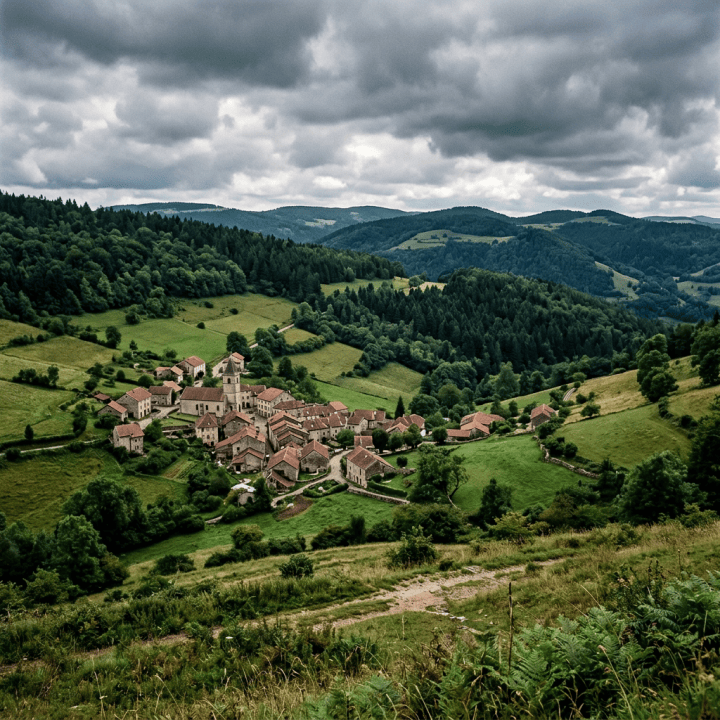
In Montécheroux, a small village located in the Doubs department of the Bourgogne-Franche-Comté region, the simultaneum has a fascinating, turbulent, and deeply hyper-local history. [1]
Because of its geography in the Jura foothills near the Swiss border, Montécheroux became a Protestant stronghold. When French troops enforced the simultaneum here, it played out as a direct conflict between the local population and the French crown. [2]
🪖 The 1700 Armed Takeover
Unlike regions in Alsace where the transition was sometimes a gradual legal squeeze, the implementation of the simultaneum in Montécheroux required brute military force. [3]
Initial Resistance: In April 1700, royal officials tried to seize the village church (which had been a Protestant temple since 1565) to install a Catholic altar. The local citizens successfully resisted and turned them away. [3, 4]
The French Bayonets: On June 5, 1700, French troops returned with fixed bayonets. They forcefully took over the church, officially declaring it shared under the simultaneum. To break the community’s spirit, the soldiers occupied the village for three weeks and expelled the Protestant pastor. [3]
⛪ Coexistence in the Parish Church
From 1700 to 1745, the stone walls of the village church bore witness to forced religious sharing. [5]
The space accommodated two very different groups:
The Catholic Minority: Composed primarily of royal officials and foundational local families recorded in the Catholic registers.
The Protestant Majority: Composed of local craftsmen, cutlers, weavers, and Swiss Lutheran refugees fleeing across the border, who gathered under the leadership of pastors like Pierre Doriot. [2]
The simultaneum in Montécheroux eventually ended in the mid-18th century, and the building today functions as a Lutheran temple (Temple luthérien). [4, 5]
🛠️ Isolation and the Rise of the Cutler Industry
The enforcement of the simultaneum and the village’s Protestant identity deeply isolated Montécheroux from its strictly Catholic neighbors. Cut off from surrounding trade, the town was forced to become self-sufficient. [6]
This isolation directly sparked the town’s famous ironworking and cutlery industry (coutellerie). By the late 1700s, Montécheroux established tight economic loops with Switzerland, eventually evolving into a major historical hub for manufacturing precision tools and pliers. [6, 7]
When my 3X great-grandfather, Jean Baptiste Francois Xavier Jeanin-Gaume, emigrated in 1833, his occupation was listed as “blacksmith.”
[2] https://gatheringleaves.blog
[4] https://recensement.patrimoine-religieux.fr
[5] https://recensement.patrimoine-religieux.fr

