I found this book at Google Books. The book titled “Le bailliage de Baume-les-Dames en 1789” by Robert Jouvenot (1985) was a preview-only edition written in French. I was able to grab four pages that contained the list of grievances (Cahiers de Doléances) of the town of Montécheroux in 1789.

The cahiers de doléances (lists of grievances) were official registers compiled across France in the spring of 1789. Summoned by King Louis XVI for the first meeting of the Estates-General since 1614, communities and corporate bodies in each of the Three Estates drafted them to articulate their problems, propose fiscal reforms, and petition the Crown directly.
Tens of thousands of cahiers were produced, drafted at parish, guild, and municipal levels before being consolidated at the electoral district (bailliage or sénéchaussée) level.
I loaded images of pages 106 thru 109 and asked Gemini for a translation. It appears that my 5x great-grandfather, Jean Germain Voisard was a deputy of the assembly.
Response: An English translation of the provided pages containing the 1789 French Revolutionary cahier de doléances (register of grievances) and assembly minutes (procès-verbaux) for Montécheroux and Villars-lès-Blâmont:
Page 106: Montécheroux
01.15-MONTECHEROUX
Minutes (Procès-verbal)
Assembly: March 20, 1789. – Presiding officer: Baudinot.
108 attendees (1 of the 7 communities where women appear):
ABRAM (Geo.); ABRAM (J.-Ja.); ANGONIN (Ja.-Ant.); BAUDROIT (Ja.); BAUFILS (J.-Cl.); BEAUDROIT (Samuel); BERTOLET (Ja.); BILLON (Geo.); BILLON (J.-David); BILLON (Josué); BILLON (the daughters of Josué); BILLON (P.); BONNOT (Cl.); BONNOT (P.); BOUGOIN (J.); BOURQUIN (J.-Ja.); BOURQUIN (Geo.); BOUTON (Fréd.); BOUTON (Geo.); BOUTON (P.); BOUTON (J.-P.); BOUVIER (Geo.); BOUVIER (Nic.); BRAHIE (Et.-Jh.); BRAUT (Jonas-Fréd.); BRISCHOUX (Ursanne); CHARTON (Nic.); CHARTON (Daniel); CHARTON (J.-Ja.); CHARTON (J.-Urbain); CHARTON (P.); CHARTON (Daniel); CHAVERDOT (the daughters); COURANT (P.); CRELEROT (Geo.); CUVIER (P.); DORIOT (Fréd.); DORIOT (Geo.); FAIVRE (Ja.); FRESART (Modeste-Cyprien); GUENTAL (Geo.); GUENTAL (Daniel); GUENTAL (P.); GUENTAL (Hugues); GUILLEMOT (Elisabeth); GUILLEMOT (P. the younger); GUILLEMOT (Fr.); GUILLEMOT (P.-Mathieu); GUILLEMOT (Fr. the younger); GUILLEMOT (Ja.); HUBRESAC (Bapt.); HUGONNIOT (Nic. father); HUGONNIOT (J.); HUGONNIOT (the widow of P.); HUGONNIOT (Et.); HUGONNIOT (Geo.); HUGONNIOT (Nic. the younger); HUGONNIOT (P.); HUGONNIOT (Geo.); HYDOUX (Ant.); LACHAT (P.-Jh. the younger); LACHAT (P.-Jh.); LACHAT (Fr.-André); LANOIR (J.-Nic.); LANOIR (P.-Nic.); LANOIR (J.-Ja.); LENOIR (André); LOICHAT (P.-Fr.); MAIROT (Laurent); MATOMON (Geo.); MEQUILLET (J. the younger); MEQUILLET (J.-Nic.); MEQUILLET (Ja.); MEQUILLET (P.); MEQUILLET (J.-Ja.), mayor; MEQUILLET (Et.); MESLIER (P. the younger); MESLIER (Geo.); MESLIER (P. the elder); MESLIERE (J.-Ja.); PETIT (P.); PETIT (Ja.); PETIT (Daniel); PETIT (Nic.); PETIT (P.); PETIT (Daniel); PETIT (P.-Et.); PETIT (J.-Ja.); POULIGNOT (Léopold); QUELLET (Geo. the younger); QUELLET (Geo. the elder); QUELLET (Nic.); QUELLET (J.-Ja. the elder); QUELLET (P.); QUELLET (Ja.); QUELLET (Daniel); QUELLET (J.-Ja. the younger); RICHARD (Esaie); RICHARD (Léopold); SCHOM (Christophe); VANNIER RUYER (P.); VERNIER (Pierrette daughter of Chaverdot); VERON (Ja.); VERON (Geo.); VERON (Nic.); VERNIER (P.); VIENOT (Daniel); VIENOT (P.); VOISARD (the daughters of Ja.-Ignace); VOISARD (Ja.-Ignace); VOISARD (Germain); ;
Deputies: J.P. Mequillet & Germain Voisard.
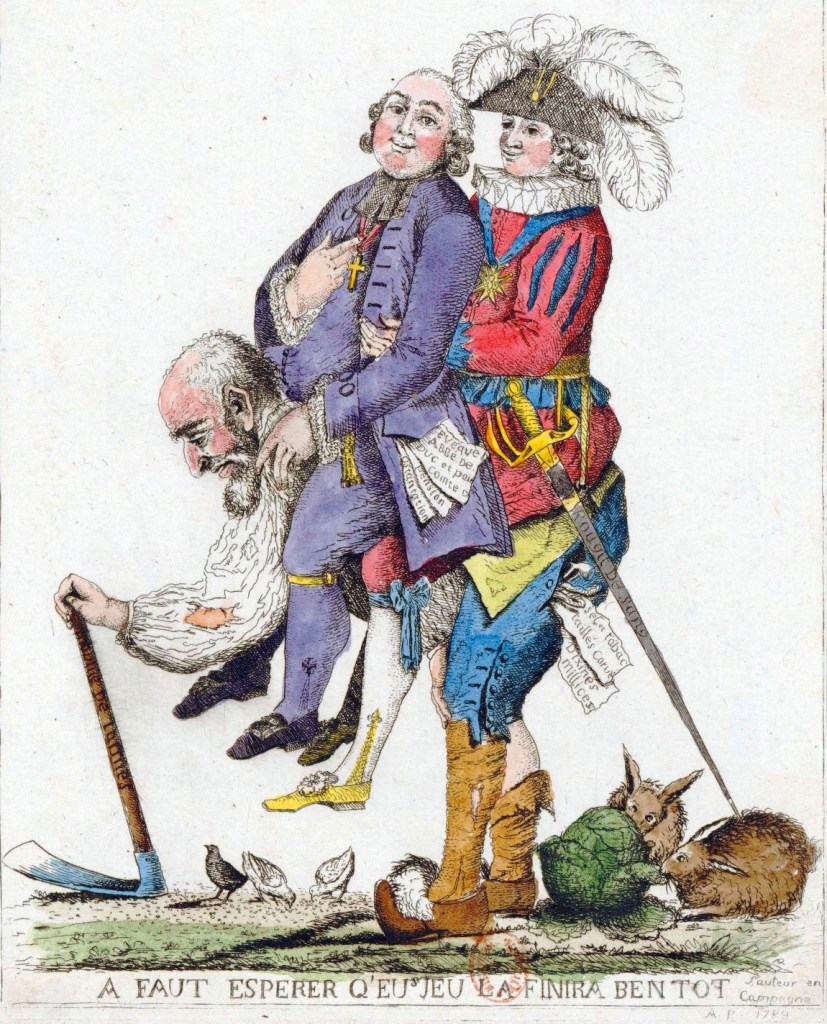
Register of Grievances (Cahier)
16 pages; 29 articles. – 47 signatures on the minutes and 50 signatures on the grievance register; appears to have been drafted by Nic. Lanoir.
Preamble: same as Pierrefontaine.
Articles 1–13: = Pierrefontaine 1–8, 10–13, 15.
14. The exportation of grain out of the kingdom must not be permitted when…
Page 107: Montécheroux (Continued)
01.15-MONTECHEROUX
…grain sells for only 1 sol 6 deniers per pound or less.
15. Our territory is situated on Mount Lomont, which is very dry land. Often our grain is frozen, at other times rotted under snow that lingers too long; at other times, on the eve of the harvest, the grain is blighted [1] by the dry fogs attracted by Mount Lomont, so that the husbandman often reaps only the seed sown, which is why the grain produced by our fields is not sufficient to feed half the inhabitants of the place.
16. We have no communal revenue beyond the tax rolls and twentieths (vingtièmes), by which the community finds itself overcharged, being assessed each year in the sum of 2,300 to 2,400 livres. We are forced to draw up local rolls to pay local burdens such as: the pension of the stallion-keeper, the lodging of the officers employed at the castle of Blâmont, daily wages for bridge and road (ponts et chaussées) inspectors, as well as a roll that we are obliged to make each year in the amount of 204 livres for the wages of the Catholic schoolmaster, oil for the sanctuary lamp, and the laundering of church linens, because there is no factory (fabrique) revenue in our parish.
17. In 1762 we were obliged to rebuild the presbytery, which cost over 3,000 livres. We were forced to take out loans to provide this sum, which are still outstanding, and to pay interest every year without being able to foresee any means of repaying the principal.
18. In 1764 we sold our reserve timber quarters (quarts en réserve) for the reconstruction of our church. The proceeds were sufficient for only half the auction price; we were obliged to cover the remainder by economizing, which plunged us into great destitution; and to add insult to injury, we continued to be deprived of the right to hold our religious services there.
19. That the lords be required to destroy harmful game, such as wild boars and excessive numbers of red deer and hares on their respective lands, or else fence their forests; otherwise everyone should be free to defend their own property against their depredations.
20. That we are extraordinarily overburdened toward the lord. In addition to the tithes he levies across our territory, we pay him annually: 144 quartes [of grain], half wheat and half boige [meslin/rye mix], per household; 24 quartes of oats for a parcel of meadow; 13 pounds of wax; 57 livres for interest on our loans. Each hearth or household also pays two quartes of grain each year called quartes de fourg [oven dues], along with two chickens and 3 sols in foreterie [drilling/wood dues], with the exception of widows and tenants who pay only half. These charges very often exceed the royal taxes. We demand that the lord provide authentic titles justifying this collection.
21–27. = Pierrefontaine 17, 18, 20–24.
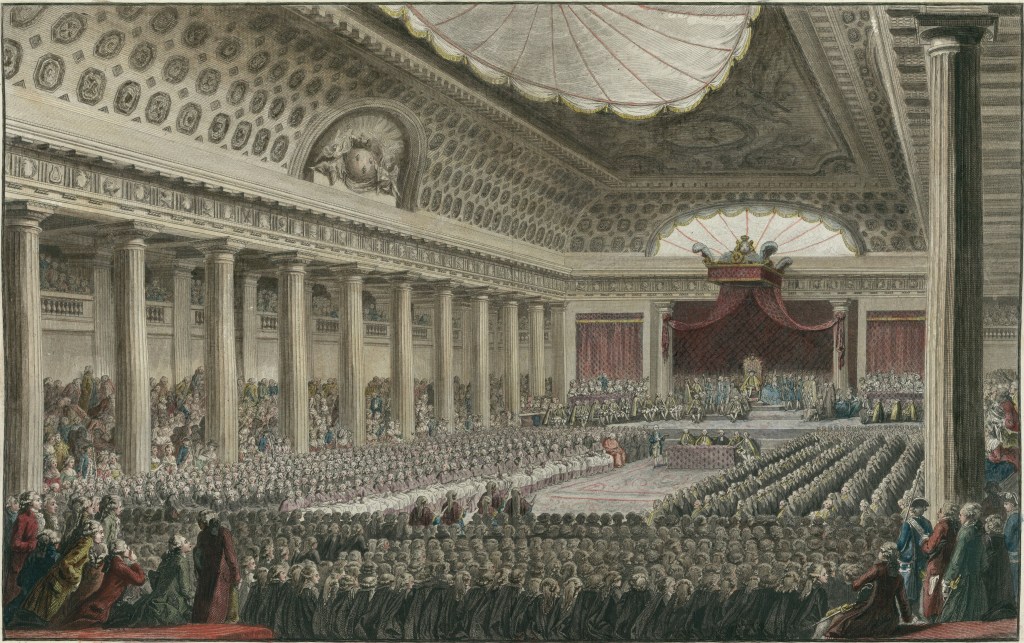
The opening of the Estates General May 5, 1789 in the Salle des Menus Plaisirs in Versailles.
28. Finally, the inhabitants of the village of Montécheroux, county seat of the…
Page 108: Montécheroux (Continued)
108 | 01.15-MONTECHEROUX
…seigniory of Clémont, who profess the religion of the Augsburg Confession [Lutheranism], were before 1700 sole owners of the church of Montécheroux to the exclusion of Roman Catholics. However, Louis XIV, having deemed it fitting to establish a parish priest (curé) there at that time, our church then began to serve both forms of worship [a simultaneum]; it continued to be shared until the death of the last [Protestant] minister, who died in 1745. At that time, the parish priest of Montécheroux took advantage of the situation to forbid Protestants, on his private authority and without any official orders communicated, all use of their church.
Peaceable and faithful subjects, complying with simple verbal prohibitions from the curé, they have since retired to the minister of Pierrefontaine; but the hardship they suffer from this state of affairs no longer allows them to persist. The village of Pierrefontaine is more than a league away from Montécheroux; one must cross a very considerable mountain where heavy amounts of snow fall. The elderly, children, and pregnant women are deprived of instruction, and the sick of consolation; the youth languish in a dismal ignorance through the prohibition placed on them against testing a schoolmaster of their communion, and children are sometimes deprived of receiving baptism because of the distance between us and Pierrefontaine, as well as the harshness of winter. And if, by misfortune, fire should break out in any house in their village while they are attending services at Pierrefontaine on a Sunday or feast day, it would risk burning down because no necessary help could be brought, given that the houses are almost all contiguous to one another, numbering 90 Protestant hearths or households.
29. In 1766, the Protestants of Montécheroux obtained verbal permission from the intendant’s chief secretary to appoint a local man to teach their children to read and write; but the priest opposed it. Based on a report (procès-verbal) presented to the intendant, signed by two Catholics, stating that an assembly was held to instruct on religious rites—which was entirely untrue, since the children’s class numbered over 80 and the oldest were only 12 to 13 years old—the intendant ordered a fine of 300 livres and an arrest warrant against the man who ran the class.
First, they seized his body without allowing him to go home to say farewell to his wife and children; they took him to the rectory and from there to the prisons of Baume. Two men were sent to the intendancy to obtain the prisoner’s release, which they were only able to obtain after an eleven-day detention, and upon paying a fine of 50 livres and 40 livres in expenses to bring him to Baume; which, combined with the delegates’ expenses, amounted to a sum of more than 300 livres charged to the Protestant community, with an injunction never to hold school in the future.
Fathers and mothers who have their children’s best interests at heart send them abroad to be educated, thereby depriving us of their labor; others who do not have the means to do so live in great ignorance. This has caused our village to become impoverished by half ever since we were stripped of the freedom to have a minister and a schoolmaster, due to the expenses of every kind we are forced to incur.
Page 109: Montécheroux (Closing) & Villars-lès-Blâmont
01.15-MONTECHEROUX | 109
(Handwritten note added by Baudinot:) However, the Catholic inhabitants of the said place declare that they formally protest against Articles 21 to 29, demanding to be upheld in their privileges in accordance with the King’s ordinances, and those who can write have signed…
(1) Scorched, parched, turned reddish-brown, like the upper vegetation sometimes is by frost.

