(see Using AI in Genealogy and Family History for a detailed description of how this was created Google Gemini)
This post contains two parts. In the first part I present a novel-like view of the events in Montecheroux during the years of the Terror of the French Revolution. The second part provides a detailed analysis of both the form and content of the records extracted from images of the original records.
Chapter VIII: The Shadow of the Republic
The summer sun of July 1793 climbed sluggishly over the limestone cliffs of Saint-Hippolyte, casting long, sharp shadows across the quiet roofs of Montécheroux. In the home of Jean Germain Voisard, the morning broke in absolute stillness.
There was no fevered coughing this time, no desperate prayers whispered over an emergency cup of baptismal water. At six in the morning, when Marie Angélique gave birth, the child entered the world without a cry. The boy was stillborn.
Jean Germain stood in the doorway, staring down at the dust of the road. Four times in three short years, the ground had opened for his seed. Pierre Louis and Jean François had been swallowed by the winter fevers of ’91; an unbaptized boy had barely lived to hear the noon bell that same spring. Now, this quiet shadow.
+———————————————————————–+
| “19 July 1793… Jean Germain Voisard, aged 41, |
| and Pierre Claude Loichot, aged 35… appeared to |
| declare a male infant born without life…” |
+———————————————————————–+
A firm hand clamped onto his shoulder. Pierre Claude Lachat—his brother-in-law, his neighbor, his steadfast companion through every graveyard vigil—nodded silently.
“We must go to the town hall, Germain,” Pierre Claude said softly.
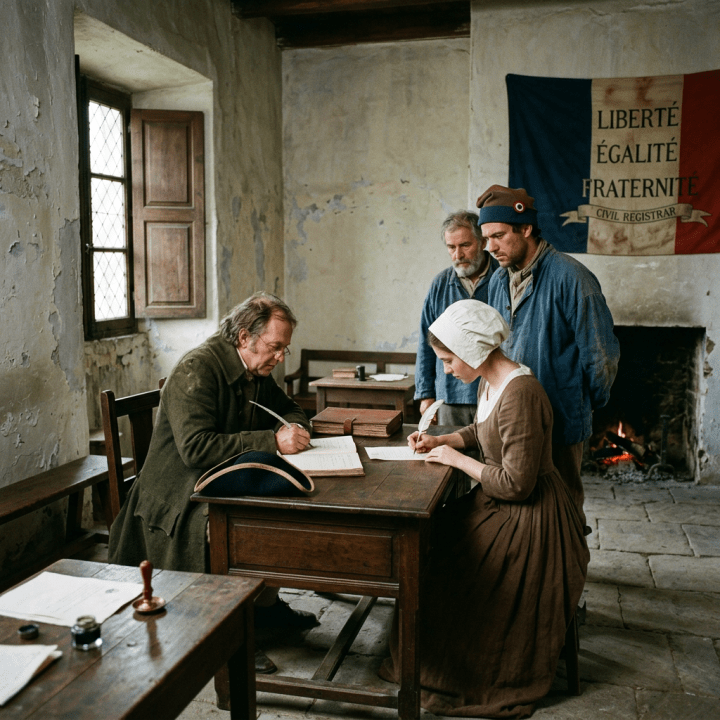
There was no curé to summon now, no church bell allowed to toll. Together, the two men walked down the dirt lane toward the maison commune, where the tricolor flag hung limp in the summer heat. Mayor Abram sat at the heavy oak desk, dipping his quill into iron-gall ink. Jean Germain stated the hour, his voice rough as gravel. When the document was drawn, he and Pierre Claude took the pen and scratched their names into the new secular ledger of the Republic.
Outside the town hall, the world was fracturing. Word had arrived from the frontier: the allied armies were pressing against the Rhine, and the young men of the village—the volontaires of the 8th Doubs Battalion—were marching through mud and musket smoke. Within weeks, the Bourquin family would receive their boys back from the lines, broken and dying of camp fever in their fathers’ beds. Grief in Montécheroux wore many uniforms.
By the winter of An III, the old measures of time had vanished. The parish bells were silent; the days were numbered in tens, the hours divided into decimals, and the seasons bore the names of fog, snow, and wind.
On a bleak afternoon in Ventôse—the month of winds—the frost clung thick to the eaves of François Xavier Monnot’s loom-house. Inside, the rhythmic clatter of the weaver’s shuttle had stopped. Monnot’s two-week-old daughter, Anne Marie Marthe, had breathed her last.
The young weaver sat trembling on a wooden bench, his apron soiled with dye. It was Jean Germain Voisard who came through the door. At forty-two, Germain was weathered by hard winters and stony furrows, but he knew the road of a grieving father better than any man in the parish.
“Come, François,” Germain said, extending a calloused hand. “You need not walk before the magistrate alone.”
Side by side, the weaver and the farmer trudged through the melting snow to the greffe. Before the municipal clerk, Germain stood tall as the official witness, affixing his steady signature to the republican register.
Through church closings, changing calendars, epidemics, and war, the village persisted. Jean Germain returned home across the plateau as the dusk gathered over the Jura. In the hearth fire’s glow, Marie Angélique sat by the spinning wheel, watching over their surviving children. The cradles that had broken their hearts could not break their blood. The land remained, the seed endured, and the line of Voisard pressed forward into the uncertain light of the new century.
Part I: Year-by-Year Narrative & Cross-Referenced Analysis (1793–1795)
The secular civil death registers for Montécheroux during 1793 (Year II of French Liberty / Year I of the Republic) and An III (1794–1795) reveal the social, military, and domestic life of the Jura plateau at the height of the French Revolution.
These records directly document key moments for the Voisard, Lachat/Loichat, Monnot, and allied lineages, illustrating both continuing infant mortality and the everyday civic duties of family patriarchs.
1. The Year 1793: Revolutionary Mobilization & Domestic Heartbreak
The year 1793 represents the full implementation of civil record-keeping in Montécheroux. The register documents 14 deaths, characterized by heavy military losses among local volunteers and continued bereavement within the direct ancestral line.
19 July 1793 (Declaration of Stillborn Male Infant Voisard):
At 6:00 AM, Marie Angélique Lachat/Loichat (LACH-006 / VOIS-010 / JOUR-010) gave birth to a stillborn son (mort-né). Later that day, Jean Germain Voisard (VOIS-009 / LACH-007 / JOUR-009, aged 41, laboureur) appeared before the municipal officers to formally register the birth and death. He was accompanied by his brother-in-law, Pierre Claude Lachat/Loichat (aged 35, laboureur), who signed the register alongside him. This marks the fourth infant/child loss suffered by Jean Germain and Marie Angélique within thirty months (following Pierre Louis and Jean François in February 1791, and an unnamed boy in May 1791).
27 March 1793 (Death of Prosper Félix Régnier & Monnot Connection):
Two-hour-old Prosper Félix Régnier died in his parents’ home. The declaration was made by the father, Jean François Régnier, and the infant’s maternal uncle, François Xavier Monnot (aged ~25, tisserand / weaver), providing a direct link to the allied Monnot line (LACH-018).
21 August & 10 September 1793 (Fallen Volunteers of the 8th Doubs Battalion):
The realities of the War of the First Coalition struck the village directly when two sons of stonemason George Bourquin—Pierre Bourquin (aged ~20) and Nicolas Bourquin (aged 24)—died at home after falling ill while serving as soldiers (volontaires) in the 8e Bataillon du Doubs.
16 November 1793 (Death of Auguste Frédéric Méquillet):
Another young soldier, Auguste Frédéric Méquillet (aged 25, volontaire au 2e Bataillon du Doubs), died in his father’s house. The death was registered by his father Jean Nicolas (a wheelwright / charronneur) and his brother-in-law George Mélière.
2. The Year An III (1794–1795): Decimal Time & Civic Witnessing
The An III register (comprising 15 death records from Vendémiaire to Fructidor An III / Sept 1794 – Sept 1795) is notable for its strict application of the Republican calendar and decimal time (e.g., recording deaths at 3:75 or 4:30 decimal hours).
17 Ventôse An III / 7 March 1795 (Death of Anne Marie Marthe Monnot):
Fifteen-day-old Anne Marie Marthe Monnot, infant daughter of weaver François Xavier Monnot (age 29), passed away at 4:30 decimal hours in the afternoon. Jean Germain Voisard (VOIS-009, recorded as a 42-year-old laboureur and neighbor) stepped forward to serve as the official witness and declarant alongside Monnot, cementing the close neighborly and kinship ties between the families.
9 Thermidor An III / 27 July 1795 (Death of Marianne Gourant):
When 69-year-old Marie Anne Gourant died in the home of Marie Geneviève Lanoir, Jean Germain Voisard once again served as the primary independent witness before Mayor Jean Nicolas Abram, demonstrating his established civic standing in Montécheroux.
29 Brumaire An III / 19 November 1794 (Death of Marie Joseph Loichot):
Eighteen-month-old Marie Joseph Loichot, daughter of cultivator Pierre François Loichot (age 41) and Catherine Jobin, died in Montécheroux, documenting the collateral Loichot/Lachat branch in the village.
22 Pluviôse An III / 10 February 1795 & 8 Messidor An III / 26 June 1795 (Deaths of the Lanoir Patriarchs):
The village lost Jean Nicolas Lanoir (age 68, former greffier de la municipalité), reported by his son Pierre Joseph Lanoir (P. J. Lanoir, who had married Catherine Hugoniot in May 1792), followed by 78-year-old André Lanoir in June.
 Gathering Leaves