I went looking for my father’s military records thinking that I won’t learn anything new. I found his draft registration from 1948, two years before the start of the Korean War. To put things into perspective the Korean War began on 25 June 1950 when the Korean People’s Army (KPA), equipped and trained by the Soviets, launched an invasion of the south. In the absence of the Soviet Union’s representative, the UN Security Council denounced the attack and called on member nations to provide military assistance to repel the invasion. UN forces under the unified command comprised 21 countries, with the US providing around 90% of military personnel. On 27 June 1950 President Harry S. Truman ordered US air and sea forces to aid South Korea.
Seoul was captured by the KPA on 28 June, and by early August, the Republic of Korea Army (ROKA) and its allies were nearly defeated, holding onto only the Pusan Perimeter in the peninsula’s southeast.
The family story was that my father had been called home from Chicago by his father, who disapproved of his attending Art School. He had been there two whole years. Once home, he spent most of his time at the local “Malt Shop” drinking beer, a situation not unlike the situation I was in twenty-seven years later. The culture that my father belonged to at that time is eloquently described in Jack Kerouac’s Stream of Consciousness novel On the Road. In other words, he was an early beatnik.
According to my Dad’s life story, while he was at the “shop” one day, his mother called the “bar” (I mean, “shop”) to warn him NOT to come home because a card from the US Selective Service had arrived in the mailbox. She urged him to go immediately to the Post Office to enlist in the US Navy, hoping that would prevent him from being sent to Korea. He recounted racing to the Hastings, Nebraska post office in a panic, only to find it had closed just minutes earlier at 5:00 p.m.. He described the subsequent walk back to his parents’ house as the longest and most painful of his life, where he finally found his draft notice waiting.
After completing basic training at Fort Riley, he soon found himself on a transport ship bound for Busan, South Korea. He eventually reached the rank of staff sergeant—or supply sergeant, as he often called it—and was stationed at the Taegu Airfield, where he supervised a crew of North Korean prisoners of war. His life changed forever during an incident at precisely 12:00 noon one day. As he and the POWs were unloading heavy crates labeled “tools” from a truck, a signal was given; the prisoners immediately snapped to attention and stopped working. The prisoner holding the other end of the crate my father was moving dropped it, causing a back injury that would plague my father for the rest of his life.
While convalescing at an Army hospital in Tokyo, Japan, he developed a deep interest in Japanese history and culture. After leaving the service, he used the GI Bill to attend Georgetown University in Washington, D.C., with the goal of joining the US Foreign Service. In October 1953, he met my mother at a Halloween party hosted by State Department employees, and he graduated from Georgetown with a BA in Japanese history shortly after my birth.
When I was about a year old, we traveled to Hastings, Nebraska, to visit my grandfather, a man known as “The Dictator” for his attempts to control his adult children’s lives. He told my father that the State Department was no place for a family man and insisted he enroll in a unique master’s program for Hospital Administration at St. Louis University. Following orders like a good soldier, my father complied, eventually leading us to Fort Worth, Texas, where he completed his residency at St. Joseph’s Hospital. Although he excelled at his career, he was never truly happy; his lifelong ambition had been to be an artist, specifically a cartoonist. This professional dissatisfaction eventually led him to drink, and he passed away from arteriosclerosis at the age of 53 in a singles apartment in Sherman Oaks, California.
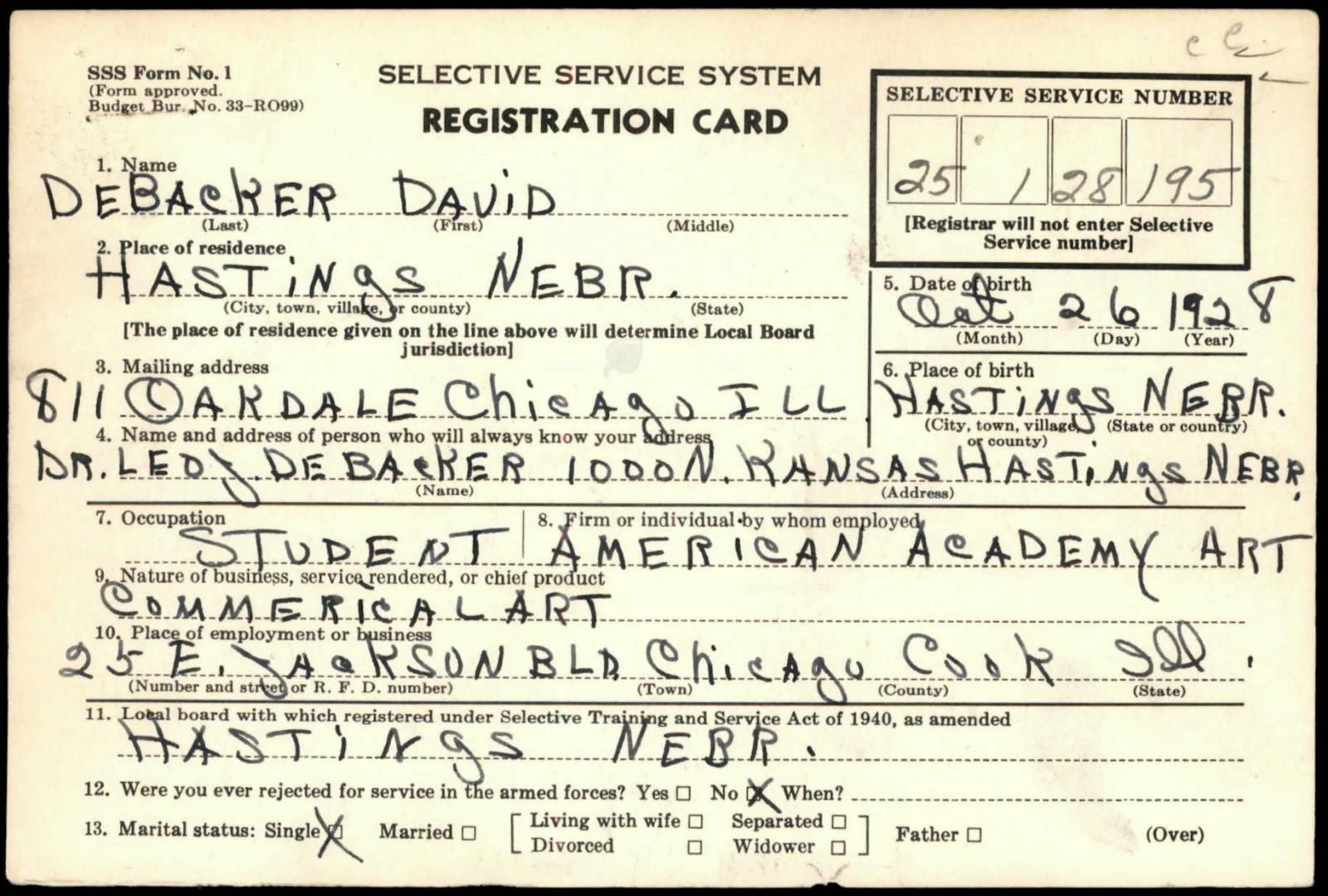
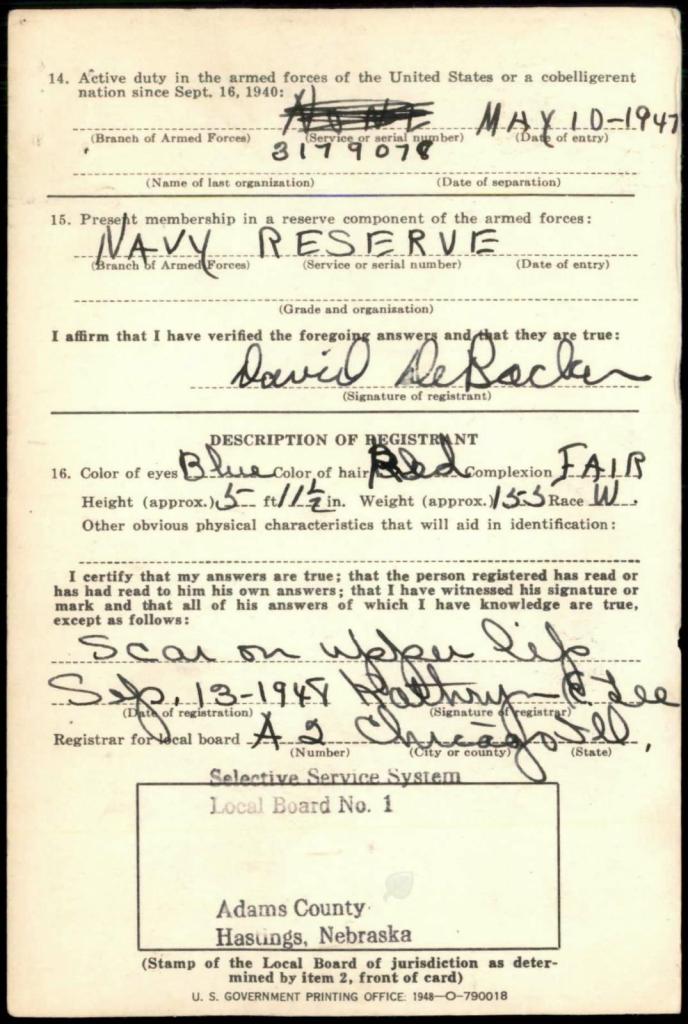
Historical documents provide a slightly different perspective on this period. His draft registration card shows he registered while living at 811 Oakdale in Chicago, where he was a student at the American Academy of Art focusing on Commercial Art at 25 East Jackson Boulevard. The card lists Dr. Leo J. DeBacker of 1000 North Kansas Street, Hastings, Nebraska, as the person “who would always know his address.” Interestingly, the back of the card notes that he was already a member of the United States Naval Reserve at that time.
What I learned from his draft registration card was that he registered for the draft when he was living in Chicago. It gives his address as 811 Oakdale Chicago Illinois and says that he is a student at American Academy of Art focusing on Commercial Art. The school was located at 25 East Jackson Boulevard Chicago.
On back page, it indicates that he joined the Naval Reserve on May 10, 1947. This was when he was age 19 and attending Hastings College.
Finally in regard to my dad’s daily visits with “The Malt Shop” in the summer of 1950. I liken it to a reality show version of Andy Hardy, and very similar to my siuation twenty-seven years later, only I had burned my draft card two years before I volunteered with the Signal corps, US Army. I joined the Army while living with my parents in West Palm Beach, Florida. The cultural shift was palpable following Jimmy Carter’s inauguration in January 1977, yet my personal world felt stagnant in West Palm Beach, Florida. I was living under my parents’ roof again, adrift and unemployed, reeling from the end of a relationship with my girlfriend of nearly three years. This period of transition was defined by a hollow, repetitive routine: each morning began with a walk to the neighborhood 7-Eleven to buy a six-pack of Busch Bavarian tall boys. I would spend those long, humid afternoons consuming beer brewed and canned in Tampa, a sedentary existence that mirrored the aimlessness I felt. It was a time of quiet desperation, strikingly similar to the stories I would later discover about my father’s own youthful idleness decades earlier.