This is a history regarding an ancestor on my mother’s side who fought in the American Revolutionary War and was at one point presumed killed in action.
One legend suggests that my maternal fifth great-grandmother, Theodosia Beasley, left her husband, John McMullan—also my fifth great-grandfather—for another man named William Dula, after she and John had five children together. According to this account, John McMullan spent three to five years serving in a Virginia regiment with the Continental Army. Upon his return, Theodosia’s father reportedly advised him to forget about her and instead take his children to Georgia. John followed this advice, moving his family, including my fourth great-grandfather, Patrick McMullan, to Hart County, Georgia, where he eventually became a prosperous owner of a rice plantation.
Another legend which I came across recently says that Theodosia Beasley never left John McMullan and that it was a cousin also named Theodosia Beasley who married Mr Dula.
According to some proponents of the first legend of Theodosia Beasley, she left John McMullan because she thought he had died.
It turns out that she was not the only one who assumed that John McMullan had died.
According to his military records found at fold3.com, John McMullan was in the 11th Virginia regiment which later became the 7th regiment. He either came from Loudoun, Frederick, Prince William or Amelia County in Virginia.
The regiment saw action at the Battle of Brandywine (September 11, 1777), Battle of Germantown (October 4, 1777), and the Battle of Monmouth (June 28, 1778). The unit was reassigned to the 2nd Virginia Brigade on 22 July 1778, and it was reorganized to nine companies and redesignated as the 7th Virginia Regiment on 12 May 1779. It was relieved from the 2nd Virginia Brigade on 4 December 1779 and assigned to the Southern Department. John McMullan’s term of service ended in December 1779.
Fold.com lists his terms of service under the heading of Virginia 7th regiment, which was a consolidation of a number of other regiments including the 11th Regiment in May, 1779. Page one of the muster rolls lists 48 pay cards. Some are muster rolls, some are returns.
There are muster rolls that cover the period from March to May 1777, from May to June 1777, July and August 1777. August 1777 pay card dated September 2nd 1777 states “absent” in the remarks section but then the word is crossed out.
The muster roll from September 1777 which is dated October 13th 1777 has him in Captain William Johnson’s company and states that he was killed 11 September.
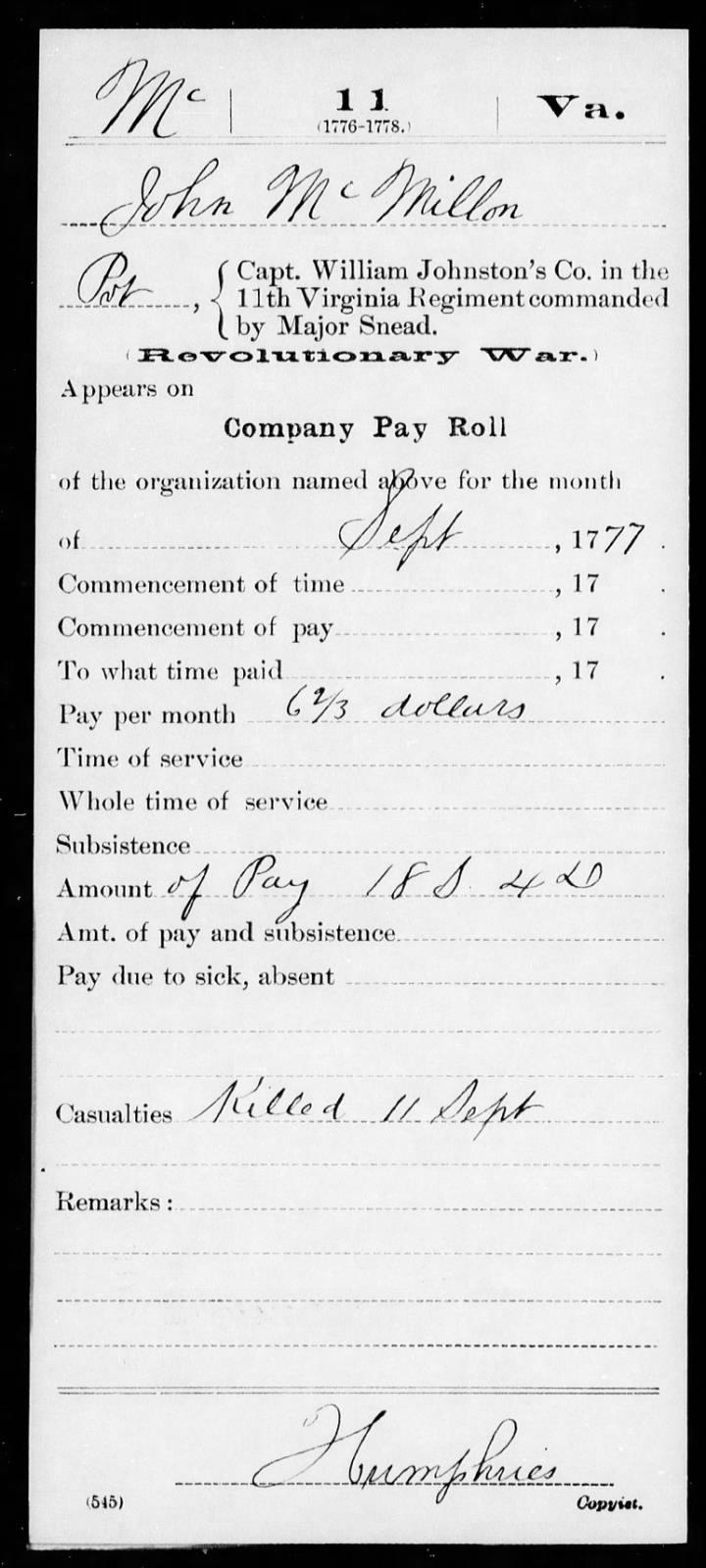
Another the return for September 1777 says that he was paid 18 Shillings and four pence. This card also states that he was killed 11 September 1777
Did anything exceptional occur on 11 September 1777?
Yes the Battle of Brandywine was on that date.
The Battle of Brandywine was the largest single-day battle of the American Revolutionary War and one of its most important defeats for General George Washington. It took place on September 11, 1777, near Chadds Ford along Brandywine Creek in what is now Pennsylvania. American casualties were about 1,000 killed, wounded, or captured.
Pay card of March 1778 provides a clue as to what happened to John McMullan following the Battle of Brandywine.
It says Time of Service: 11 Sept to 1 Apr 6 mo and 19 days
Amount paid “in lawful money 13 £ 5 S. 4p
A pay card for the period of March 1778 dated April 6th 1778 at Valley Forge remarks say “arrested since action of Brandywine and since joined” I think they mean omitted because that is what at least two other cards say that he was “omitted” as in “omitted from the muster rolls since September 11, 1777.
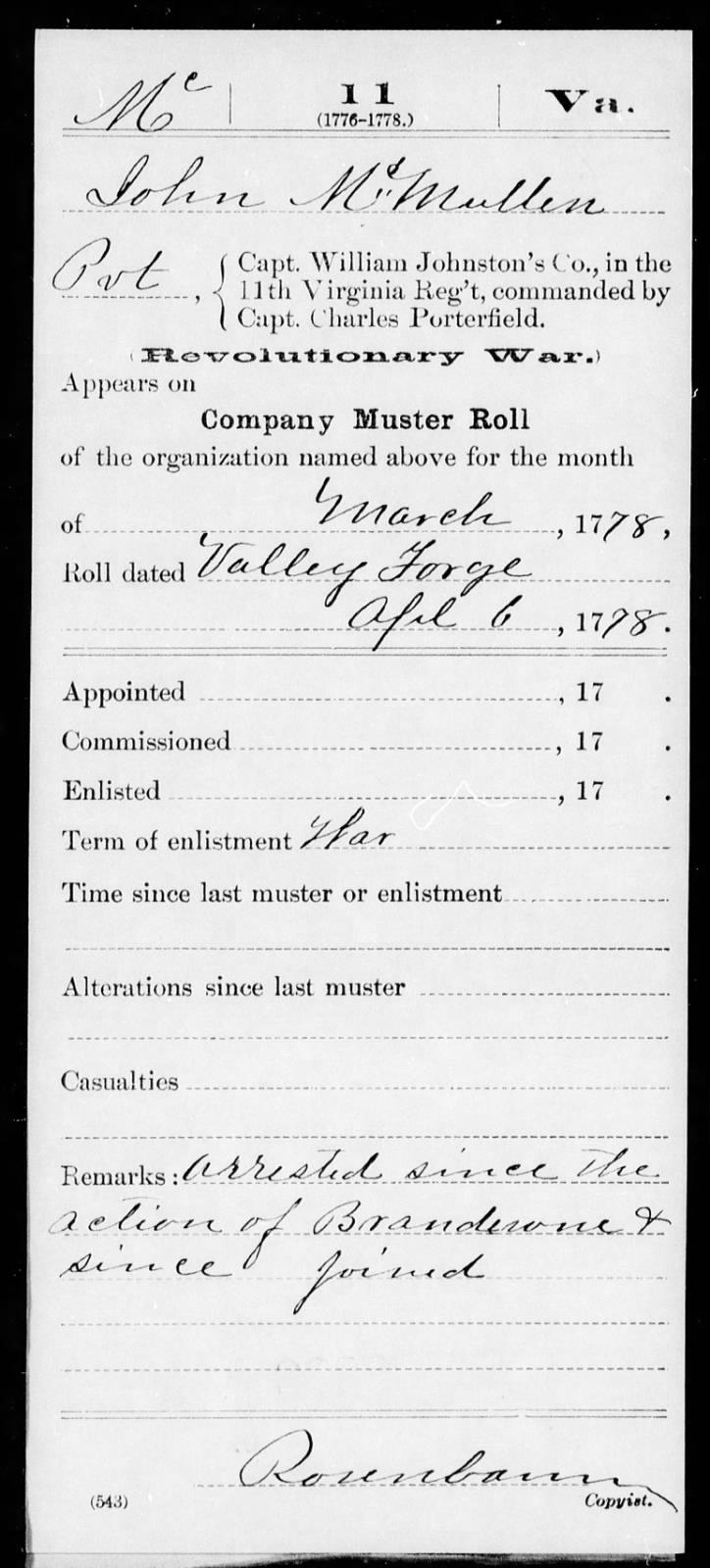
On another card, under casualties the note says “omitted since Battle of Brandywine and since joined.” It is not clear what is meant by “and since joined.” Also, the card has for Time In Service: “11 Sept to 1 Apr 6 mos, and 19 days” This refers to the time he was missing. The rolls do not indicate this but it is possible that he was captured by the British and held in harsh conditions in Philadelphia until a prisoner swap took place in March, 1778, but that is just speculation on my part. I would think that if they thought he was AWOL or had deserted the record would show that – but it doesn’t.
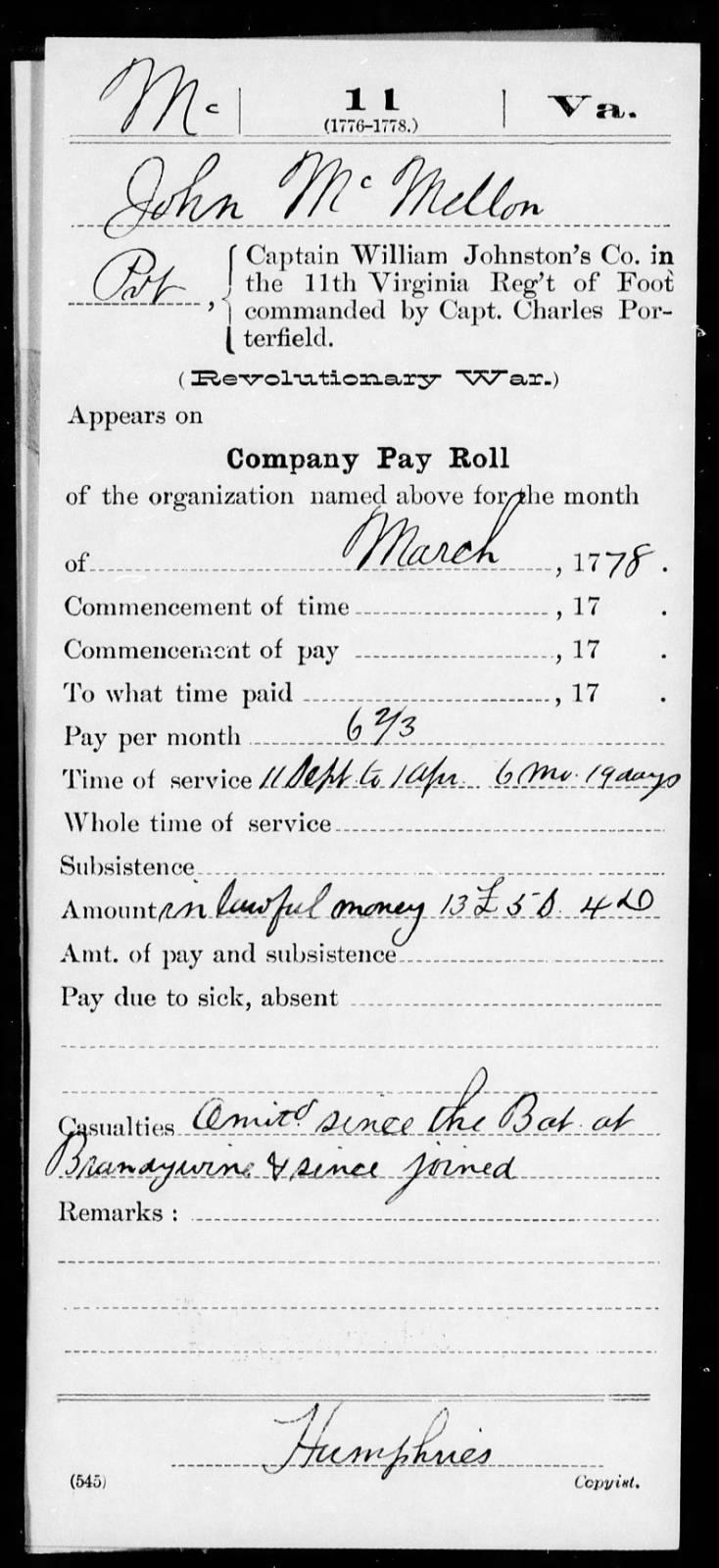
Apparently because he was presumed KIA at the Battle of Brandywine he was not on the payroll for 6 months in 19 days. The fact that he was paid 13£ and some change instead of the usual eighteen shillings would indicate a pay raise of 2 shillings and not back-pay.
There is a card dated May 1778 shows that he was paid 6 and 2/3 dollars time of service from 1 May to 1 June at Valley Forge, PA.
The next card is for June 1778 he is paid the regular amount for privates. The casualty note says “Sick Jersey’s;” indicating he was hospitalized somewhere in New Jersey.
July 1778 also lists him as being “Sick Jerseys.”
August 1778 roll dated September 3rd 1778 Camp White Plains, NY. The comment reads “Sick in Jersey.”
September 1778 says that he was left off the rolls for June, July, and August. He was paid 6 and 2/3 dollars. A return dated September 9th 1778 says that he enlisted February 17th 1777.
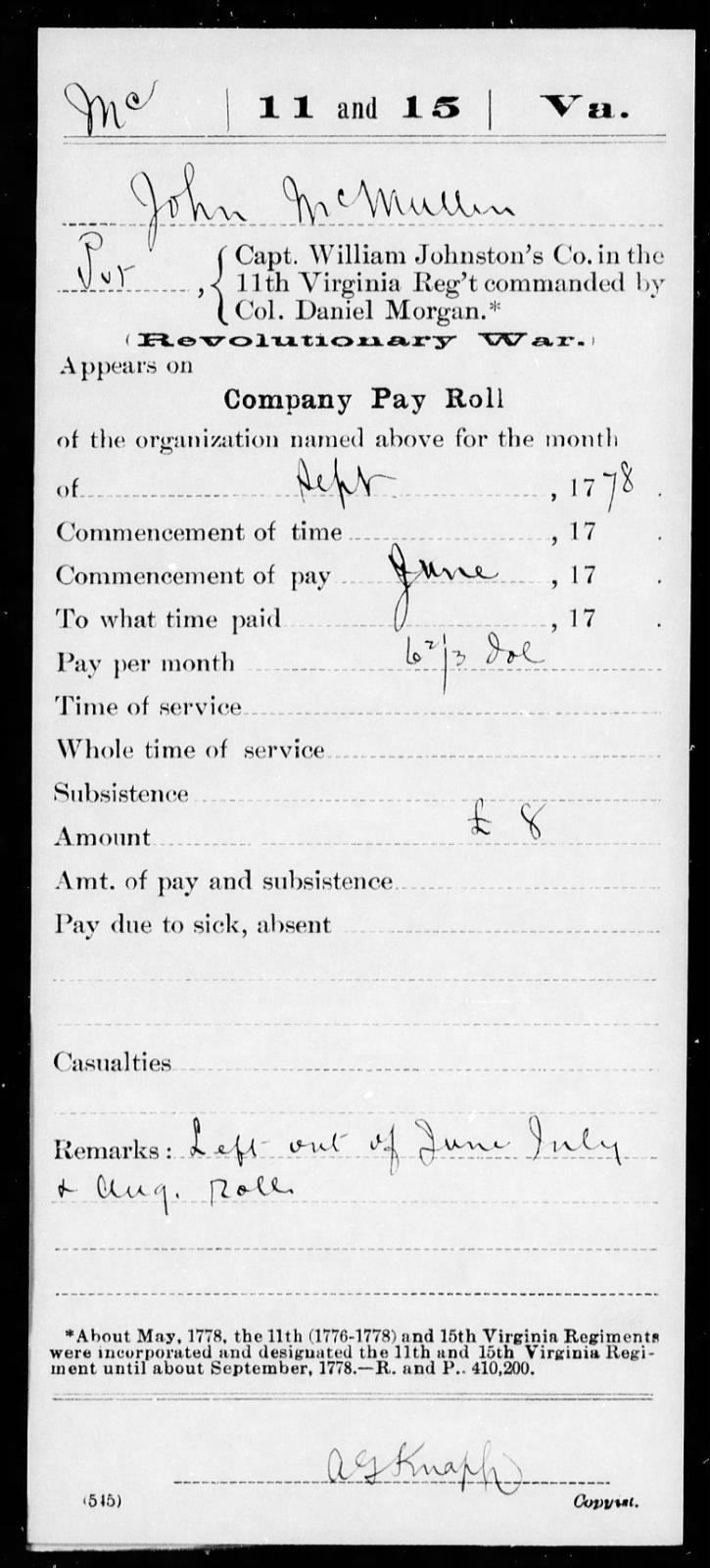
He’s on the muster roll for September 1778 roll dated October 28th 1778 at New Ark New Jersey
October 1778 does not indicate that he was still in the hospital. It states that the 11th Virginia regiment which later was Consolidated into the 7th regiment was commanded by Colonel Daniel Morgan.
November 6th 1778 places him at Pompton Plains, New Jersey
December 1778 he was paid 6 and 2/3 of dollar
Payroll for November 1778 roll dated December 1st 1778 at Pompton, N.J.
January 13th 1779 says that he’s on furlough
The muster roll for April 3rd 1779 at Camp Middlebrook, N.J. says that John McMullan was on furlough.
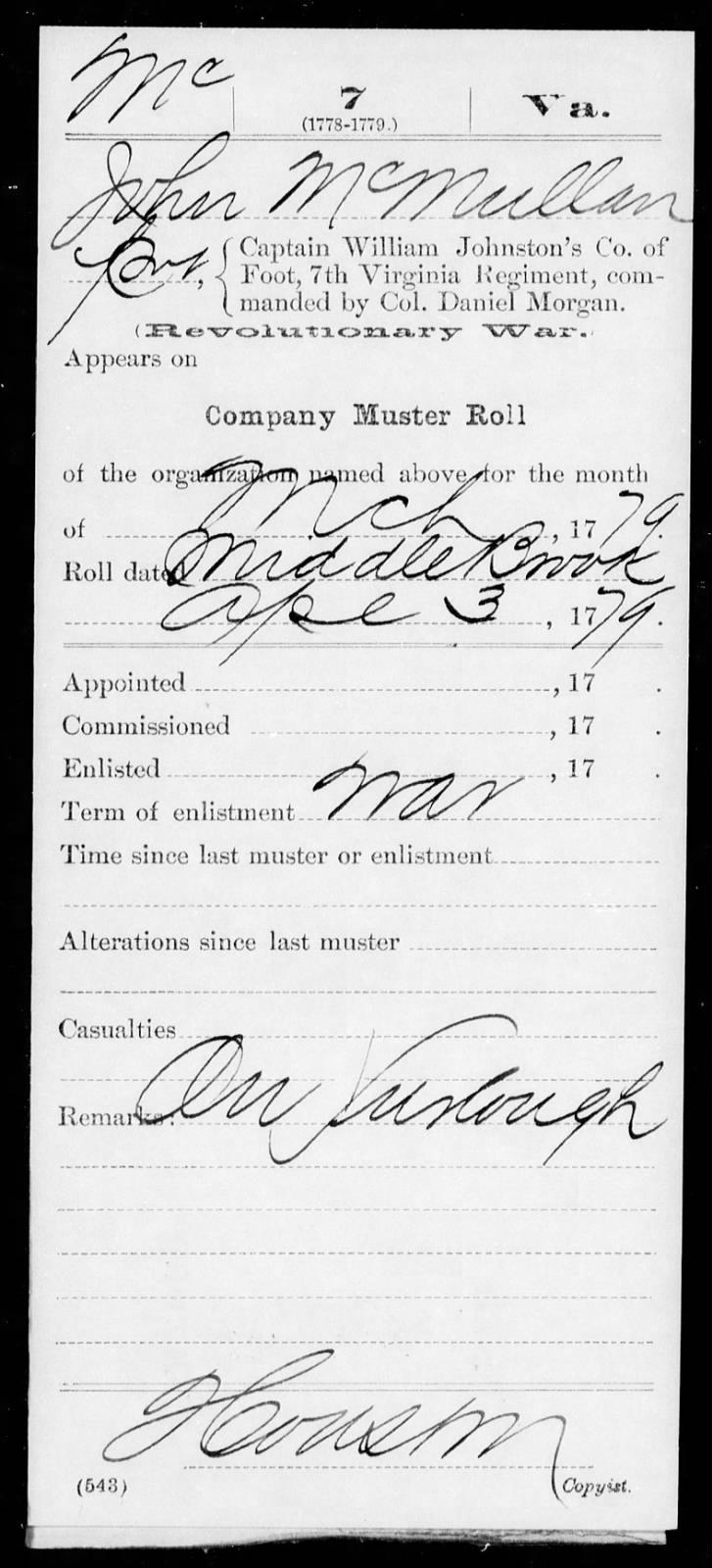
The last card is dated December 9th 1779 and it indicates that he was at Camp Morristown, N.J..


John and Theadoshe McMullan’s daughter, Catherine, was born in 1778.
Theadoshe (Beazley) McMullan was named in her father James Beazley’s Will in 1798 as daughter “Theodoshea ~Mullan”. There is no one named in James Beazley’s Will with a surname of Dula.
William Dula’s wife is identified only as “Docia Dula, daughter of James Beasley” in his 1817 Will. DAR and SAR Applications from descendants identify her as Laodocia Beasley, born 16 Jun 1757 in (now) Patrick County, Virginia and marriage to William Dula on 13 May 1785. Ancestry of the Dula Family For Five Generations identifies her as Ladocia Beasley.
LikeLike