This narrative follows the life of Eldad Corbett, my paternal 4x great-grandfather. While multiple records confirm his service in the Massachusetts Militia during the American Revolution, he later emerged as a reactionary, firmly opposing the concept of perpetual rebellion.
Born in 1752 in Mendon, Massachusetts, Eldad was the grandfather of my 3x great-grandmother, Tamar Denny, wife of Corbet Pickering. Documentation from the History of Rowe Massachusetts identifies him as an early resident of that Western Massachusetts town—then known as Myrfield—settling there in 1785. By the next year, he had already taken on a civic role as a highway surveyor.
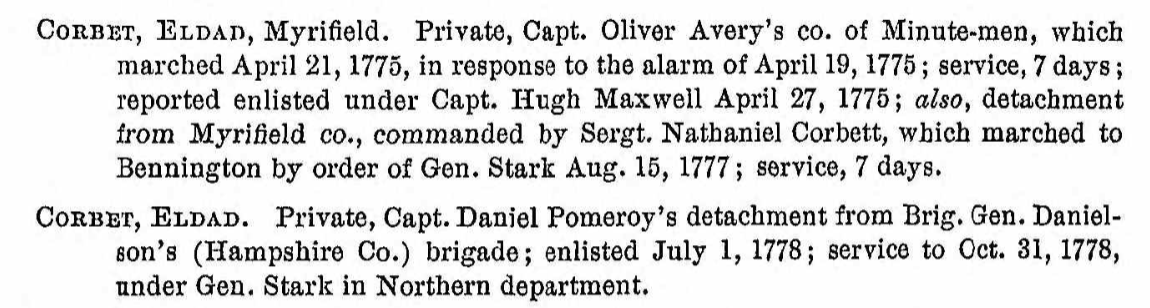
According to Mass Soldiers and Sailors of the American Revolution, Eldad entered military service as a Private during the crisis of April 1775. He is recorded as serving seven days in Captain Oliver Avery’s company of Minutemen in response to the alarm of April 19, 1775. Records indicate he then enlisted under Captain Hugh Maxwell on April 27, 1775. Later, on August 15, 1777, he was part of a Myrfield detachment led by Sergeant Nathaniel Corbett—possibly his brother—that marched to Bennington under the orders of General Stark. National Archives muster rolls further confirm his service during the summer of 1777 within Major John Brown’s Detachment of Militia, which represented New Hampshire, Vermont, and Massachusetts. This service would have placed him at the Battle of Bennington.
Fought on August 16, 1777, the Battle of Bennington was a pivotal moment in the American Revolution. American forces, commanded by General John Stark and Colonel Seth Warner, secured a major victory against British and Hessian troops under Lieutenant Colonel Friedrich Baum. The engagement took place near Bennington, Vermont, as the British sought to seize vital supplies. Despite being outnumbered, the Americans successfully ambushed the opposition, resulting in over 700 British soldiers killed or captured. This triumph significantly raised American morale and served as a crucial turning point that paved the way for the later success at the Battle of Saratoga.
Later he was listed as a private in Captain Daniel Pomeroy’s detachment from brigadier General Danielson’s brigade under General Stark in the “northern department” in the summer of 1778 to the fall of that same year.
Following the war, Eldad Corbett became a prominent figure in the local government of Rowe, Massachusetts. He played a key role in the town’s incorporation and was instrumental in officially changing its name from “Myrfield” to “Rowe.”
Eldad’s political journey from a revolutionary to a reactionary is a complex one, as he never truly abandoned his revolutionary spirit. Approximately five years after the conflict ended, his perspective shifted. The man who had been a dedicated soldier, reenlisting twice during the war’s most difficult periods, evolved into a reactionary defender of the original revolution—even when that meant infringing upon the civil rights of his own neighbors. This shift reflects a distinction made by many veterans of the era: the difference between rebelling against a distant monarch and opposing a newly formed republic. To understand how this transformation manifested, we must look at the events that followed.
In the aftermath of the Revolutionary War, the town of Rowe, like many of its neighbors, grappled with the severe economic hardships of the era. Citizens faced daunting challenges, including military drafts, a critical shortage of currency, depreciating money values, and mounting debt, all of which contributed to a dwindling trust in the fledgling government. This unrest culminated on Aug 22, 1786, when conventions were convened in Hampshire, Berkshire, and Middlesex counties to address these public grievances. The situation escalated rapidly as nearly 1,500 armed men gathered at Northampton to halt court proceedings, and by December 1786, Daniel Shays—a former captain in a Massachusetts regiment—led 300 insurgents to seize the courthouse in Springfield.
Shays’s Rebellion, as this uprising became known, was a widespread armed movement in Worcester and Western Massachusetts driven by a debt crisis and fierce opposition to the state’s aggressive tax collection. While the insurrection was eventually suppressed by state troops a month later—leading Daniel Shays to flee to Vermont before receiving a pardon in 1788—the local impact in Rowe was profound.
In response to the “Disturbed” state of civil law, the town of Rowe took decisive action on Oct 17, 1786, by appointing a five-member “Committee of Safety”. Eldad Corbett was chosen as a member of this committee, alongside Deacon Jonas Gleason, Nathan Foster, Joseph Nash, and Nathaniel Morrill. Their mandate was to “inspect any Disorders that may arise in this Town” and to work toward suppressing “Criminality as much as possible” during this period of civil upheaval.
Like many other towns, Rowe experienced significant challenges in the period following the Revolutionary War. The town faced demands for men and financial contributions, monetary scarcity and depreciation, increased debts, and diminished trust in government—issues commonly referred to as grievances. On August 22, 1786, conventions were convened in Hampshire, Berkshire, and Middlesex counties to discuss public concerns. Approximately 1,500 individuals gathered armed in Northampton, preventing the court from sitting. In December 1786, Daniel Shays, a former captain in a Massachusetts regiment, led 300 dissenters into Springfield and seized the courthouse. State troops subsequently quelled the insurrection a month later, and Shays fled to Vermont, ultimately receiving a pardon in 1788.
Local tradition holds that one of the Steels, after whom Steele Brook is named, was either sympathetic to or actively involved in the insurrection. On October 2, 1786, Rowe appointed a five-member Committee of Safety—Deacon Jonas Gleason, Nathan Foster, Eldad Corbet, Joseph Nash, and Nathaniel Morrill—to oversee any disturbances and mitigate criminal activity during this turbulent period.
The same meeting authorized that Joseph Steel and James Trask, identified as criminals, be held at the town’s expense until further consultation with neighboring towns determined subsequent actions.
While historical records provide limited additional details, Pressey, a local gadfly and author of novels, recounts discovering an original Shays Rebellion document signed by William Steel. According to Pressey, Steel and eight other local participants surrendered to Colonel Hugh Maxwell and regained their arms after swearing allegiance before Squire Wells.
Drawing upon these accounts, Mr. Pressey crafts a narrative featuring the upper Steele Brook valley as its setting, with William Steel depicted as Robin Hood and Elder Carpenter, Rowe’s first Baptist minister, as Friar Tuck, and the Committee for Public Safety as the villains.
As to why the majority of Americans rejected Shay’s rebellion and other Uprising such as the Whiskey Rebellion that occurred in 1794. The transition from a monarchy to a republic fundamentally changed how many Americans—especially those in power—viewed the legitimacy of armed resistance.
In the eyes of the Federalists, the American Revolution was a rebellion against a monarch who did not represent the people. Conversely, Shays’ Rebellion (1786) and the Whiskey Rebellion (1794) were seen as attacks on a republican government established by the people’s own consent.
The Political Logic
The core argument was that in a republic, the people have “constitutional” ways to redress grievances—specifically through voting and petitioning. Therefore, taking up arms was no longer a “defense of liberty” but an act of “treason” against the collective will of the people.
Key Leaders and Their Views
- George Washington: Initially sympathetic to the plight of veterans, he became horrified by Shays’ Rebellion, fearing it proved that “mankind, when left to themselves, are unfit for their own government.” As President during the Whiskey Rebellion, he led the militia himself to prove that a republic could enforce its laws.
- Alexander Hamilton He was the most vocal proponent of this distinction. He argued that if a minority could use force to overturn laws passed by the majority’s representatives, the government would dissolve into “anarchy.”
- Samuel Adams: Interestingly, the former “Firebrand of the Revolution” took a hard line against the Shaysites. He famously stated: “In monarchies, the crime of treason and rebellion may admit of being pardoned or lightly punished, but the man who dares rebel against the laws of a republic ought to suffer death.”
- Thomas Jefferson:He was the notable outlier. He famously wrote from France that “a little rebellion now and then is a good thing,” viewing it as a “medicine necessary for the sound health of the government.” However, even his party (the Democratic-Republicans) eventually distanced themselves from the violence of the Whiskey Rebellion to maintain political legitimacy.
The View from the 1790s
The following is written in the persona of an educated Federalist-leaning citizen in 1794, reflecting on the Whiskey Rebellion.
“Good sir, do not confuse the glorious cause of ’76 with the lawless rioting we see today in the western counties. When we raised our muskets against King George, we did so because we were subjects denied a voice; we had no Parliament to hear us, only a Crown to command us. Resistance was our only sanctuary.
But look upon us now! We live in a Republic. We have framed a Constitution by our own hands and sent men of our own choosing to Philadelphia to deliberate upon our taxes. If a law—be it a tax on spirits or a duty on trade—is found burdensome, the remedy is found at the ballot box, not at the end of a pitchfork.
To rise against a King is to seek liberty; to rise against a Republic is to seek the ruin of us all. If every band of disgruntled farmers can nullify a law of the Union with a torch and a shout, then our ‘liberty’ is but a fleeting shadow, and we shall soon find ourselves begging for a Dictator to restore the order we so foolishly threw away. We must prove to the world that a free people can be law-abiding people.”
Sometime before 1790, Eldad relocated to Canaan New York and is listed in the census there in August of 1790 Although family members were not listed by name in the 1790 census his family consisted of his wife Hannah Stearns and his only child his daughter, Esther Corbett who Later married John Denny of New York and became the mother of Tamar Denny the mother of my father’s great-grandmother, Cordelia Pickering.
Eldad Corbett died on November 1st 1831 in Bridgewater New York when he was 79 years old.


Quite an amazing life journey and one that reflects the mood of the times and the challenges of turning a revolutionary period into the beginnings of an operational government.
LikeLiked by 1 person