A few years ago, my brother Patrick, while on a business trip to Atlanta, paid a visit to our great-grandfather’s hometown of Marietta, Georgia, and there he bought me a book titled “A Short History of Cobb County in Georgia” by Sarah Temple. Several chapters of the book are devoted to the details of what occurred in Cobb County in the spring and early summer of 1864. This, of course, followed the Union Army’s invasion of the state of Georgia after the Confederate defeat at the Battle of Chattanooga. This began in the early spring of the year, and by late June, Sherman’s Army had pushed Johnston’s Confederate troops to the western banks of the Chattahoochee River. On July 3, the Yankees entered the town of Marietta. Here are my notes from Chapter XX – July, 1864, most of which comes from a report from a Yankee newspaperman reporting for the New York Tribune.
Mrs. Temple dedicates several pages to Marietta, detailing the town’s condition and the lives of its citizens after its capture by Sherman’s army. Twentieth-century authors have described antebellum Marietta as both a “spa town” and the “Beverly Hills of the South.”
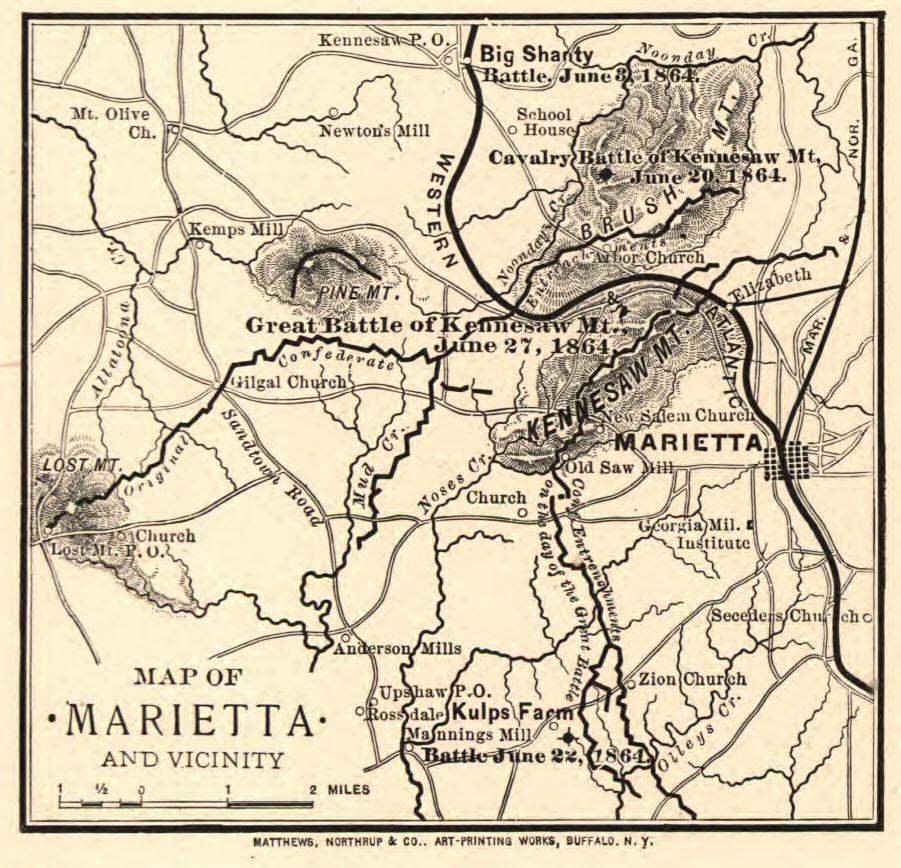
On July 3rd 1864, Marietta fell to Union forces, Mrs Temple begins by quoting from the New York Tribune: “Marietta is pronounced by those who have visited it as the finest town they have seen since crossing the Ohio River. The streets are well laid out; the private residences are upon an ample scale, and many of them elegant. They are mostly empowered in clumps of shade trees, and the better portion of them are ornamated with flower gardens exhibiting taste and culture. The place is in a good state of preservation. Most of the people have followed the tide of immigration, negroes and all. The courthouse is a large building with spacious grounds in which the horses of the generals and their staffs might have been seen luxury rating in the rich growth of grass the principal hotel noticeable for a style and elegant exterior, has been in use as a Rebel hospital. [Ed. Note: this is the largest building in town, a hotel named the Kennesaw House.] The wounded had all been removed. The graveyard just on the outskirts of the town showed by the number of recent mounds and new inscriptions, that the late actions here had contributed to people this last resting place of the Rebel soldier.“ [Ed. Note: The Confederate Cemetery is right next door to the cemetery where my mother’s great-great-grandparents, great-grandparents, and grandfather are buried.]
Mrs Temple continues: “The regular Sunday sermon was being preached in some of the churches when the federal army marched into town. What must have been the sensations of those congregations, the handful of people who did not refugee as they continued to sing those old hymns while the noise of the invaders feet and the creaking of his wagon trains sounded outside! The Tribune correspondent commented on the fact that the congregations were not disturbed.”
She continues, “If the congregations were left in peace, the other citizens of the town and the surrounding county certainly were not, for during the day as this dispatch and others mentioned, many prisoners were taken. most of them were herded out in front of the Georgia Military Institute until disposition could be made of them. Harper’s Weekly, August 13th, 1864, showed a sketch of the institute and called attention to the fact that the campus in front of the buildings was filled with prisoners. Men, too old to enter the Confederate service, were arrested on the streets of Marietta that day and sent out of town with the northern Army; there was no chance to communicate with their families, and in some cases it was many months before their Destiny was known. indeed, anxious relatives were unaware of the fate of some of them until, ragged and wasted, they made their way on foot back home from northern prisons at the end of the war.” [Ed. Note: This is why DJ Dobbs (aged 24) must have vacated Cobb County a few days ahead of the Yankees; otherwise, he would become a POW earlier than he did.]
Ms Temple continues this time quoting from another source: “The institute was an object of much curiosity on the part of Northern soldiers,” a place deemed doubtless remote from all dread of Yankee Invasion but now become one of the milestones in the southern progress of the Union armies,” said Leslie’s Weekly in September, 1864, “It is situated about a quarter of a mile from the center of town and before Sherman advanced to the neighborhood, contained 130 candidates who were training in treason and the art of war. they recorded in small buildings, Each of which contains 10 young rebels. they retired 5 weeks before we entered. The college then became barracks for our troops and was for a time occupied by the 20th Connecticut.”
[Ed. Note: DJ Dobbs, my great-great-grandfather, was a member of GMI’s inaugural graduating class in 1856. I don’t believe he was trained in treason, as the Yankee newspaper suggests. More likely, he got a heavy dose of classic literature such as Edgar Allan Poe and James Fenimore Cooper.]
The sight of The Institute won the commendation of the Tribune correspondent.”The view from this point, though are exceeded by that from Kennesaw Mountain, is still a commanding one, the town being in full sight, and making a beautiful appearance. The grounds are well shaded by fine forest trees and the sides of the road from this point to town is also finely shaded.” [Ed. Note: My third great grandfather, Colonel David Dobbs, was one of the founders of GMI]
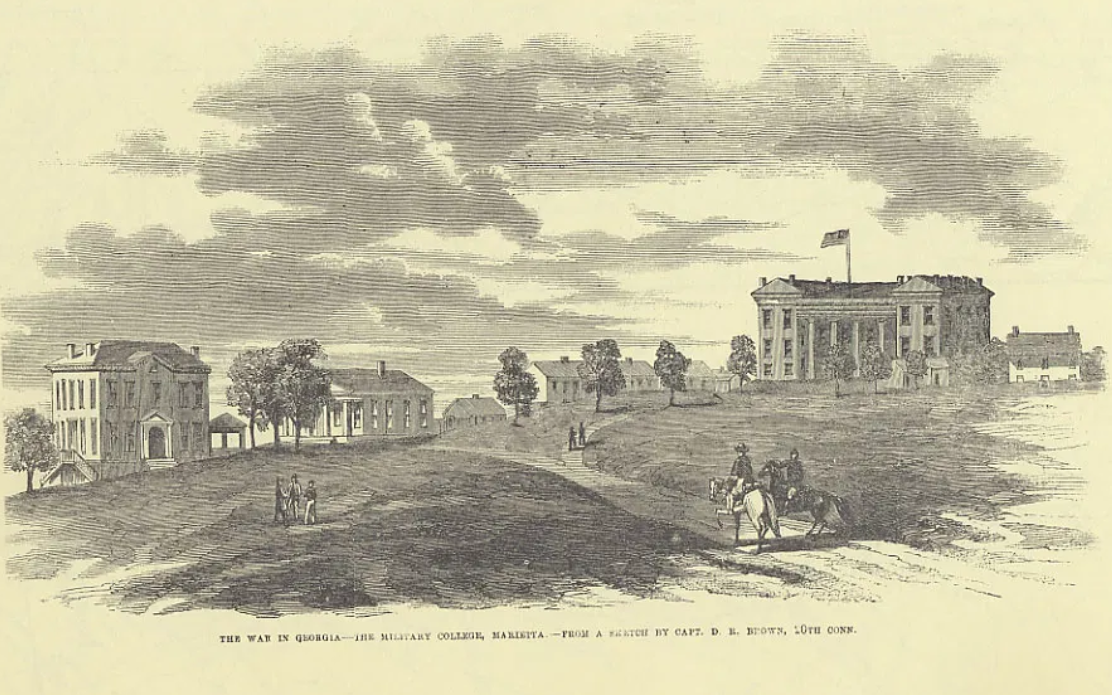
“The hill swarmed with Northern soldiers, curious to see this school whose Cadets had given so fine an account of themselves in battle. There was scarcely less curiosity concerning the square, white-columned house next to the campus which was the home of Colonel A.V. Brumby probably , the first superintendent, now long since gone to war. Colonel Brumby was locally famous as a rose grower, and on this summer morning the air was perfumed with the roses in his garden. They were soon a sorry sight, however, trampled down by men accustomed to a sterner footing than Marechal Niels and Mal-maisons.”
[Ed. Note: “Marechal Niels” and “Mal-maisons” refer to two specific and historically significant varieties of roses, both very popular in the 19th century.]
Mrs. Temple continues: “The Tribune correspondent thought Colonel Brumby’s, a princely residence. He elaborated upon the charms of the town in the second dispatch. There is much more to be said of this place than what was contained in my letter of yesterday. It must have cost the citizens many a pain to tear themselves away from the grateful shade and quiet of the luxurious homes of Marietta, to wander in the Saharas of southern Georgia at the present hot and dusty season. Probably not more than 20 houses are occupied and these by only superannuated men, invalids, and children. The town is a perfect grotto of shade. The best estates are owned by… [Ed. Note: He then proceeds to list about a dozen names one of which is my third great grandfather, Colonel David Dobbs, whom the corespondent describes as “one of the oldest citizens ” and he further describes these individuals as “ the influential men, the people of property and standing of the town.]
[Ed. Note: Based on a map I have seen, Colonel David Dobbs’s house in Marietta, Georgia, was located where the State Court of Cobb County is currently located across from the town square. ]
The Tribune correspondent then goes on, “There were during good times: two druggists, eight groceries, three hotels, four churches – Methodist Baptist Presbyterian and Episcopal – three female and one male school, besides small schools for young children, all well patronize.”
Continuing with the report from the New York Tribune, “There is an air of thrift about the place that recalls the memory of the once happier and better day for the town. In leaving the rebels literally swept the place clear of every article of value and utility which could possibly be of use to the incoming army. They tore up about a mile and a half of railroad between Big Shanty and Marietta, and carried off all the frogs from the switches to delay our advance and embarrass our movements. [Ed. Note: frog – a railroad switch, also known as a turnout.] It is the first instance in which they have done this in falling back and shows some unusual necessity for the act. They [the rebels] had a large bakery where they could convert 30 odd barrels of flour into bread daily. They removed all the ironwork and tore down one of the ovens to get it down. Two days will suffice to restore the whole to running order.”
“Guards have been stationed at every house where there are any residents remaining and not a house has been disturbed in the slightest degree. In this respect Marietta has fared better than most towns visited by the armies. The few citizens remaining declare that they find the Yankees at different class of people from what they had been led to expect from the stories that have been told concerning them. The ladies have evidently suffered for the lack of dry goods stores but a brief time will work wonders. as it was in Knoxville so it will probably be in Marietta”
[Ed. Note: The Yankee newspaperman then goes on with some nonsense about how the streets will witness the complacent promenade of well-dressed, satisfied groups that have conquered their prejudices against the Yankee Vandals. Yankee sugar, coffee and other creature comforts are all great civilizers. When the stomach pleads, prejudice must give way,” Mrs Temple describes these prophecies as “unduly optimistic.’]
“General Thomas established his headquarters for the army of the Cumberland at the Military Institute on Sunday, the 3rd, while General Sherman and General McPherson were quartered for the day in Marietta the former and his staff at the Kennesaw house. the Army which came into Marietta. They did not linger however. Johnston was not far ahead and he must be overtaken. The general movements of the federal troops were such that most of the Army of the Cumberland preceded down the Dixie Highway, the Army of the Ohio, and the Army of the Tennessee were ordered to cross Nickajack Creek and threatened the rear and right of Johnston’s Army.”
[Ed. Note: General Sherman spent only a day or two in Marietta. Therefore, any conversation between him and my great-great-grandmother, Mattie Prothro Dobbs, would have occurred on either July 3rd or 4th.]
Ms Temple then goes on to list each the Yankee units that marched through Marietta on the 3rd and 4th. The town was garrisoned by General Thomas who issued his orders from GMI, ordering his troops “to preserve everything in and about the town as nearly in the same state as that in which he finds it upon assuming command.”
On July 5th General Thomas issued orders to “endeavor to preserve public and private property in Marietta as nearly as possible in the state in which you found it and to prevent plundering and pillaging. You will arrest all deserters and stragglers and forward those belonging to the army of the Cumberland to these headquarters by squads of from 30 to 50. You will permit no officer to take quarters in Marietta, except by order of Major-General Sherman, and the topographical Engineers of the army of the Cumberland who have been sent there to establish a lithographic press for making Maps. You will permit all Union people [i.e. scallywags] desiring to go north for the purpose of remaining there to do so, and order transportation for themselves families, and baggages.
“You will arrest all resident rebels and report their names to these headquarters. You will seize all cotton belonging to the Rebel government, or which has been abandoned, turn it over to the quartermaster’s department for shipment north, taking receipts for the same, which receipts you will forward to these headquarters. All cotton belonging to private individuals you will have nothing to do with anymore than any other private property.”
[Ed. Note: As far as I know the old Colonel, David Dobbs, was not arrested. He was however forced to witness the destruction by fire of the Georgia Military Institute. The institute that he founded was burned by Union troops on November 15, 1864, at the beginning of General William Tecumseh Sherman’s March to the Sea.]
As Ms Temple points out, General Thomas’s orders differed slightly from General Sherman who had ordered that all cotton was to either be burned or seized for the account of the United States.
According to Ms. Temple, the brigade remained in Marietta until July 13th. In the next installment I will present Ms Temple’s account of the events in Marietta from August to December 1864.
 Gathering Leaves