For years, I’ve been trying to unravel the mystery surrounding my mother’s great-grandfather’s civil rights status at the close of the Civil War. I believed I had finally solved it: Was he among the thousands denied property and civil rights due to specific criteria? These categories included former Confederate civil and military officers above a certain rank, individuals who had abandoned U.S. government or military posts to aid the Confederacy, and wealthy citizens with over $20,000 in taxable property- this would be about $450K in today’s money.
I had previously determined that my great-great-grandfather’s older brother, James Monroe Dobbs of Chattanooga, Tennessee—a central figure in my grandfather’s family—was compelled to write a letter to President Andrew Johnson, pleading for a presidential pardon. This was because he possessed over $20,000 in taxable property, amassed from selling horse feed to the Confederate States of America. (See The Third Man for details)
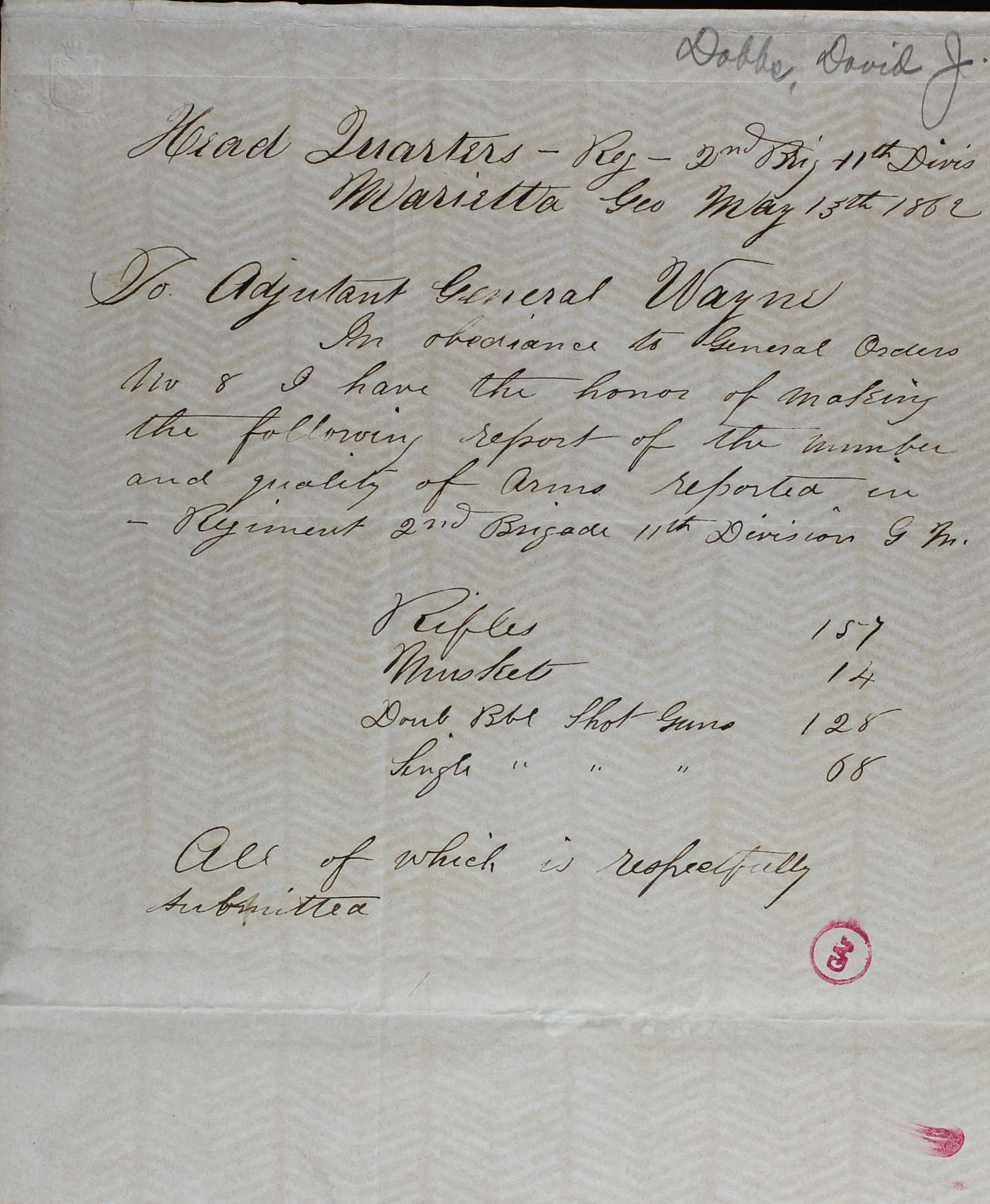
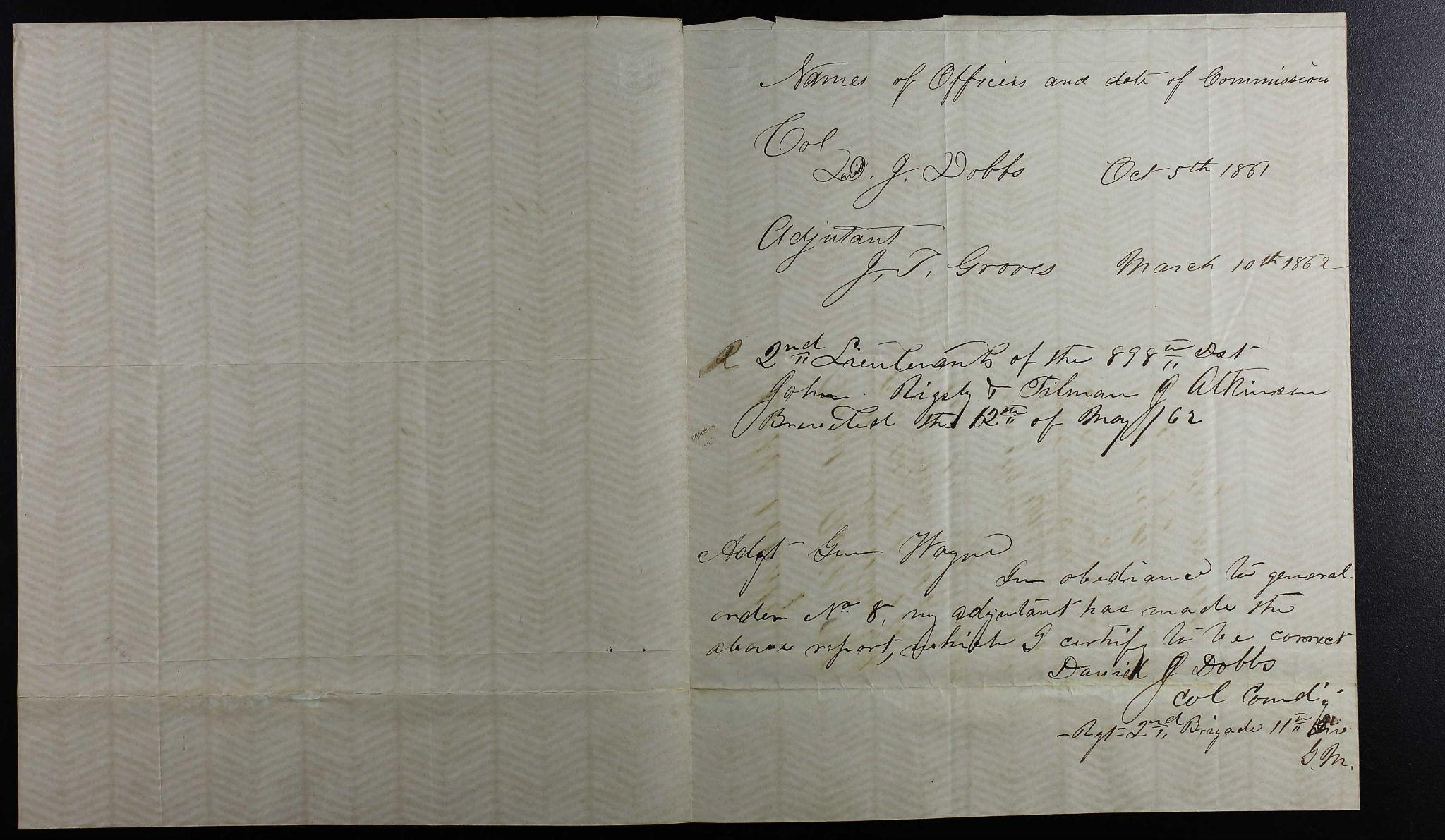
However, regarding my great-great-grandfather, Colonel D.J. Dobbs, I knew he commanded a regiment in the Georgia militia at the war’s outset but was uncertain if he held a position in the Confederate Army. While I found a letter from Cobb County, Georgia citizens requesting his appointment as the Confederate Army’s enrollment officer for the county, I never found confirmation that he became a high-ranking Confederate officer. The other day I thought that I found it until realized upon what I was seeing, I had misread.
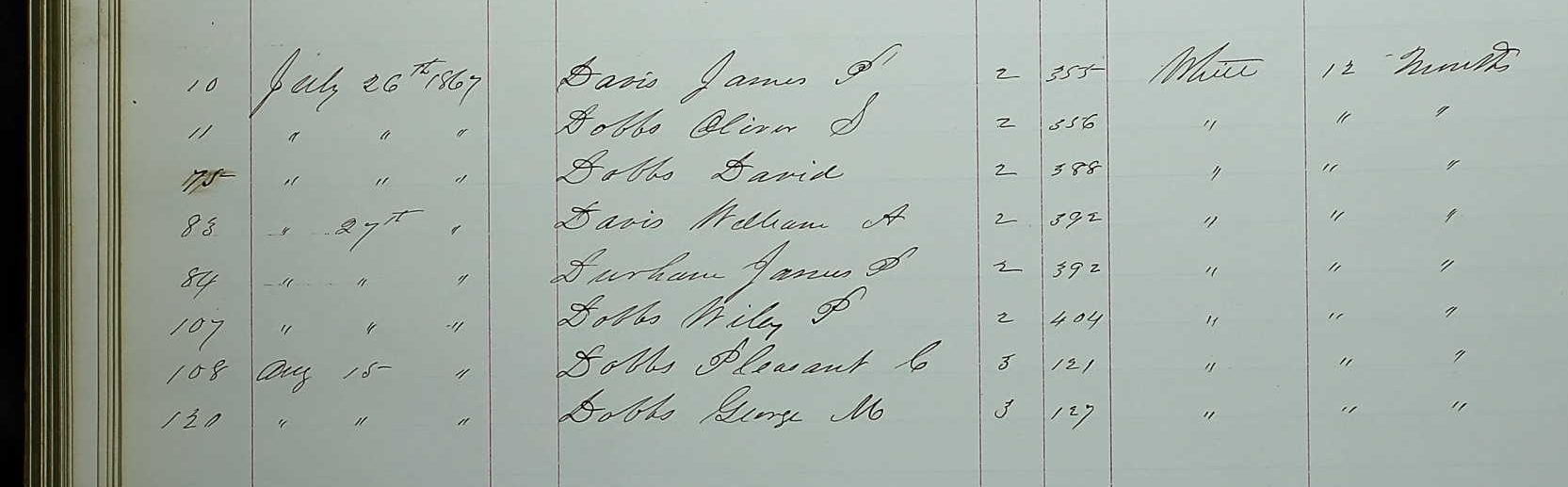
I discovered two crucial pieces of evidence. First, a Cobb County voters’ register from 1867 lists D.J. Dobbs’s father, David Dobbs, along with several uncles and cousins, as registered voters. D.J. Dobbs is conspicuously absent. To me this indicated he couldn’t vote until his civil rights were restored. I was wrong.
Second, I found an Oath of Allegiance signed by D.J. Dobbs in August of 1867. After taking this oath, my great-great-grandfather could again own property (though no more slaves), conduct business, pursue legal cases, and vote or hold office, unless otherwise barred by the state of Georgia. Again, I was reading it wrong.
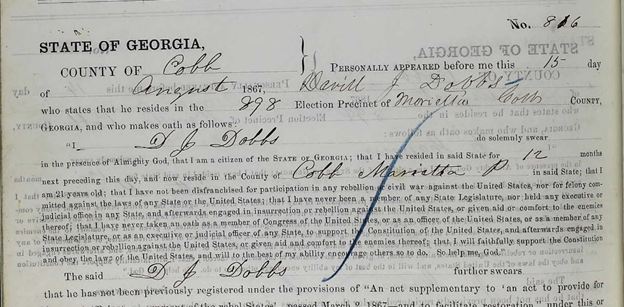
I wasn’t aware that D.J. Dobbs was registered in Cobb County. He resided in a different district than his father, the old Colonel, who lived in Marietta. D.J., his family, and my great-grandfather lived on the family plantation, midway between town and the Chattahoochee River.
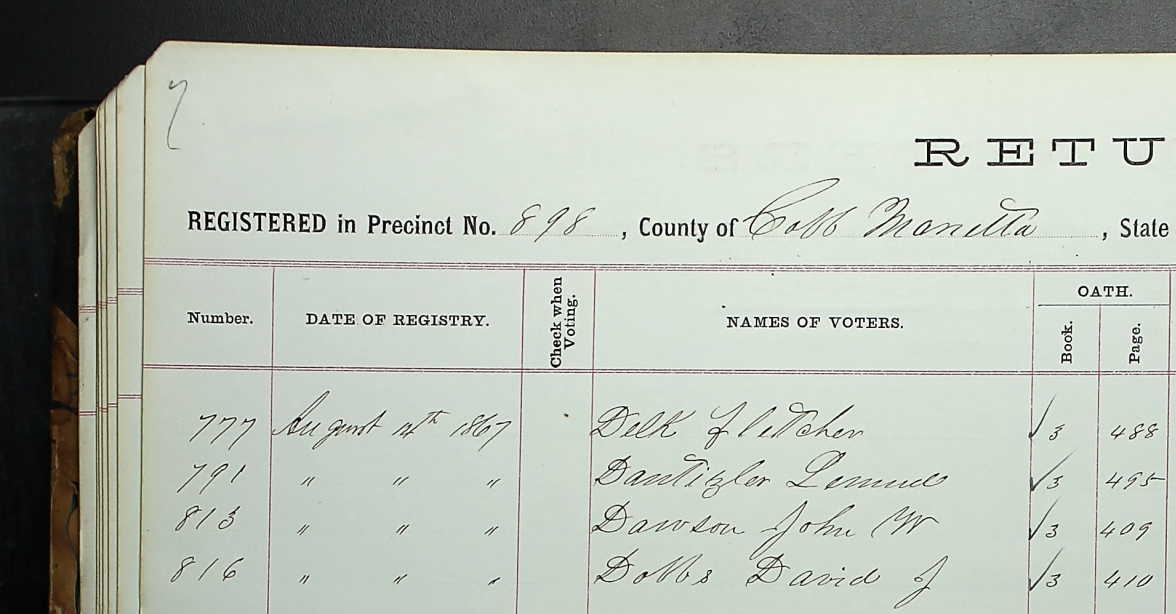
If I had looked closer I would noticed that the two columns to the right of the individual’s name indicate where their oath of allegience is to be located. Apparently every eligible voter (white or black male) was required to take an oath with the state of Georgia.
The oath given to voter’s in Cobb County reads:
“I, ___, do solemnly swear or affirm, in the presence of Almighty God, that I am a citizen of the State of ___; that I have resided in said State for ___ months next preceding this day, and now reside in the county of ___, or the parish of ___, in said State, as the case may be; that I am twenty-one years old; that I have not been disfranchised for participation in any rebellion or civil war against the United States, nor for felony committed against the laws of any State or of the United States; that I have never been a member of any State Legislature, or held any executive or judicial office in any State, and afterwards engaged in insurrection and rebellion against the United States, and given aid or comfort to the enemies thereof; that I have never taken an oath as a member of Congress of the United States, or as an officer of the United States, or as a member of any State Legislature, or as an executive or judicial officer of any State, to support the Constitution of the United States, and afterwards engaged in insurrection or rebellion against the United States, or given aid or comfort to the enemies thereof; that I will faithfully support the Constitution and obey the laws of the United States, and will, to the best of my ability, encourage others to do so. So help me God.”.
The claim that he did not engage in Insurrection or Rebellion against the U.S. is technically accurate, provided he held no position within the Confederate government or military. From 1861 to 1863, D.J. Dobbs served as a commissioned officer in the Georgia militia. In November 1863, following the Confederate defeat at the Battles for Chattanooga, Georgia Governor Joe Brown instructed Georgia militia officers to temporarily suspend their commissions and enlist as private soldiers in the Georgia State Guards. D.J. Dobbs was not called into service with Company E of the 7th Georgia State Guards, known as “Joe Brown’s Pets,” until July 1864, after the fall of Marietta. (see also where I ask ChatGPT to explain the phrase Joe Brown’s Pets.)
It is understood that the younger Dobbs’ family became refugees and eventually made their way to South Carolina.
Old Colonel Dobbs and his three grandchildren remained in Marietta. Later he was forced to witness the destruction of Georgia Military Institute by Sherman’s Army.
The younger Dobbs family first went to Atlanta where they stayed an unknown amount of time. They would have had to have left at the latest by September 4th when Sherman issued special field orders #67, demanding that all citizens evacuate the city of Atlanta.
They were in South Carolina by December where they attended the funeral of Martha Prothro Dobbs’ father, Evan Prothro of Barnwell County, S.C.
They were documented as being present during probate of Evan’s estate. It was in January of 1865, that Martha received her inheritance of $1500 paid in near-worthless Confedrate paper money. D.J. promptly turned around and purchased from the estate an old mule, several pounds of shoe leather, and some silverware for the sum of around $1500 dollars.
On May 23, 1865, D.J. Dobbs was made POW by the Union Army at Greenville South Carolina. On the muster roll he is listed as a private in Company A 7th regiment Georgia State Guards.
So what’s still unclear is whether or not D. J. Dobbs, a graduate of Georgia Military Institute in 1856, at any point during the war actually took up arms against the United States. Throughout the rest of his life until he died in 1877 at the age of 42, he was known as Colonel David Judson Dobbs.
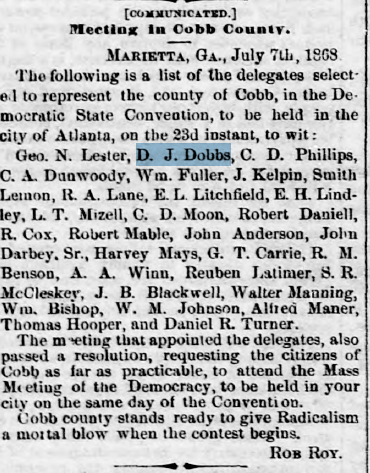
Then I see that there is also a report of a meeting of the Democratic Party in Cobb County that was held in Marietta Georgia on July 7, 1868. Here they chose delegates to attend the state convention of the Democratic Party of Georgia and one of those delegates was my great, great-grandfather D. J. Dobbs. Their statement ends with “Cobb County stands ready to give Radicalism a mortal blow when the contest begins.”
At this time, Georgia’s white planter class believed their troubles were over. Little did they know that 1868 would see the election of Ulysses S. Grant as president and an overwhelming Republican majority in both Congress and the Senate. Presidential Reconstruction had ended, and Congressional Reconstruction, along with the occupation of Georgia by a standing army, had begun and with it the Lost Cause narrative was born.
 Gathering Leaves