Aside from being a national holiday, the Fourth of July is extra special for my family. It’s the shared birthday of my maternal grandfather, James Monroe Dobbs, Jr., and his father, James Monroe, Sr. Here is an excerpt from Gathering More Leaves, Part I: Chapter One
It came like a long-forgotten letter finally delivered.
In the spring of 2022, when the U.S. government released the 1950 census records, I found myself staring at the screen longer than necessary, unsure of what I was even looking for. A name, a place. Some thread. My parents, both twenty-two that year, were still strangers to each other–my father possibly sketching nudes in a cold Chicago studio, my mother perhaps typing reports in some smoky Washington office. The census might know what I no longer could ask. They were gone now.
It was a simple enough question: Where had they been that year? But I realized, sitting in my cluttered office, that I didn’t know the answer.
I remembered something. A binder. My mother had given it to me before she died–dozens of ruled pages covered in her looping script, pasted photographs, and curling news clippings. At the time, I remember being critical of her for gluing the exhibits directly onto the pages. Now, as I retrieved it from a drawer, the glue seemed like devotion.
The answer came quickly enough. She had lived in a boarding house in Washington, DC., and then, in August, boarded a ship bound for Europe. A paragraph, a time line, a box checked.
But I kept turning pages.
One exhibit stopped me. Three items affixed to a single page. Two I recognized: newspaper obituaries for my maternal grandfather, clipped from The Dallas Morning News and The Waco Times-Herald. They told me what I already knew–James M. Dobbs, age 53, died alone in a hotel room in Temple, Texas. The official word: natural causes. They both provided the basic information regarding his death, which I already knew about. James M Dobbs, age 53, former administrative officer of the Soil Conservation Service in Temple, Texas, was found dead in his hotel room. The Justice of the Peace returned an inquest verdict of the death by natural causes. He had been ill for several days. He was born July 4, 1902, in Dallas and graduated from the University of Georgia law school in 1923.
I am mentioned in both the obituaries in the list of survivors:
Survivors include two daughters, Mrs. William W Carlin of Corpus Christi and Mrs. David DeBacker of St. Louis, Missouri; one grandchild and one half-sister, Mrs. WH Smith of Washington DC.
My mother had been estranged from her father for most of her life. In fact, in her memoir, she mentions him only three times. The first is an early memory that she has of him before her parents were divorced in 1932. She was four years old and remembers that he was “tall, thin, and had dark hair.” After her parents divorced, she did not see her father for 18 years. The next time she saw her father was when he came to see her in Washington, DC, just before she left for Europe. That was in the summer of 1950. When my parents married in 1954, my grandfather was not invited to the wedding at my grandmother’s insistence. However, according to my mother’s memoir, she saw her father again, a month or two after the wedding. She said that he met my father, and the three of them had dinner together. She describes her father as “tall, thin, with dark hair” on both occasions.
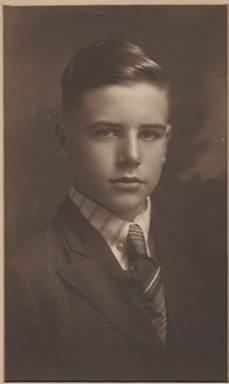
age 15 years
Regarding family resemblance, I tend to favor my mother more than my dad, except that I am not a blonde. If I were fleeing a crime scene, I am sure the witnesses would describe me as “tall, thin, with dark hair.” In the few pictures I have seen of my maternal grandfather, I feel a resemblance between us. I grew up with a photograph of my grandfather taken when he was about 15 years old hanging in my bedroom. Ever since then, I have been obsessed with knowing more about him. I met my paternal grandfather one time, and that was when I was about four years old. On the other hand, my maternal grandfather, whose picture hung on my bedroom wall, died when I was about six months old.
And that brings me to the third item on the page with the two obituaries. It was a typewritten letter from my grandfather’s second wife, Helen Mewhinney Dobbs. The letter was folded, so I probably missed it on the first pass. It was typed on letterhead from the First National Bank of Holland, Texas, dated January 23, 1956. It is addressed to “Dear Emita, Pat, and Jo: “that would be my grandfather’s half-sister, my mother, and my Aunt Joie.
It begins: “May I suggest that you try to remember Jim as I will try to remember him (as I knew him in earlier days).“
This intro is an apparent reference to the disease of alcoholism that took my grandfather’s life. Helen had divorced my grandfather a couple of years before he passed away because of his drinking. According to her privately published autobiography, she did so, hoping that the separation would force him to change.
What follows is a beautifully written memorial to my maternal grandfather, James Monroe Dobbs, Jr., by my step-grandmother.
He was refined and genteel, soft-voiced, appreciative of the finer values of life, polite, cultured, and polished.
He was well-educated, had an excellent choice of words, and dictated beautifully. He had an excellent memory and constantly strove to improve his knowledge, parroting out minute details to be better informed.
He was competent. Whatever he undertook, he did with precision and perfection. Queer thing: he never liked to tackle a problem a second time but constantly sought new fields of endeavor.
He was broad-minded. He always gave a person the benefit of the doubt. If criticism of a person was made in his company, he would invariably say something kind about that person, questioning your authority for any criticism made. He did not like commentators who gave their opinion. He preferred to form his own.
He had beautiful features, was always neat in appearance, and was always immaculate in his dress.
He liked to do things for those he loved. His workshop was a hobby, and I encouraged it constantly. If he heard me say that I wished I had something made or fixed, he took great pleasure in getting it done. You could not hurry him, but he would get it done in his own time – and it was a perfect job. I think he loved me best when I was ill in bed and he had to wait on me. Whistling or humming a tune, he would tend to me lovingly, cook me good food, and keep the house in order so that things ran smoothly.
He was a good sportsman. He loved his guns, took excellent care of them, and kept all the rules for fair hunting. He prized the walnut, handmade gun rack I gave him.
He liked to be systemic and orderly. So do I. I have heard him brag that if he were called to make a trip to Europe and had to pack in the dark, he would still know exactly what he was taking.
He loved good literature and music. Often, he read aloud to me and always inspired me to read classics that I failed to read in my small-town schooling. He loved good music so well that he told me that he became an usher in Atlanta at the opera house in order to see some operas.
He loved children. Before he contacted you two daughters, nearly every time he would take a child into his arms he would shed a tear and hurriedly wipe it away. He often told me of Pat’s antics as a baby and how he loved feeding her early-morning bottle. Joe’s two visits to our home brought us both much happiness. It was always a great disappointment that he would never get you, Pat, to come.
He presided well. He helped organize a knife and fork club in Temple and he became its second president, doing a very creditable job.
He was a loyal friend. He would “go to bat” for any man he felt worthy of his esteem. He was a member of the Lions Club and worked indefatigably on the Lion’s Minstrel each year.
His home was his palace and how he loved it! Both homes in which we lived, he liked and help select. He could and did show them with pride. Each was paid for at the time of purchase, and that gave him an inner satisfaction that radiated. His first choice of entertainment was to sit and read by his own fireside.
The letter, signed “Helen Dobbs,” is a beautiful testimony from someone who must have loved my grandfather very much. She makes him sound perfect, although we know that, like all humans, he had his flaws. I know that he commited adultery and he allowed alcohol to take over his life. Nevertheless, having discovered this letter, I feel a sense of closure, and now I think I better understand who my grandfather was.
 Gathering Leaves