Here is a fun game to play with your family at Thanksgiving this year. I call it “Are you a Mayflower descendent?”
Here is how it’s played. it’s really simple! you start by asking, “Are you a Mayflower descendent?” Then, you clumsily go about trying to figure out how you are going to answer the question. You open up your genealogical software, Roots Magic, and start creating a custom report from scratch because that’s how real genealogists do it. But after screwing around trying to create a custom report, You stumble upon a pre-built report titled the “Who Was There?” list. https://help.rootsmagic.com/RM9/who-was-there-list.html
“The “Who Was There?” list is a very powerful report that lets you see everyone in a particular place at a particular time. The report will print the name of each person who may have been in that place at that time, along with their birth and death date, and any events in their lives that occurred in that place.”
So, I set the settings as such and pulled the lever.
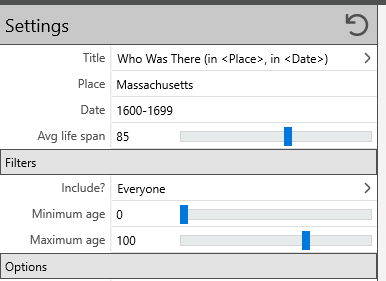
This gave me a spreadsheet containing a table of 97 names. At first, I was astonished to think that this list represented 97 of my ancestors who lived in Massachusetts ten generations ago. But I soon realized that this was not what it appeared to be. First, these records are here only because they contain dates from the 17th century. This means that this is not representative of every one of my ancestors who lived ten generations ago. It’s only the ones I know of.
Second, the filter that I used included “Everyone.”
So, I pulled a second Report with a new filter this time, which calls for ancestors plus collateral families living in Massachusetts between 1600 and 1699. This returns a list of 90 people.
Let’s Get Serious, Now
Finally, I pulled a report that I filtered for direct ancestors only. The complete filter called for direct ancestors with dates who lived in Massachusetts approximately ten generations ago.
This returned 49 individuals, meaning I am the direct descendant of 49 individuals who lived in and around the Massachusetts Bay area in the 17th century.
From the first report, containing 97 names, there were a couple of hundred or more events with locations in the Massachusetts Bay Colony. I derived a report of all the place names associated with the events. I extracted 28 locations into a KML file, which I loaded into Google Earth. I showed that most events occurred around Boston, and only a few occurred in the vicinity of Plymouth Rock.
I was not getting any closer to finding an answer to my question of whether I had any ancestors aboard the Mayflower. I figured the best next step would be to do some research into the question of who the Pilgrims were. How are they different from the Puritans? Why don’t we know the Pilgrims by their real name, the Separatists? And most importantly, why were we, as children, told an almost fictitious story instead of the real story of the first Thanksgiving?
I remember being in fifth grade and suddenly feeling liberated when I learned from my teacher the true story of the first Thanksgiving. It was as if I had discovered something that others didn’t know. This is when I first thought of becoming a historian and spreading the truth. Our 5th-grade teacher taught us that the story of the Pilgrims and the first Thanksgiving was far more complex than what we had been taught in earlier grades. Many students were confused, but not me. I then began to explore other historical mysteries, like how come Lincoln’s birthday came before Washington’s.
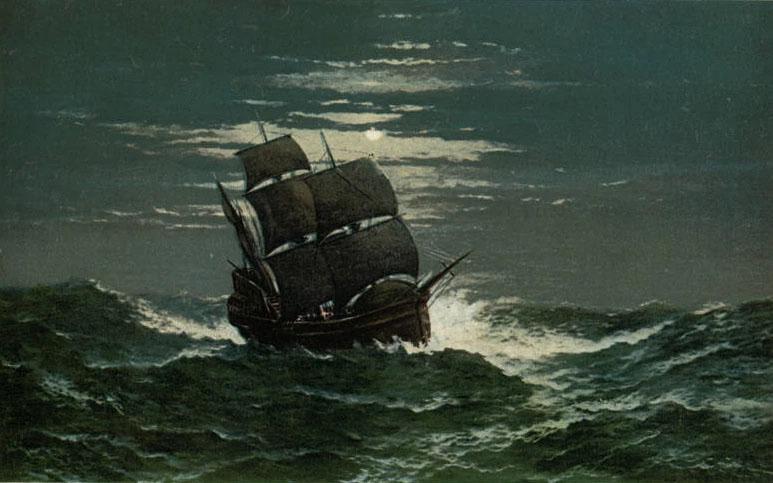
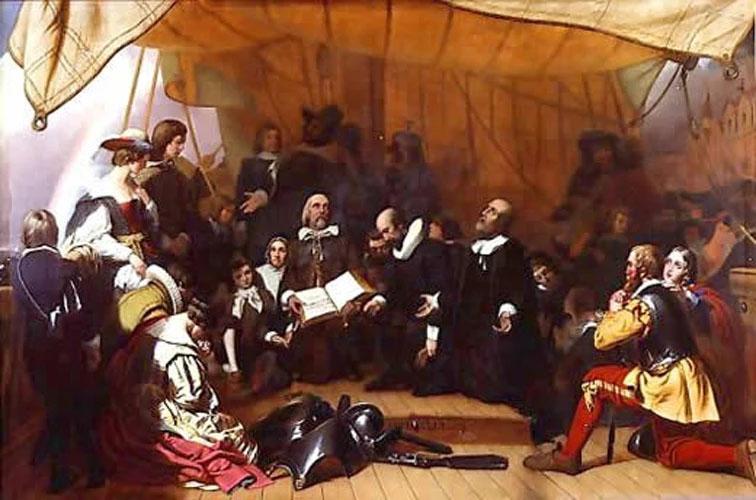
The Pilgrims were English settlers who founded Plymouth Colony in 1620. Driven by religious separatism, they sought to practice their faith freely, unlike the Puritans, who aimed to reform the Church of England. Initially relocating to the Netherlands because their leaders had been arrested, the Pilgrims journeyed to North America due to integration challenges and a desire to retain their English identity. Upon arrival, they signed the Mayflower Compact, a self-governance agreement, and celebrated the first Thanksgiving in 1621 with the Wampanoag, whose aid had been vital to their survival.
Differences between Pilgrims and Puritans included goals and religious tolerance. The Pilgrims were separatists who focused on establishing a small, independent community, while the Puritans aimed to model a reformed society in the Massachusetts Bay Colony. Pilgrims were more cooperative with Indigenous peoples and somewhat more tolerant of religious differences, whereas Puritans enforced strict religious conformity and often clashed with Indigenous communities.
The term “Pilgrims” replaced “Separatists” over time due to historical romanticizing. “Pilgrims” suggested a spiritual journey, aligning with American values of religious liberty and unity, while “Separatists” had negative connotations of division. This name shift helped distinguish them from the Puritans and positioned them as symbols of America’s founding ideals.
The “First Thanksgiving” narrative became simplified to create a unifying national identity. As a comforting story, it emphasized peace and gratitude, omitting the conflicts that followed. This version, promoted during Lincoln’s presidency to encourage national unity, became ingrained in education, focusing on shared values rather than colonial realities. However, there is a growing movement to acknowledge the full history, including Indigenous perspectives.
I highly recommend watching the BBC Documentary The Mayflower Pilgrims: Behind the Myth. The founding moment of America (2016), in which Welsh actor Roger Rees portrayed Governor William Bradford in what may have been his last performance.
Yet, before I went any deeper down the rabbit hole, I discovered that familysearch.org has a search engine very similar to the one that I reviewed a few months back in which you could put in the name of one of your ancestors and find out if you were related to someone famous.
In this case, they now have a search interface that allows you to determine if you are a Mayflower descendant. Doink!
The instructions are as follows:
Search this collection of authenticated genealogies tracing Mayflower descendants. Just do the following:
- Type the name of an ancestor who was born on or before 1910.
- Look for a match. See if one of the results matches your ancestor’s information.
- View the descendancy chart. If you find a match, click on the name to go to the authenticated genealogy chart that stretches back to your Mayflower ancestor.
Not all the Mayflower descendancy trees have been added. If you don’t find a connection, be sure to come back often and keep searching! If you have a FamilySearch account, you can also use Relative Finder to see if you are related to a Mayflower passenger.
Here is the link:
https://www.familysearch.org/en/collection/mayflower-descendants/
I searched, using the only ancestor who would qualify and whom I know has a documented genealogy going back to ancestors who lived in Massachusetts in the 17th century. in other words, I found a known descendant of the 49 or so individuals in the report from my Roots Magic database. That person was Corbett Pickering, father of my father’s great-grandmother, Cordelia Pickering. The response was NIL.
So, my connection to Colonial Massachusetts is to the Puritans living in Salem and nearby places, whom I continue to honor every Halloween, and not to Pilgrims (Separatists) who settled in the Cape Cod area.
 Gathering Leaves
I am a Mayflower descendant, from John Alden. I proved the connection to the satisfaction of the General Society of Mayflower Descendants, and was elected to membership therein. I descend from both Pilgrims and Puritans, in my father’s line. After a while, the lines became blurred, as people from the two groups intermarried. Puritan squabbling became rather comical, to me. The church being the center of Puritan society, there’d arise some schism or other, and one group would break off and establish a separate church, creating thereby a separate town. Thus did the town of Bridgewater, where my ancestors settled, eventually become divided into West Bridgewater, South Bridgewater, and North Bridgewater. It was in that latter town that my ancestors lived. North Bridgewater is known today as Brockton.
LikeLiked by 1 person