The recent discussions about immigrants eating cats and dogs remind me that my ancestors were immigrants. Some arrived from Europe as early as the 1630s, while others came as late as the 1880s. Their experiences varied—some were treated better than others. For instance, my German ancestors managed to preserve their culture and language long after arrival, which the English-speaking population found objectionable. There was pressure for everyone to speak only English and to spend all day Sunday warming a pew in a cold church instead of enjoying the beer garden with warm pretzels and cold beer. But that’s a story for another time.
Today, I’d like to share the story of a newly discovered immigrant ancestor. My mother had German ancestors on both sides of her family. Her father’s German relatives began immigrating in the 1830s. By the end of the Civil War, they had moved from the Lower East Side of Manhattan to Savannah, Georgia, and eventually Dallas, Texas.
I believe there were three main reasons for this relocation:
1. The New York City Draft Riots of July 1863.
2. Changes in the cigar-making industry that affected my great-great-grandfather’s ability to work.
3. During the Civil War, some family members discovered firsthand that there was more to America than New York City.
Recently, I found immigration papers for one of my fourth great-grandfathers, George Dietrich Horbelt, who immigrated in the 1830s. He was the great-grandfather of Helen D. Spiegel, my mother’s paternal grandmother.
I don’t know much about George Dietrich Horbelt, as I only recently discovered this branch of my family tree. I do know that he was born in 1790 in what was then the Electorate of Bavaria and died in 1850 in New York City. He married Joanna Augustina Werther in Bavaria, and together they had five children: four daughters and one son.
Following Napoleon’s defeat in 1815, Bavaria became a kingdom under the rule of the “mad” King Ludwig. The country grew increasingly reactionary, leading up to the failed revolution of 1830. In 1832, George D. Horbelt and his family fled Bavaria as high taxes and censorship were crushing the middle class.
The name Sophia appears frequently in the family. One daughter was named Sophia, and two others had Sophia as their middle name. One of his daughters, my third great-grandmother, Susanna Catharina Horbelt, named one of her daughters Sophia. She was my great-great-grandmother. A photograph of Sophia was sent to me by a second cousin in 2019, the year before my mother passed away. Like me, my mother had never seen the photograph before and knew nothing about Sophia’s family. She had always believed that her grandmother, Helen, was born in Germany when, in fact, she was born in Dallas, Texas.
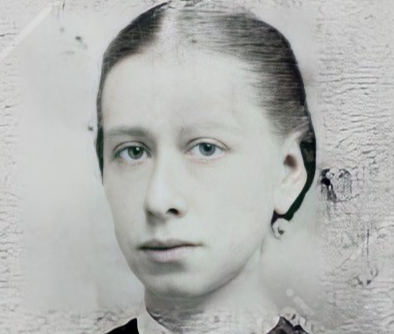
For a while, I only knew Sophia as “Sophia B.” Eventually, I learned that the “B” stood for Brecht (or Precht), though this was not her birth name but her stepfather’s. Her birth name was Schmidt; her father, John George Schmidt, died the year she was born, and her older brother, George, later anglicized his name to George Smith, marking the start of their assimilation.
From 1846 to 1849, the family lived at 145 Delancey Street in New York City’s Lower East Side. Whatever existed there in the 1840s has long been replaced by modern skyscrapers of glass and steel.
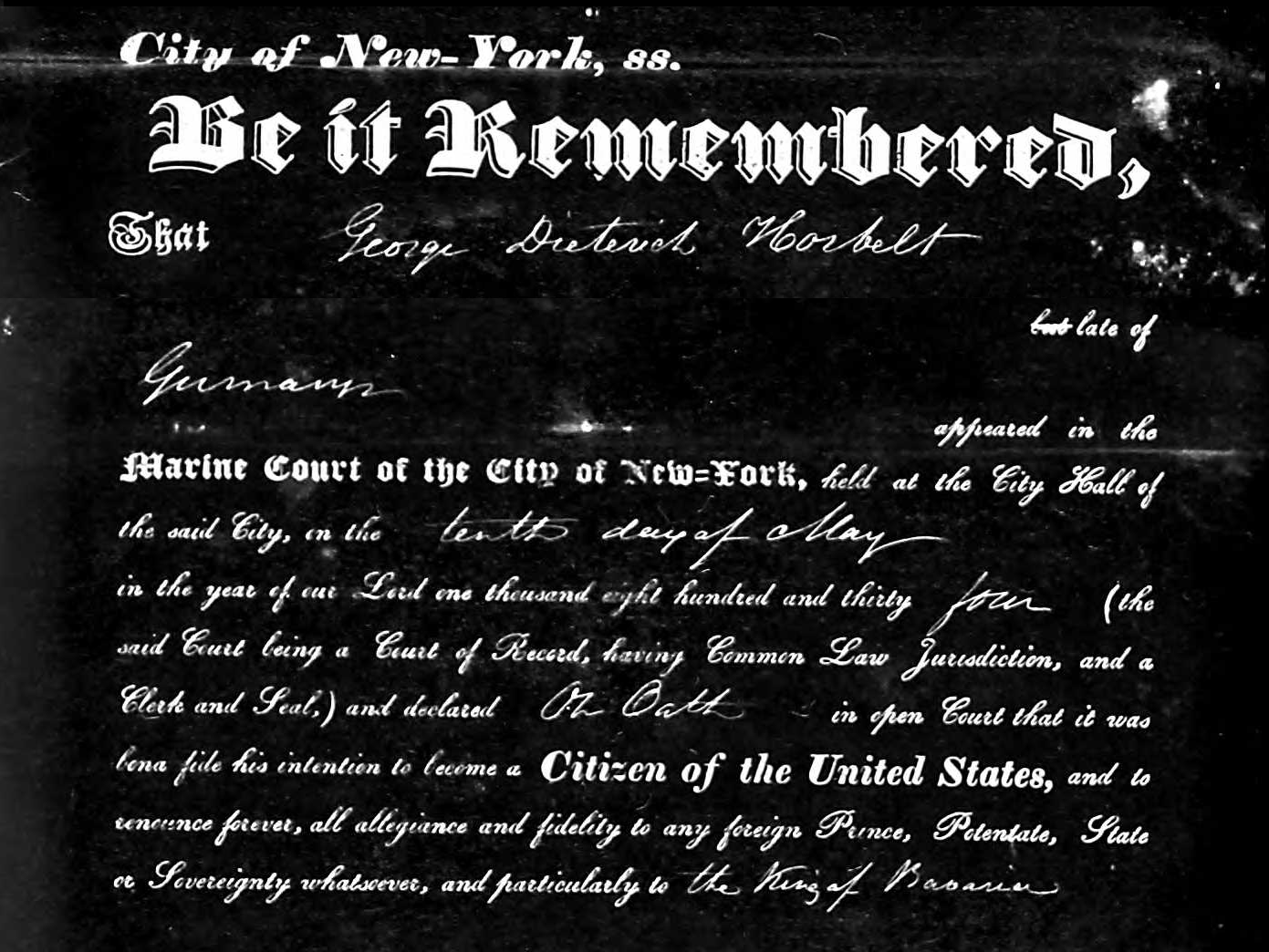
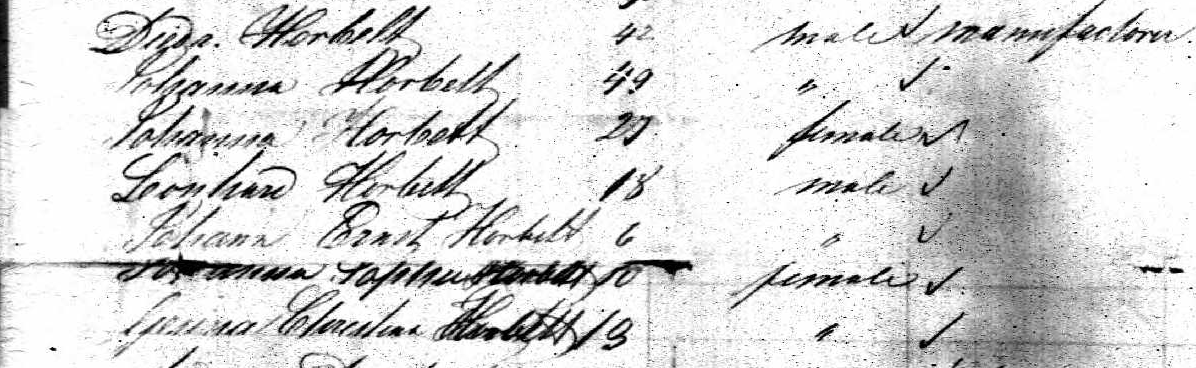
The passenger list shows George, his wife, and their children—one son and two daughters—arriving from Bremen, Germany, along with two siblings: a 27-year-old sister and an 18-year-old brother. By 1848, they were living at 84 Pitt Street, just a block north of Delancey Street. This information comes from the naturalization papers of their son, John.
George Dietrich Horbelt’s occupation is listed as “manufacturer” on a passenger list, but it doesn’t specify what he manufactured. A later listing in an NYC city directory shows Geo. Dietrich and Son, makers of lamp wicks and the address listed is 84 Pitt Street.
As for their religious background, it’s unclear whether they were Catholic or Lutheran. Bavaria was predominantly Catholic, and today there is an old Catholic church on the same block as the Pitt Street address.
George’s son, John, served in the Union Army, enlisting as a private in Company C of the New York 5th Heavy Artillery Regiment. He was mustered out as a corporal on June 28, 1865, at Harpers Ferry, Virginia, at 36.
This is the extent of what I have uncovered about the Horbelt branch of my family so far.
 Gathering Leaves
John Horbelt was my great, great grandfather. Interesting article.
LikeLiked by 1 person
Hello Doug,
If my calculation is correct. because John’s sister, Susanna Catherina, was my 3rd great-grandmother, this would make us 2nd Cousins once removed.
LikeLike