Ancestry.com was offering a 40% off sale on its subscription packages over Memorial Day weekend. After debating which of the three six-month options to purchase, from the moderately priced USA Records-only package to the complete package, including access to Fold3.com (the military records database) and Newspaper Archives, I ultimately decided on the whole package. I knew I would regret not having access to everything.
On Fold3.com, I experimented with different searches to explore any updates to the data’s front-end user interface. I was particularly interested in the Confederate Records for the Civil War era, so I searched for my great-great-grandfather, David Judson Dobbs, who resided in Georgia during the war.
The results included five images from the Civil War Muster Rolls transcription records from the National Archives. These records provided details about his enlistment, unit, and service during the war. Although the information wasn’t new to me, seeing it the first time just a couple of years ago provided a deeper understanding of my ancestor’s role in the war.
My mother’s great-grandfather, David Judson Dobbs, the son of plantation owner David Dobbs, graduated from the Georgia Military Institute in the 1850s. When the Civil War broke out, he was a married man with young children overseeing his father’s plantation in Cobb County, Georgia. His role on the plantation initially exempted him from service. This changed in 1863 when the governor mandated men like Dobbs to join the State Guards.
David held the rank of Colonel in the Georgia state militia, but this was more of an administrative title as he served as the chief enrolling officer for Cobb County. At the start of the war, much like a scene out of “Gone With the Wind,” he and other local men formed small militia units. They wore new uniforms sewn by their wives and sisters, marched in drills, and engaged in mock battles. This was a popular pastime until the demands of the harvest called them back to their primary duties. The citizens of Cobb County petitioned the Confederate government to appoint David as the enrolling officer for the Confederate Army representing Cobb County. However, it’s unclear if he ever served in that capacity. From 1863 until the war’s end, he was enrolled as a private in Company E, 7th Infantry Regiment of the Georgia State Guards.
The Georgia State Guards were a militia organization formed in response to the pressing need for local defense during the Civil War. Initially, these units were made up of men who were exempt from Confederate service due to age, occupation, or other reasons. The State Guards were tasked with maintaining order, protecting infrastructure, and defending the state against Union incursions. They played a crucial role in the local defense efforts, particularly as the war progressed and more able-bodied men were called to the front lines. Despite their varied levels of training and equipment, the State Guards provided essential support to the Confederate war effort within Georgia.
According to Rhett Butler, a fictional character in Margaret Mitchell’s Gone with the Wind, the rank and file of the State Guards believed that they would never see action. They were nicknamed Joe Brown’s Pets.
“There’s a rumor floating about to that effect. The rumor arrived on the train from Milledgeville this morning. Both the militia and the Home Guards are going to be sent in to reinforce General Johnston. Yes, Governor Brown’s darlings are likely to smell powder at last, and I imagine most of them will be much surprised. Certainly they never expected to see action. The Governor as good as promised them they wouldn’t. Well, that’s a good joke on them. They thought they had bombproofs because the Governor stood up to even Jeff Davis and refused to send them to Virginia. Said they were needed for the defense of their state. Who’d have ever thought the war would come to their own back yard and they’d really have to defend their state?”
-Rhett Butler – Gone with the Wind – Margaret Mitchell
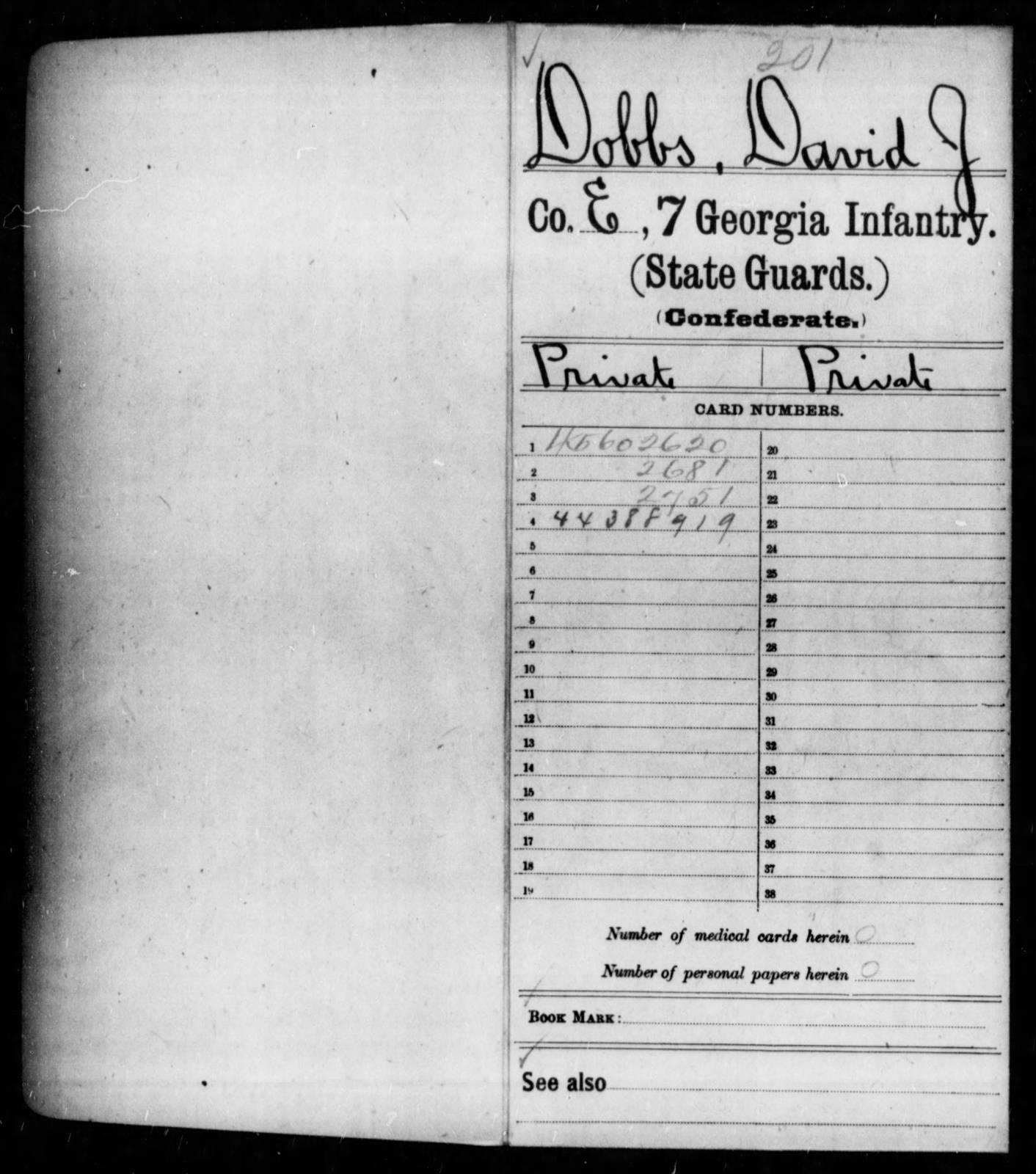
Let’s explore the unique historical documents I unearthed on fold3.com. The first image is an outer sleeve containing the cards from a transcription of the muster rolls for Company E, Seventh Georgia Infantry Regiment. This regiment, distinctively known as the State Guards, should not be mistaken for the Seventh Infantry Regiment of the Georgia State Militia. Each card represents a soldier, and these muster rolls offer unique insights into the composition and activities of the regiment during the Civil War.
This second card provides a lot of information. In addition to his name and rank, we are told that he is in company D and that the commanding officer is Captain Grambling. It then sets the boundaries for where this unit will operate, which is essentially in Northwest Georgia from the North Carolina/Tennessee line down to the Chattahoochee River in Cobb County and further to the City of Atlanta.
This tells us that his six-month enrollment began on August 1, 1863, in Cobb County, Georgia, and that he was absent from August 1st until August 8.
There is some additional information that explains that Company D subsequently became Company E, 7th Regiment Georgia State Guards, and that it was formed about September 1863 as the consolidation of two battalions, Lester’s Battalion and Neely’s Battalion.
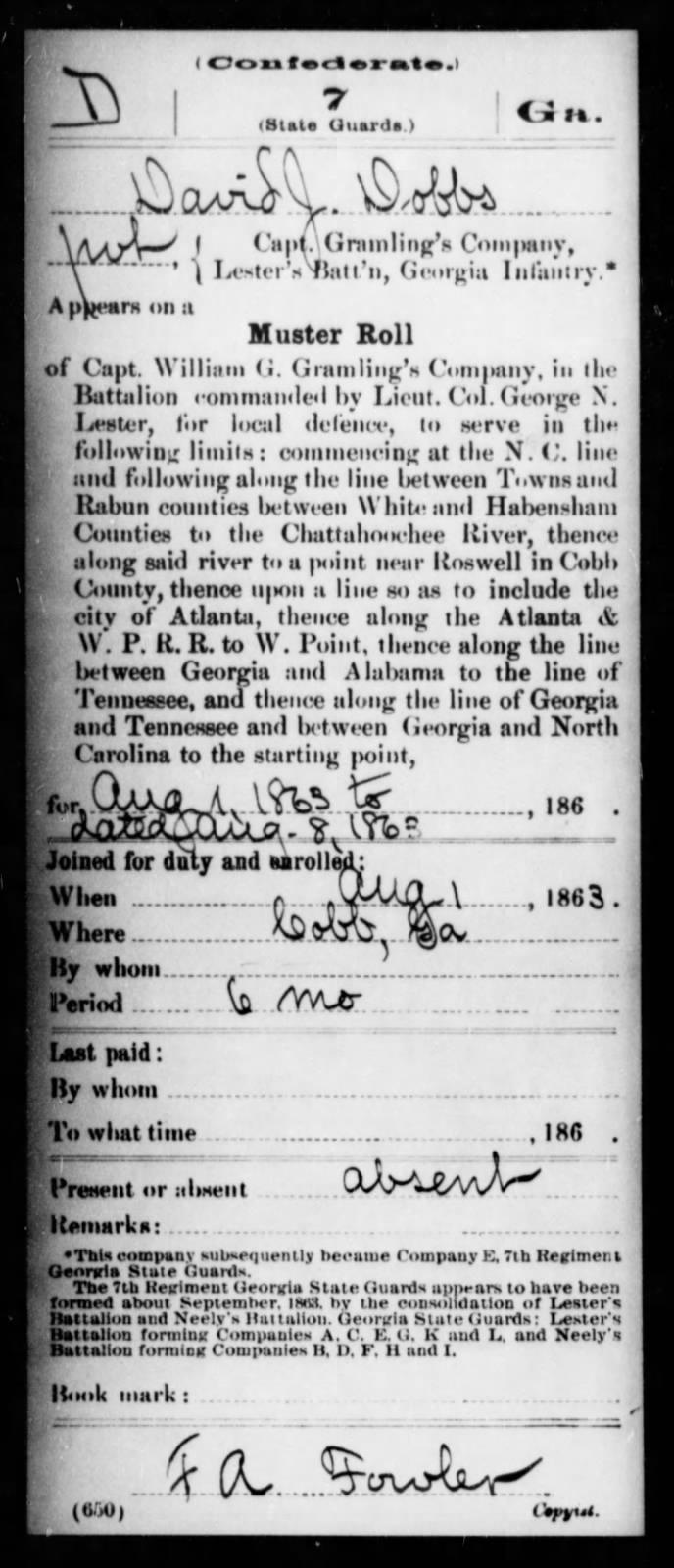
Image #3 notes that it is now Company E and that the period covered by this muster roll is for November and December 1863. It notes that he was enrolled August 1, 1863, in Cobb County Georgia by Captain WG Grambling for a period of 6 months. it indicates that he was last paid money due on September 5, 1863, but does not say what the amount was. It also notes that from the roster “present” or “absent” was not stated.
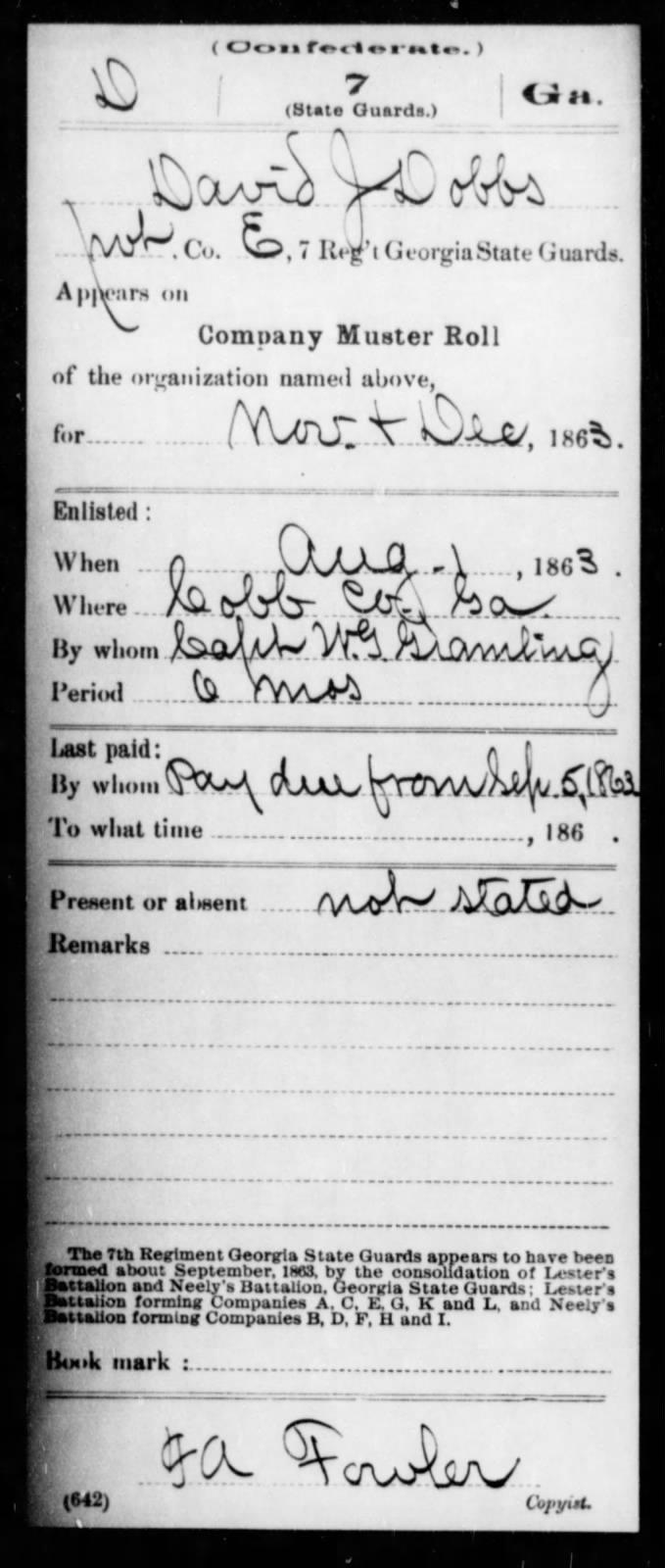
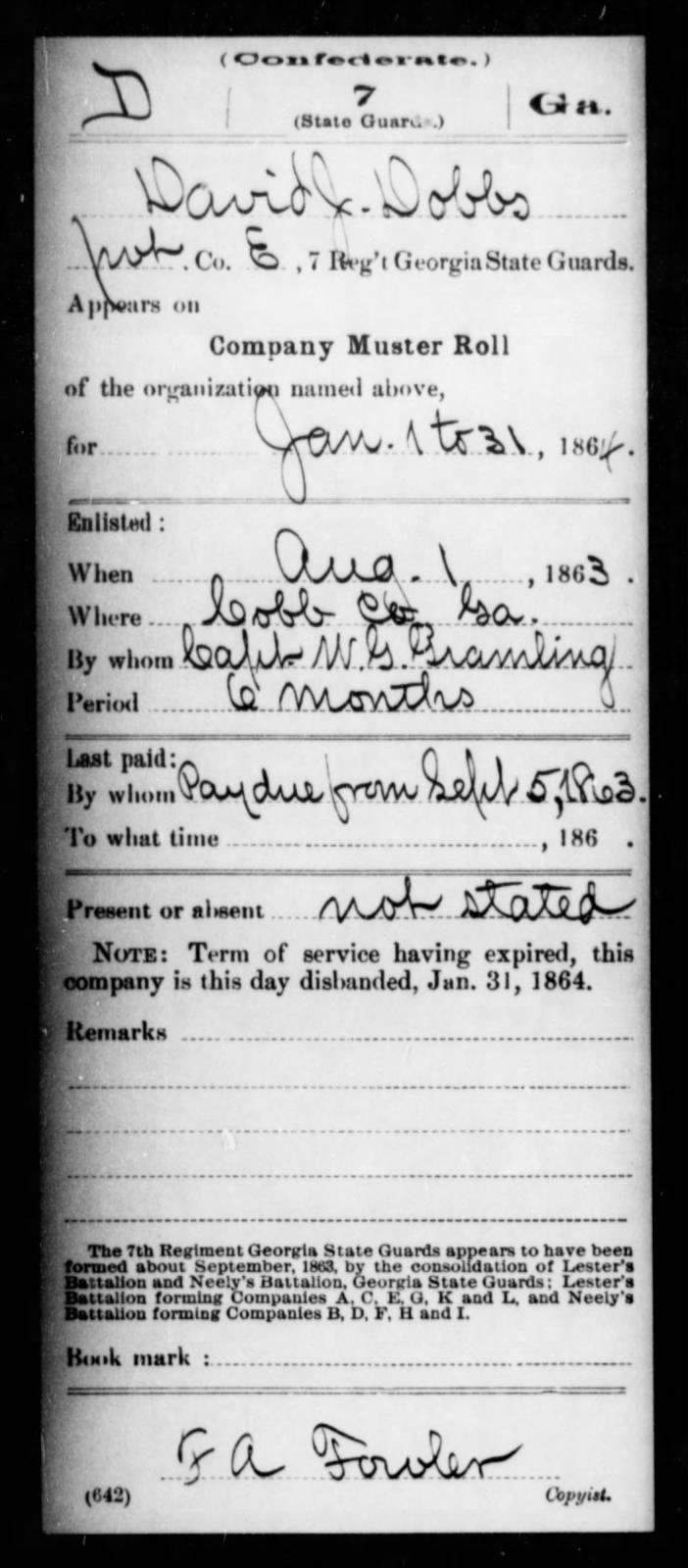
Image #4 covers the period January 1 to 31 1864, and it repeats information regarding David’s enlistment. It also repeats information regarding payment, and “presence or absence” is not stated on the roster form.
There is an important note on this card stating that “Term of service having expired, this company in this day disbanded January 31, 1864.” Given that, it is unclear what transpired between the end of January 1864 and the date shown on the fifth and final card.
Not long after Sherman’s Army invaded Georgia from Tennessee, and Marietta fell to Union forces, DJ and his family became refugees in South Carolina. Around 1999, I first learned about the history of my maternal grandfather’s family. Up until I first saw the 5th image from the muster rolls, I had assumed that following the death of Martha’s father, Evan, in December of 1864, the family lingered out of harm’s way in Aiken, South Carolina, before eventually making their way back to Marietta to restart their lives in post-war America.
But card #5 tells an entirely different ending to the family’s Civil War adventure. We are first informed that the Seventh Infantry Regiment had been reduced to just one company – Company A. Then, about six weeks after Lee’s surrender at Appomattox, DJ Dobbs was taken prisoner by the Union Army at Greenville, South Carolina.
DJ was paroled a few weeks later in Georgia.
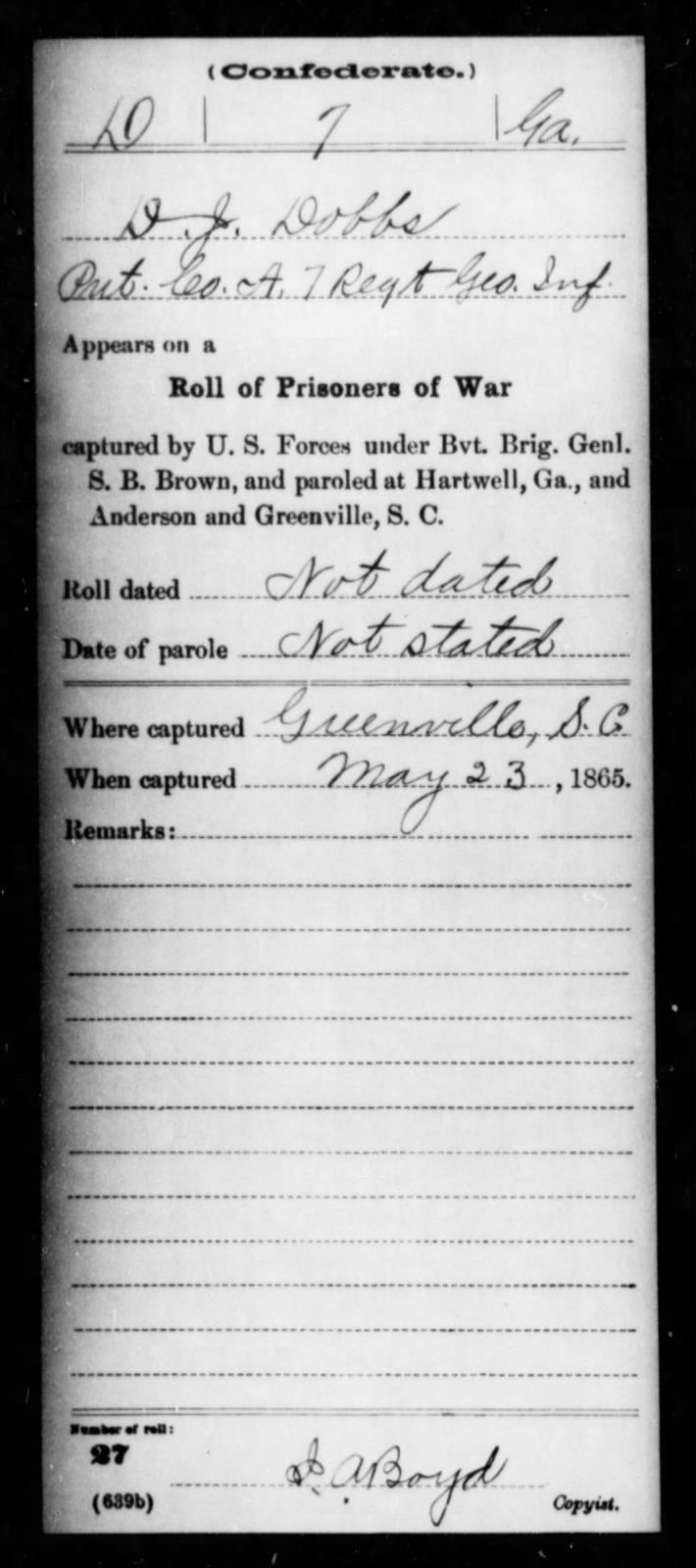
I have confirmed through other sources that there was Union activity in Greenville, South Carolina, on May 23, 1865. There was one news report that stated that the day before, two Confederate soldiers were executed by Federal forces outside of Greenville.
The big mystery I would like to solve is what life was like for the Dobbs family upon returning to their plantation after the war. I know that D J Dobbs was active in politics and that he and other men in the community wanted to revive the old Georgia Military Institute, which they refer to as having been “destroyed by a horde of Yankee soldiers.” In 1868, the first year of a presidential election after the Civil War, DJ Dobbs was a delegate to the Democratic Party’s state convention as a representative from Cobb County. In the early 1870s, he was a delegate to the Baptist convention held in the state capital of Milledgeville.
DJ Dobbs died on 18 July 1877 at the age of 42. It is unknown how he died. I have yet to find a newspaper or notice of his death and the state of Georgia, along with other states, did not institute death certificates until after WWI.
For more details on the fate of Col. David J. Dobbs, see Diving into Historical Context and The Third Man
 Gathering Leaves
2 thoughts on “The Fate of Col. David J Dobbs (May 1865)”