Here is a look at my Puritan ancestors who lived in Salem, Massachusetts, during the time of the Witch Trials in the 1690s. This is also the story of a family that owned and occupied the same house for ten successive generations.
Introduction
Years ago, when I embarked on my journey to research my family history, I encountered a branch about which I had very little information. All I knew was the scant knowledge my father had shared about his paternal grandmother. He could only recall her first name, Della, and he said her last name was Gaum, but he spelled it GUAM. Interestingly, this spelling mistake turned out to be significant in a way that he never knew. In addition, he mentioned her origin in Ohio, her French descent, and described her as a “French peasant woman,” based on what he had heard from his mother.
Following my father’s passing, I decided to delve deeper into the history of our ancestor, Della Gaume. My focus was on locating her in the 1870 and 1880 census records for Ohio. While perusing these records at the National Archives in Laguna Niguel, I stumbled upon Adeline Gome, born in 1867, the daughter of Louis Gome in Stark County, Ohio. In my enthusiasm, I mistakenly assumed that Adeline Gome was our Della Gaume.
Roughly a decade later, I published my findings on my website, and it was not long before my dad’s cousin, Rita, discovered my error. She reached out to point out the mistake, clarifying that our Della had been with her grandmother in Stark County, Ohio in 1870. The 1870 U.S. Census for Stark County, Ohio, listed Delah Gum, a two-year-old, residing with her grandmother, Eliza Gum, while the 1880 U.S. Census indicated Delly Gaum, aged twelve, living with her grandmother, Elise Gaum.
In light of this revelation, I contacted the National Archives and Records Administration (NARA) and requested military service records for my great-great-grandfather, which unveiled that Della’s father, Frank Gaume had married her mother, Della Pickering, in Wisconsin, around November 1868. However, this date’s accuracy is uncertain, as it relies on the claim that Della passed away eight months after their wedding. Notably, an affidavit from March 26, 1915, signed by Frank Gaume, stated that he and his first wife were married in June 1868. This discrepancy was further complicated by affidavits from three other individuals, including Frank Gaume’s sister, Mrs. Mary Saunier from St. Marys, Kansas, all asserting that Della Pickering died in June 1868 and was buried at the “Catholic Cemetery at Louisville, Ohio.”
In these documents, the name Della Pickering remained consistent. However, three of these affidavits contradicted Frank Gaume’s claim that he married his first wife in June 1868 and that Della (Pickering) Gaume passed away on June 2, 1869. An affidavit from Joseph Blanchet, Frank’s brother-in-law from Holmes County, Ohio, in 1917, confirmed Della Pickering’s death in June 1868 and burial in Louisville, Ohio. Another affidavit by Mary Saunier, originally Mary Gaume of Louisville, Ohio, filed in St. Marys, Kansas the same year, concurred with Della Pickering’s demise in 1868 and her burial in the “Catholic Cemetery at Louisville, Ohio.” A third affidavit from 1917, signed by Katie Bakule, a childhood friend of Frank’s second wife, Justine Blanchet, and an Ohio resident, corroborated Della Pickering’s death in June 1868 and burial in the Catholic cemetery in Louisville.
The reason behind all this paperwork? The government agency responsible for Veterans Affairs was questioning Frank’s marriage to his second wife, due to their age differences and the absence of ample evidence that they were in fact married despite their having seven children between them.
I also explored burial records from the public library of Stark County, revealing that my great-great-grandmother was not interred at St. Louis Cemetery, the only Roman Catholic cemetery in Louisville. In May 1868, Frank’s daughter, Della Gaume, was born in Canton, Stark County, Ohio. Delia Pickering’s death in Louisville, Ohio, was recorded as occurring one month later, on June 2, 1868, according to the service records. The U.S. Census of 1900 and 1910 showed that Della (Gaume) DeBacker’s mother was born in Pennsylvania.
A decade later, Cousin Rita made an intriguing discovery. She found a book published in 1884, housed in the LDS library in Salt Lake City, titled “Centennial History of Susquehanna County, Pennsylvania” by Rhamanthus M. Stocker. According to this source, our ancestor, Della (Cordelia or Cordilla) Pickering, was the daughter of Corbett Pickering from Gibson, Susquehanna County, Pennsylvania. The book mentioned her marriage to a “Frank Guam” and her death in Michigan. (Note: the name is misspelled GUAM)
The information from the book was partially confirmed by census records. Corbet Pickering’s daughter appeared as “Cordelia,” aged 10, in the 1850 census for Gibson, Susquehanna County, Pennsylvania, and as an 18-year-old in the 1860 census.
For a long time, this was the extent of our knowledge. However, my skepticism persisted. I kept separate databases to trace Cordelia’s genealogy, including a branch leading back to Charlemagne and branch to leading to a man named John Pickering of Salem, Massachusetts.
Around 2020, when I received my DNA results from Ancestry.com, the first thing I did was turn to the ThruLines section to assess my connection to Della Pickering and her presumed father, Corbett. ThruLines, generated exclusively by Ancestry, link individuals through publicly available family trees, allowing data comparison as if it were in the same database. Notably, these connections depend on documented research. Although more DNA matches are likely to exist, they are partially hidden due to the absence of public linked trees.
Examining the ThruLines results for Corbett Pickering dispelled any remaining doubts. It showed close cousins, descendants of my great-grandmother, Della Gaume, and her mother, as well as individuals claiming descent from Corbett’s siblings. Beyond the 11 DNA matches listed under Cordelia Pickering, who we identified as Della Gaume’s mother, the report added 13 more DNA matches through her father, Corbett.
Going back one more generation to Della Gaume’s great-grandfather, the report unveiled ten 5th cousins, with our most recent common ancestor being my 4th great-grandfather, Jotham Pickering.
These DNA results were significant, as our sole connection to the Pickering family of Pennsylvania had initially relied on a single line of text in an obscure, locally-focused book from the late 19th century. Fortunately, today, the book is accessible and searchable through Google Books, while a couple of decades ago, accessing it required a visit to an out-of-state library.
Thanks to Google Books, I gained access to even more information about the Pickering family in Pennsylvania. As mentioned earlier, the Pickering family of Corbett Pickering had moved to Pennsylvania from Massachusetts. Jotham Pickering, a Revolutionary War veteran, was born in Mendon, Massachusetts, and his grandfather, Edward, hailed from Salem. This journey ultimately led me to Edward’s grandfather, John Pickering of Salem.
First Generation
In my quest to uncover the history of my immigrant ancestor, John Pickering, I came across two volumes that shed more light on the Pickering’s, a family that occupied the same house in Salem, Massachusetts for ten consecutive generations until the 1920s. My ancestors were part of the first three generations before they moved to Mendon.
The first book I stumbled upon was titled “The Life of John Pickering.” Initially, my excitement waned when I realized it was about a later John Pickering. However, Mary Orne Pickering’s introduction to the book did offer valuable information about our immigrant ancestor, John Pickering. She recounted that among Salem’s early settlers was John Pickering, who was born in England, around 1615. It had been a family tradition that he hailed from Yorkshire, though there is no written evidence to confirm this claim.
The name Pickering had historical connections to England, particularly in the vicinity of Scarborough and Whitby. The earliest documented information about our English ancestry was found in Salem Town records. On February 7, 1636, the entry mentions John Pickering, carpenter, being granted “inhabitant status.” Two years later, the town fathers contracted him to build a meeting house.
The author noted, “Few facts connected with his private history remain,” but she did mention that John Pickering built the Pickering mansion in 1651. Remarkably, this house, which was still standing in 1887, remains a historical site in Salem today. However, it was sold in the 1920s and is currently owned by the Pickering Foundation. A park now encompasses the area, and the Pickering House, open to the public, remains a prominent feature within walking distance of Salem Witch Museum and the House of the Seven Gables.
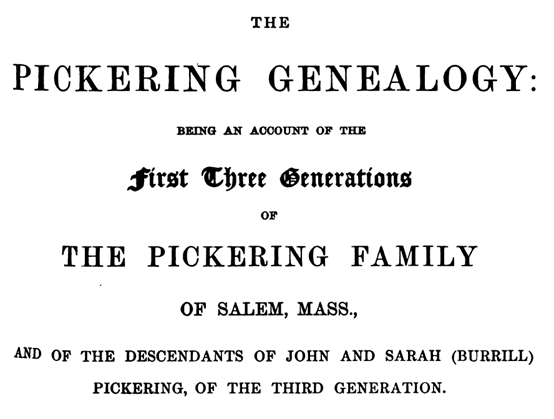
The second book I discovered, titled “Pickering Genealogy,” delves deeper into the first three generations of the Pickering family in Salem, Massachusetts. The book begins with a disclaimer, stating that no connection between any family of Pickering’s in England and John Pickering of Salem has been established, as no dedicated effort has been made to establish such a connection. Nevertheless, the statistical evidence suggests that John Pickering probably hailed from Yorkshire, England.
The book contains sections on the Pickering coat of arms, both in England and America, along with information about other settlers with the Pickering name. While the book covers ten generations of Pickering’s, I focused on the first three generations relevant to my research.
In the first generation, John Pickering is identified as the founder of the Pickering family in Salem. He was reportedly born in England in 1615, as per a record found in the family Bible of his grandson, John Pickering. Tradition suggests he hailed from Yorkshire, England, but this is not definitively confirmed. John lived in Ipswich, Massachusetts, between 1634 and 1637 before moving to Salem, as documented in the Salem Town records. He was granted inhabitant status in Salem in early 1637.
While he was fined for fencing off land without authorization, it is still unclear if the fine was ever collected. He lived from the 1630s until the late 1650s, predating the Salem Witch trials by approximately 30 years.
John Pickering was awarded a contract to maintain a bridge, but complications arose, and he faced fines for defects in the bridge’s construction, along with the threat of having his belongings (a bull and a cow) seized if he didn’t comply.
Following this incident, an extract from the memoranda book of Colonel Timothy Pickering suggests that John Pickering contemplated moving to Connecticut to establish a plantation but abandoned the idea after returning with frostbitten legs. This forced him to live as a cripple for the remainder of his life.
John Pickering’s house, partly built in 1651, was maintained by his descendants. The Pickering house, still standing today, became John Pickering’s home until his death around 1657.
The book notes the presence of chimney back plates, with one of them still in the dining room’s fireplace as of the 1890s. The Pickering House, at that time, was already 243 years old and continued to be owned by a branch of the Pickering family until the 1920s. Notably, it emphasizes that John Pickering’s early death in 1657 at the age of approximately 40 was likely hastened by injuries sustained during his journey to Connecticut. His will was dated July 30, 1655.
John divided his estate between his two sons. The elder son, my ancestor, stayed in the main house, while the younger son and his mother, Elizabeth, who later remarried, moved to another part of the property. Elizabeth’s maiden name remains unknown, and there is no definitive date or location for their marriage. The Bible of their grandson, John Pickering, suggests a marriage date of 1636, likely occurring in America.
Only four children are documented: two sons, John and Jonathan, and two daughters, both named Elizabeth, who were baptized shortly before their deaths. As they were married for twenty years, it is likely that there were other children who did not survive.
In the second book it states, we do not know whether John Pickering was a church member or not. And from the fact that we do not find that he took the Freeman’s Oath, or did he ever held public office, we infer that he was not.
Some suggest that Elizabeth’s maiden name might have been Alderman, as John Alderman of Salem bequeathed her an item in his will in 1657. John Alderman had lived in Dorchester in 1634 and later moved to Salem, where he made bequests to Elizabeth’s sons, John, and Jonathan. This has led to speculation that John Alderman may have been Elizabeth’s father, potentially making her maiden name Elizabeth Alderman.
Second Generation
John Pickering, the eldest son of John and Elizabeth Pickering, was born and died in Salem. He was a farmer who resided there. In 1684, Lieutenant John Pickering and his wife were admitted to membership in the First Church of Salem, and he gained full communion on April 1, 1694. Through inheritance and purchase from other heirs, he acquired the family mansion, where he continued to live, and eventually passed it down to his son, also named John. This first John Pickering, whom we’ll refer to as the original ancestor, had a son named John as well.
According to the “Annals of Salem” by Joseph B. Felt, the second John Pickering was well-known for his involvement in public affairs. His continuous services demonstrated his competence, enterprise, and public spirit. He lived during the Salem Witch trials from 1692 to 1693 and passed away the year following the trials’ conclusion. He served as a selectman for Salem town multiple times, held the position of constable in 1664, and was among those appointed to run the stage line between Salem and Lynn in 1669. He was also responsible for collecting subscription money in Salem for the support of Harvard College.
However, his prominence was most notable in military affairs. In 1675, he was appointed Ensign of the Salem militia and later received a higher rank as Lieutenant. He served in this capacity during the Indian War of 1675 and was present at the fight at Bloody Brook near Deerfield after the defeat of Captain Lathrop on September 18, 1675. Lieutenant Pickering, along with Perez Savage, led the troops and distinguished themselves for their skill and determination.
In 1664, Lieutenant Pickering was involved in a legal dispute with the owners of the “New Mill” on the South River due to his ownership of land adjacent to the river. The conflict revolved around the damming of the river, hindering access to Pickering’s land. The lawsuit concluded with a judgment in favor of the defendants.
Lieutenant Pickering was a legatee under the will of John Alderman of Salem in 1657, just like his mother and his brother John. The bequest to him consisted of specific items, including a table, two stools, a cloak, cloth breeches, worst stockings, and 2 pounds of barley.
Though the exact day and month of his birth are not known, the family Bible of his son John records his birth year as 1637, which matches the age inscribed on his gravestone. He was buried in the 57th year of his age on May 5, 1694. His gravestone, along with others from the family, was initially located on what is now called the Broad Street Burying Ground. Later, these gravestones and remains were relocated when the hill where they stood was excavated. This hill was previously known as Pickering Hill and was opposite the present Pickering estate.
Lieutenant Pickering appears to have prospered and expanded his landholdings, leaving a substantial estate to his family. His will, dated May 3, 1694, named him as a “John senior of Salem.” He bequeathed land to his sons Benjamin and William, specifically granting Benjamin a piece of marsh at Forest River. His will also reveals that he owned at least one slave, a girl named Maria, who was left to his wife, Alice.

Regarding Alice Pickering, previously Alice Flint, the book states that the records of the First Church of Salem indicate that she was admitted to the church in 1684. It was later discovered that she had married Henry Bullock, Jr., of Salem as her first husband, with whom she had two children.
Furthermore, Alice Flint had been mentioned in court records for violating a law against excessive dress in 1652. Despite being presented for wearing a silk hood, she was excused due to her declared worth of £200. Some confusion arises about whether this Alice Flint was William Flint’s daughter, as she would have been quite young in 1652. It is more likely that she was confused with her mother, also named Alice Flint, who was the one with the substantial assets. William Flint, her husband, was considered a prosperous man. In 1661, he was about 58 years old and held various town offices, including overseer of fences, surveyor of the Southfield fences, perambulator of the Lynn line, and more. He died on April 2, 1673, and his estate was equitably divided among the heirs in 1695-96 after a delay due to disputes raised by his daughters.
Third Generation
My ancestor, Benjamin Pickering, belonged to the third generation and was the son of Lieutenant John Pickering. Some genealogies list his name as Benjamin William Pickering, which is unusual for two reasons. First, it’s remarkable because no one else in the family seems to have had a middle name, and it wasn’t customary for Protestants of that time to give their children middle names. The Puritans, in particular, were known for their aversion to excess. Benjamin had a younger brother, William, who was very close to him.
Benjamin was born in Salem on January 15, 1665/66, and he passed away before November 6, 1718. He was a “mariner” by occupation and resided in Salem. According to the book, “It is probable that Benjamin Pickering was trained in the shipwright trade, but he was mainly engaged in maritime pursuits, working as a shipmaster, perhaps starting in 1702.”
On June 22 of that year, he conveyed land to his brother William. In this deed, he was referred to as “Yeoman Alias Shipwright.” In deeds from 1695 and 1696, he was called a “Mariner,” and in 1698, he was termed “Shipwright or Mariner.” In 1701, he entered into an agreement with his brother William to divide the property they inherited from their father. As per this agreement, he was to have the western part of the house with one of the ovens, half of the cellar, the eastern part of the Great barn, one-third of the north lean-to, and all the land to the westward. This document labeled him as a “yeoman or Shipwright.”
According to the book, it is evident that he took part in the Indian War as of July 24, 1676, when four pounds and ten shillings were credited to Benjamin Pickering for military service at the Brookfield garrison. I wonder if this is not a case of mistaken identity because in 1676 Benjamin would have been ten years old.
The book notes that “Benjamin Pickering has more descendants bearing the name Pickering than any of his brothers.” It lists his seven children, including my ancestor, Edward Pickering.
According to the book, Edward Pickering was born on November 18, 1701, and he passed away in his 93rd year, which would place his death in 1794. However, this conflicts with other information that suggests he died at the age of 86 before May 1788 in Bedford, Massachusetts. He married Hannah Gowing of Lynn on March 12, 1724. It’s noted that Hannah’s maiden name was Bancroft, and she had been previously married to a Gowing or Goeing.
Jane Hobby was the wife of Benjamin Pickering, and their marriage took place on April 27, 1693. She is said to have originally come from Plymouth, England. She outlived her husband by 32 years.
Later Generations
The book provides detailed information on ten generations of Pickerings, but my direct lineage extends only up to the third generation. My ancestor, Benjamin’s son, Edward Pickering, serves as my sixth great-grandfather. He was born in November 1701 in Salem and died in Mendon, Massachusetts. In 1724, he married Hannah Bancroft in Lynn, Massachusetts, and shortly after that, he relocated from Salem to Mendon, a town in then in the frontier of Western Massachusetts.
Edward Pickering’s son, and my ancestor, was Jonathan Pickering. He resided in Mendon, Massachusetts, from 1736 to 1832. On February 28, 1760, he married Elizabeth Hunt in Mendon, Massachusetts, and together, they had five children. Jonathan lived a long life, passing away in April 1832 at the age of 96, resting in peace in Massachusetts.
Jotham Pickering, the son of Jonathan and my ancestor, my fourth great-grandfather, was born around 1761 in Massachusetts. He eventually made his home in Gibson Hill, Susquehanna County, Pennsylvania, where he sadly passed away around 1809. Jotham is known to have been a veteran of the Revolutionary War, serving in Fishkill, New York.
Jotham and his spouse had several children, one of whom was my third great-grandfather, Corbett Pickering.
 Gathering Leaves
Hi there, so it appears we are related. Cordelia and my ancestor Eveline Pickering were sisters.
I’d love to connect and find out more and share what I know. I’m still delving into the genealogy files my dad left me.
LikeLike
I am a Descendent of Corbet Pickering of So. Gibson. Corbett is my 4x great grandfather. My Pickering line goes from Corbett to his son, Henry Jonathan, to his daughter Jennie Mae to her son Charles Christian Haas, to my father, William Karl.
LikeLike
Hello Biil,
As Corbett Pickering was my third great grandfather that would make us “third cousins 1X removed.”
Just curious, did your Pickering branch move to Wisconsin after the Civil War or remain in Pennsylvania for yime longer?
LikeLike
Dear D.M: Henry Jonathan married Elizabeth Ashton Wilson in N.E Pennsylvania (not far from So. Gibson) In 1872. This was his second marriage, first one was to Charity Cross shortly after he returned from the Civil War, Charity gave birth to two children and she died in 1871. Elizabeth and Henry had a child, Jennie Mae in 1874. In abt June 1876, Henry took a trip West, supposedly to look for a place for them to move to in California. He got as far as the Black Hills of Dakota Territory and spent several months Gold prospecting in the Deadwood area. He returned to So. Gibson that October. During that winter he apparently touted the opportunities in the Deadwood area to others. About February 1877, Henry, Elizabeth, baby Jennie Mae and a group of other local people left On the train for the Black Hills. They departed the train at a station along the Platte River trail in Nebraska (I believe this was at Kearney.) according to my grandfather’s writing, they spent 10-14 days organizing a wagon train and purchasing livestock and supplies. It appears others join the group and when they left there on their wagons, the group consisted of 22 wagons, 101 men, 2 women and one child (2 year old Jennie Mae). I believe that Henry’s cousin Emory Jonathan Pickering, also from So. Gibson) was with them as I have proof that he was in Deadwood in June of 1877. They arrived in the Deadwood area on April 17, 1877. I believe Henry and Emory area the only Pickering who went to the Dakota’s. Regards, Bill Haas Regard
LikeLike
Bill,
Great story! Thank you for sharing.
LikeLike
A connection to Charity Cross and Henry Jonathan Pickering:
My husband’s great grandmother was Lilian Hope Pickering, the first child born to Charity and Henry. Charity died in childbirth with second child, her son, Julian Pickering.
LikeLiked by 1 person
I suspect I may be a descendant of Sarah Pickering
LikeLiked by 1 person