When I started exploring my family history nearly 45 years ago, I never imagined that someday I might find a werewolf in my family tree… but here we are! And it does seem appropriate that I would make this discovery in the dog days of August because according to the commercials I keep hearing on the radio, Halloween is just around the corner.
Building upon the content of my preceding blog entries, I am delving into the lineage of my sixth great grandfather, Louis de Wadripont, an ancestor on my father’s side. Thus far, my investigations have unearthed some intriguing findings. Tracing back to the 11th century, I have unearthed a few men who embarked on journeys to Palestine during the Crusades, and you can read about the crusading knights I did discover in my previous posts (“Noblesse Oblige” and “The House of Bethune“).
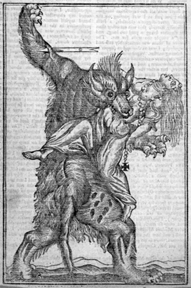
The focus of this post centers on a particular branch within Louis’ family tree, specifically that of his thirteenth great grandmother, Adelaide de Saint-Pol (1130-1175). She was the wife of Robert V de Bethune, seigneur de Bethune, de Richebourg, de Warneston & de Choques, and advocate of Arras.
Adelaide’s father, it appears, was a man of severe malevolence – a very bad man. We are talking awful on a scale of Osama bin Laden-awful. Multiple sources indicate that Adelaide’s father, Hugh III of Campdavaine (?-1141), was responsible for the deaths of nearly 3000 individuals, including men, women, and children. Historical accounts reveal that his heinous acts led to his excommunication by the Pope due to his crimes against humanity. According to legends, his punishment in the afterlife was both unusual and eerie.
Hugues III de Campdavaine , also known as Hugues de Camp d’Avesnes, held the title of Count of Saint-Pol from 1130 to 1141. Several sources, including a Wikipedia article in French, detail Hugues III as the son of Hugues II and Elisende de Ponthieu. For reasons shrouded in obscurity, Hugues engaged in a devastating conflict with the Collet family, forcing them to seek refuge in the Abbey of Saint-Riquier, situated near the town of Abbeville. The fortified location was besieged, and on August 28, 1131, Hugues orchestrated an assault that resulted in the destruction of the abbey using Greek Fire, a medieval variant of napalm. This conflagration claimed the lives of every individual within, regardless of age or gender.
François César Louandre’s “Histoire ancienne et moderne d’Abbeville et de son arrondissement” (1834) vividly recounts this act of savage cruelty:
“In 1131, Hugues de Camp d’Avesnes, Count of Saint Pol, came to besiege Saint Riquier, where the lords of Auxi and Beaurain-sur-Canche had sought sanctuary. These were his sworn adversaries whom he had vanquished in various clashes. Despite being one of the most fortified strongholds in the kingdom, Saint Riquier fell to the Count’s forces. Yet, pillaging was insufficient for Count Hugues, who employed a weapon from the East known as Greek Fire, which consisted of a combustible compound emitted by a flame-throwing weapon, to engulf the city and abbey in flames. This catastrophe claimed over 2500 lives. Those who escaped the ferocity of the fire and the victor’s blade took refuge in Abbeville, only to encounter further slaughter. In response, the Council of Reims, led by Pope Innocent II, declared Count Hugues anathema. Nevertheless, he persisted in devastating Ponthieu.”
Only when word reached him that the Pope had issued an excommunication decree did he cease his rampage. Confronted with the prohibition from receiving sacraments and even entering the Church, Hugues experienced a moment of repentance. Recognizing the enormity of his transgressions, he humbly petitioned the pontiff for the lifting of the censure he bore. The council imposed a mandate on the guilty Count: he must construct a monastery and endow it generously, thereby allowing the institution to atone for the atrocities committed at Saint Riquier. Some sources indicate he was tasked with building three monasteries. Hugh of Camp d’Avesnes indeed established at least one monastery, which was located in Pontigny.
However, Hugues’ efforts evidently fell short in purging the stain of guilt he had accumulated. Following his demise in 1141, a legend emerged surrounding Hugues and his fate in the afterlife.
Various chronicles assert that he was condemned to haunt the very places he had laid waste to for an extended duration. Legends recount that for centuries, he was seen nightly in Abbeville and throughout the Picardy region, burdened by chains and transformed into a wolf, emitting spine-chilling howls as he traversed the streets. This formidable apparition, even in the mid-19th century, continued to be known in Abbeville as the “Beast of Canteraine” (la Bête Canteraine).
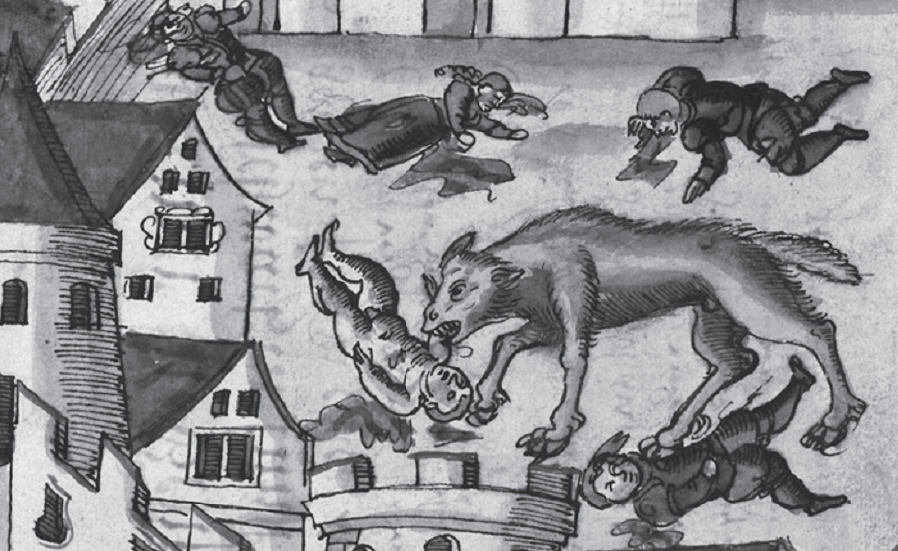
And so, we have it, my 22nd great grandfather, Hugues III of Campdavaine, Count of Saint-Pol, was what the Old French called a loup-garou and we today call a werewolf (“man-wolf”).
 Gathering Leaves
Hello! Very cool genealogical find! By any chance would you know the names of the Chronicles that talk about the ghostly wolf aspect of the story?
LikeLike
The book listed in the French Wikipedia article, François César Louandre’s “Histoire ancienne et moderne d’Abbeville et de son arrondissement” (1834), refers to its source only as “les chroniques,” but never provides a full name. There is a footnote in the introduction that reads: “Here are the titles of these works which have not been available for sale for a long time: 1) Ecclesiastical history of the town of Abbeville and the Archdiocese of Ponthieu 1646 in 4th. 2) Genealogical history of the counts of Ponthieu and mayors of Abbeville 1657 in folio”
LikeLiked by 1 person
Thank you very much! I was able to find a copy of Louandre’s book on the Internet Archive!
https://archive.org/details/histoireancienn01louagoog/mode/2up
LikeLike