In an earlier post, I connected my ancestor, Louis de Waudripont, with a minor noble family called the House of Waudripont. Connecting with one branch of nobility often leads to finding more of them. Digging deeper, I uncovered a few new branches containing half-dozen Crusaders and one family line that goes back to Charlemagne. This post focuses on the lineage of Mahaut de Bethune, an 11th great-grandmother of Louis and a 19th great-grandmother on my father’s side.
Mahaut, also known as Mathilde de Bethune, was married to Baldwin IV de Comines. In this exploration, I will trace her paternal lineage from the eldest ancestor downwards. Along this journey, we will take a few side trips into a couple of maternal branches.
Information regarding the House of Bethune comes from Dictionnaire de la noblesse (1771) by François-Alexandre Aubert de La Chesnaye Des Bois as found at Google Books.
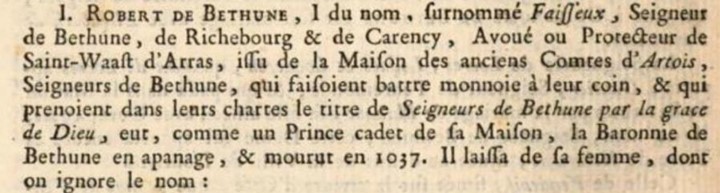
Mahaut’s fifth great grandfather, Robert I de Béthune, nicknamed “Faisseux” (Beam?), was Lord of Bethune, Richebourg, and Carency. He also was an Advocate for the Abbey of Saint Waast of Arras. He died in 1037. He had children by his wife, whose name we do not know. He is believed to be of the House of Artois.
According to the French language Wikipedia, Béthune is a French commune located in the department of Pas-de-Calais in the Hauts-de-France region near France’s border with Belgium. The lords of Béthune were hereditary attorneys of Saint-Vaast d’Arras; this earned them the qualification of Advocates of Béthune. In 970, we find the first mention of the castle at Bethune. From the 11th century, the lords of Béthune had the same role in the castellany of Béthune as the other Flemish castellans. They seem to have possessed the seigneuries of Warneton and Cassel early. The first attorney of Béthune quoted is Robert Faissieux, at the end of the 10th century and the beginning of the 11th century. He owned half of the seigneury of Richebourg (north-east of Béthune)
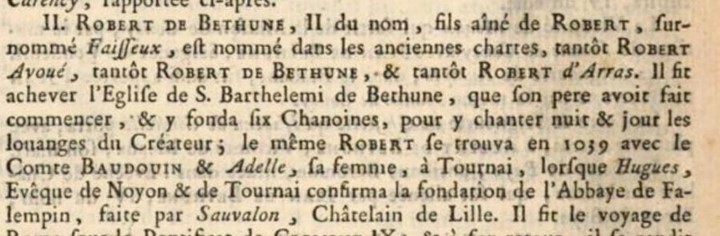
Robert II de Béthune, the eldest son bearing the name Robert, was also known as Faisseux (?) and appeared in historical records under various titles, such as Robert Avoué, Robert de Béthune, and Robert d’Arras. He undertook finishing the Church of Saint Barthélemy in Bethune, a project initiated by his father. He established a community of Canons who would sing praises to the Creator, day and night. Around 1039, Robert found himself in the company of Count Baudouin and his wife Adelle in Tournai. During this time, Hugues, the Bishop of Noyon and Tournai, validated the foundation of the Abbey of Falempin, which Sauvalon, Châtelain de Lille, had established.
Robert’s travels led him to Rome during the pontificate of Clement II. Upon his return, he became associated with the court of Baudouin, the Count of Flanders, and accompanied him on various occasions. Following the demise of the Count, Robert aligned himself with the Countess of Flanders against Robert le Frison, who had seized control over the territories of Flanders and Artois. Some historians suggest that Robert II de Béthune met his fate in the battle near Cassel in 1071, where the Countess of Flanders suffered the loss of her son Arnould. However, a handwritten genealogy of the Maison de Béthune, quoted by other historians, indicates his passing in 1075.
Robert’s offspring included:
- Robert, known as “the Bald,” comes next in the lineage.
- Baudouin is mentioned as the brother of Robert the Bald in the Pan map of Saint Barthélemy de Bethune. This map records that Baudouin bestowed upon the Church a portion of the Rohot Land to establish two new Canons and two residences adjacent to the Church.
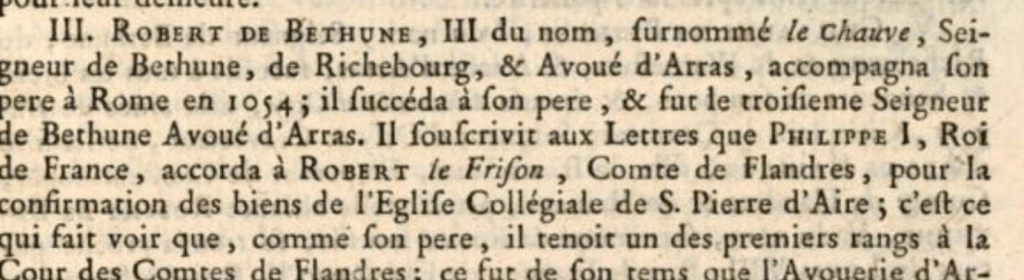
Robert III de Bethune, nicknamed the Bald, was Lord of Bethune de Richebourg & Advocate of Arras, accompanied his father to Rome in 1054; he succeeded his father & became the third Lord of Bethune Advocate of Arras. He subscribed to the Letters that Philippe I, King of France, granted to Robert the Frison, Count of Flanders, for the confirmation of the property of the Collegiate Church of St Pierre d’Aire, which shows that, like his father, he held one of the first ranks at the Court of the Counts of Flanders it was in its time that the Avouerie (advocate or lawyer) of Arras shared between the two owners was reunited at its head by the death of the Advocate Jean, who died without issue & it is since this time that this Avouerie was no longer divided & was owned by the Lords of Bethune alone. During the trip of the Count of Flanders, Godfrey of Bouillon & other Christian Princes for the Holy Land during the First Crusade, Robert the Bald stayed with the Countess of Flanders to assist her with her advice. We mark his death on October 6, around 1101, as the Martyrology of the Church of St Bartholomew de Bethune bears him. He left three sons who were:
- Robert IV, who follows.
- Adam went with Robert of Flanders to the Holy Land, where for his share of the conquests made by the Christians, he obtained the City & Barony of Bessan (Beit She’an) located in the Province of Galilee.
- Baudouin died in infancy; it is believed that he is the same man mentioned in the Martyrology of St Bartholomew on December 18, where he is called Baudouin, son of Robert Avoué.

Robert IV de Bethune, nicknamed “the Fat,” married during his father’s lifetime to an illustrious Lady named in various titles Aëlis, Aleue, Adille, Adelize, and vulgarly Alix de Peronne, of which she remained the principal heir of that House.
- Baudouin Lord of Bethune Advocate of Arras, named in two charters of the Abbey of St Eloy, which have no date & in one-third of the Abbey of St Waast of Arras in the year 1106. He died shortly after being married. The day of his death is reported in the Martyrology of the Church of St Bartholomew on April 7.
- Guillaume, who follows.
- Robert, also called the Lawyer by the name of the dignity of his House, married during his father’s lifetime, Lady named Alais, but he died without issue.
Detour #1: House of Peronne
Before continuing with Guillaume I de Bethune, let’s examine his mother’s lineage. Adelise de Peronne was the granddaughter of Robert I, Lord of Peronne.
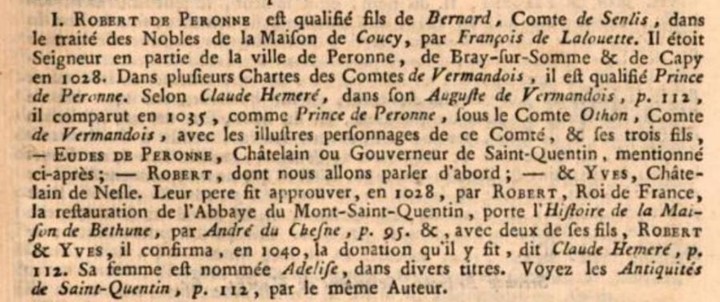
Robert I de Peronne was recorded as the son of Bernard, Comte de Senlis in The Treaty of the Nobles of the Maison de Coucy by François de Lalouette. However, other documents show him to be the son of Albert I, Count of Vermandois (see below). He was Lord in part of the city of Peronne de Bray of Somme & Capy in 1028. In several Charters of the Counts of Vermandois, he is called Prince of Peronne. According to Claude Hemeré in his Auguste de Vermandois, he appeared in 1035 as Prince of Peronne for Count Othon, Count of Vermandois, with the illustrious figures of this County & his three sons Eudes De Peronne, Châtelain or Governor of Saint Quentin. Robert, who follows & Yves Châtelain de Nesle. Their father had Robert, King of France, approve in 1028 the restoration of the Abbey of Mont Saint Quentin carries the History of the Maison de Bethune by André du Chesne p 95 & with two of his sons, Robert & Yves. He confirmed in 1040 the donation he made there, said Claude Hemeré. His wife is named Adelise (de Saint Quentin) in various titles.
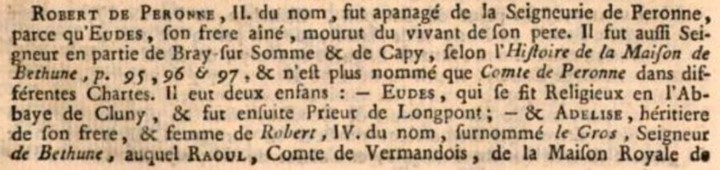
Robert II de Peronne of the name was appendaged to the Seigniory of Peronne because Eudes, his eldest brother, died during his father’s lifetime. He had two children Eudes who became a Religious in the Abbey of Cluny & Adelise, heir to his brother & wife of Robert IV, named “the Fat,” Lord of Bethune.
The Royal House of France took over the Seigniory of Peronne in 1106, but he returned it to the descendants of Eudes, brother of Adelise “Alix” de Peronne, who married Robert IV De Bethune.
But wait, there is more…
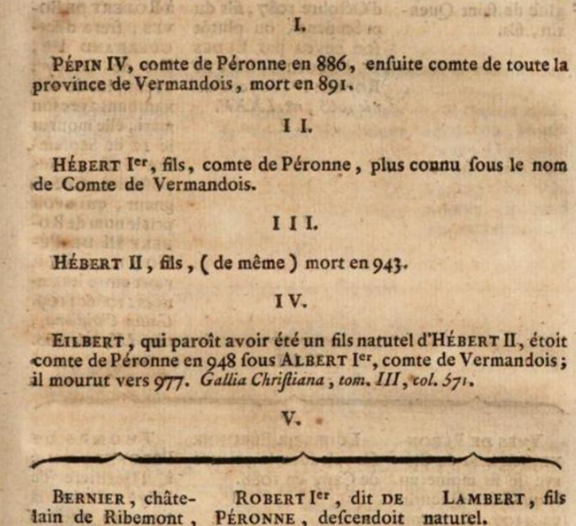
According to Mémoires pour servir à l’histoire ecclésiastique, civile et militaire de la province du Vermandois by L.P. Colliette (French, 1771-1772), Robert I de Bethune was of the House of Vermandois and son of Albert I, Count of Vermandois, making him a fifth great-grandson of Charlemagne as a descendent of the Holy Roman Emperor’s grandson, Bernard, King of Italy.
House of Bethune (cont.)
Continuing the lineage of the House of Bethune with Guillaume I De Bethune, son of Robert IV de Bethune.

Guillaume I de Bethune by the name Lord of Bethune de Richebourg & de Warneston & Advocate of Arras succeed all the goods & honors of his father and married Clemence d’Oisy eldest daughter of Hugues, Châtelain de Cambrai, Seigneur d’Oisy & Crevecœur.
One source says that Clemence d’Oisy is the granddaughter of Ade De Hainaut, daughter of Baudouin, Latin Emperor of Constantinople, Count of Flanders & Hainaut. Yet another source says that Ade De Hainaut was the sister of Baudouin, Emperor of Constantinople.

Neither of these sources appears to be true, and a third source states that Clemence was the niece of Richilde, Countess of Mons and Hainaut (c. 1018 – 15 March 1086). Richilde was a ruling countess of Hainaut from c. 1050 until 1076, in co-regency with her husband Baldwin VI of Flanders (until 1070) and then with her son Baldwin II of Hainaut who disappeared in Anatolia during the First Crusade. This Baldwin II is sometimes confused with Baldwin II, also known as Baldwin of Courtenay, who was the last Latin Emperor ruling from Constantinople.
Detour #2: House of Oisy
Clémence d’Oisy brought to Guillaume I Seigneur de Bethune several large lands & seigneuries and a coat-of-arms of silver with a crescent gules rising. She was the daughter of Hugues II, d’Oisy et de Crevecoeur.
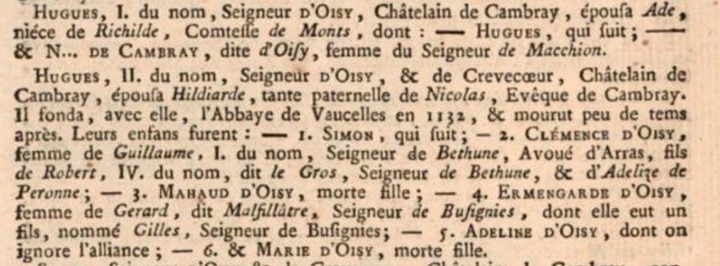
Clemence’s grandfather, Hugh I of Oisy, who died c. 1111, held the castellan (constablary) post in Cambrai. He notably defied the authority of the city’s bishops. Across the eleventh and twelfth centuries, his family had predominantly supplied the castellans for Cambrai.
Before 1076, Hugh rebelled against Bishop Lietbert, resulting in his excommunication. The Bishop’s terms for lifting the ban stipulated that Hugh must personally renounce all fiefs he held within Cambrai, a process known as “déguerpissement” in French. This custom often entailed relinquishing a symbolic representation of the fief to the initial grantor.
Throughout the episcopate of Gerard II, Hugh persisted in challenging the Bishop’s authority within the city. This rebellion gained support from King Philip I of France and the dowager Countess of Hainaut, Richilda. Their opposition to heightened imperial influence, as symbolized by the Bishop of Cambrai in the County of Flanders, led them to back Hugh’s cause with assistance from Count Robert I of Flanders, a rival of Richilda, the Bishop successfully exiled Hugh to England, a period spanning approximately from 1086 to 1090.
Clemence’s father was Hugh II d’Oisy et Crèvecœur. In 1096, Hugh attended the legendary Tournoi d’Anchin, a grand tournament that assembled three hundred knights at the Abbey of Anchin just before the outset of the First Crusade. Acting under the authority of Robert, Count of Flanders, who held dominion over his father, Hugh engaged in the first crusade alongside many relatives, vassals, and men-at-arms. Operating under Robert’s leadership, he partook in pivotal events such as the Siege of Nicaea, the Battle of Dorylaea, and the Siege of Antioch. Throughout these endeavors, his rallying cry resounded as “Oisy et Crèvecœur!” Notably, he was among the Flemish knights who valiantly scaled Jerusalem’s walls and played an active role in the Battle of Ascalon.
In 1100, Hugh entered into matrimony with Hidiarde de Baudour (or de Mons).
Subsequently, in 1116, he established a leper colony at the base of Mont Saint Géry. This initiative carried out alongside the Bishop of Cambrai, encompassed the creation of a church and cemetery dedicated to Saint Lazare and Saint Sauveur.
While harboring an underlying disagreement with Burchard, who had been the Bishop of Cambrai since 1100, concerning the governance of the castellany of Cambrai, this conflict escalated into outright warfare in 1120. In response, Hugh fortified his Crèvecœur castle and unleashed havoc upon the Bishop’s holdings. Burchard countered by capturing the Château d’Oisy. This sequence of events prompted Hugh to yield to the Bishop’s stipulations and demands.
House of Bethune (cont.)
Robert V de Bethune was the son of Guillaume I and Clemence d’Oisy.

Robert V De Bethune, nicknamed le Roux, was Seigneur de Bethune de Richebourg de Warneston & de Choques & Advocate of Arras and was one of the most renowned Lords of the House of Bethune. He was nicknamed le Roux (the red) because of his hair color. He went with the Count of Flanders, Guy de Boullion, to Palestine as part of the expedition of Philippe Auguste during the Third Crusade. He died at the famous siege of Ptolémaïde (aka Ptolemais Akko, aka Acre) in 1191. From his marriage to Adelaïde de Saint Pol, granddaughter of Hugues Comte de Saint-Pol, he had issue:
- Robert VI, named the Younger, traveled with his father to the Holy Land. He was one of the two brothers proposed in marriage by the Count of Flanders to Sibille, eldest sister of Baudouin IV, King of Jerusalem & presumptive heir of this Kingdom. Still, this marriage did not occur due to the jealousy the Prelates & Barons of the country conceived against the new French Lords who came to settle there. He died without posterity.
- Guillaume II, who follows.
- Baudouin Count of Aumale who branched out in Ecosse.
- Jean, Bishop of Cambrai & Prince of the Empire, crossed paths against the Albigensians who died in Languedoc on July 17, 1219
- Conon, Lord of Bergues, was one of the leaders of the Crusaders who conquered the Eastern Empire. In 1203 He was Governor of Constantinople & Lord of Adrianople, whose son Baudouin qualified as King. After the death of Pierre De Courtenay, Emperor of Constantinople, Conon De Bethune was appointed Regent of the Empire
- Anselme made the trip to the Holy Land and then fled to the Kingdom of Portugal & became a monk in the city of Lisbon.
- Clemence married to Baudouin, Châtelain de Bourbourg
- Mahaut married twice: first to Gautier de Bourbourg, younger son of Henri, Châtelain de Bourbourg & Béatrix de Gand, heiress of the country of Alost, and secondly to Hugues de Houdain, a knight and Lord of Choques.
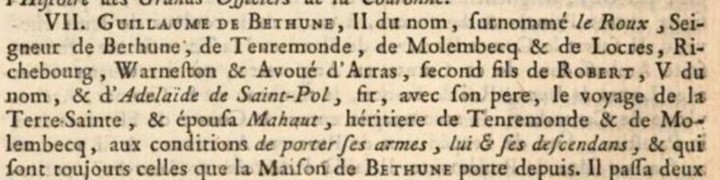
Guillaume II de Bethune, nicknamed le Roux (the red) was seigneur de Bethune, de Tenremonde, de Molembecq & de Locres, Richebourg, Warneston & Advocate of Arras. He was the second son of Robert V and Adelaide de Saint Pol. He accompanied his father on a trip to the Holy Land during the Third Crusade. He married Mahaut, heir of Tenremonde & of Molembecq. He made a second trip to the Holy Land & on his return, he died in 1213. Mahaut de Tenremonde died on April 18, 1224. They had the following issue:
- Daniel, Lord of Bethune Advocate of Arras. On his return from the Holy Land, he followed Louis of France, Count of Artois, son of Philippe Auguste, in the expedition against John of England. He died without issue in 1226.
- Robert VII sided with the Count of Flanders in a war against Philippe Auguste, king of France. He died in 1248 while traveling in the Holy Land. His body was brought to Flanders and buried at the Church of Saint Waast of Arras.
- Baudouin was named in a charter of 1194 that made a grant to the Abbey of Saint Yves de Braine and died young.
- Guillaume III was the successor to the House of Bethune.
- Jean, Count of Saint-Pol by Isabeau, Countess of Saint-Pol, his wife.
- Adelaide, Dame de Bethune, married Gaucher de Châtillon Nanteuil.
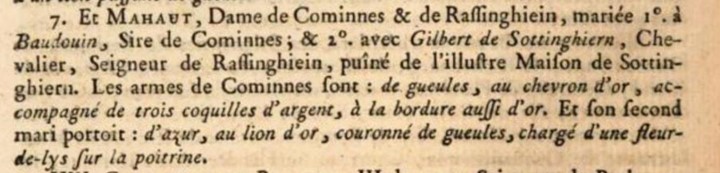
- Mahaut, Lady of Cominnes & de Raffinghiein, married first to Baudouin, sire de Cominnes & secondly with Gilbert de Sottinghiern, a knight & Lord of Raffinghiein.
This completes a review of the lineage of Mahaut de Bethune, an 11th great-grandmother of Louis de Waudripont and a 19th great-grandmother on my father’s side.


One thought on “The House of Bethune”