Two intriguing mysteries have finally been solved. For quite some time, I had been fascinated by the ancestry of two of my 18th-century Belgian forebears, Louis De Wadripont and Maria De Backer. They were not ordinary brick walls in genealogical research, and their origins remained a mystery until last night. Louis and Maria, who married in 1794, piqued my curiosity with their elusive lineages.
My first query centered around Maria, and whether she had any connection to my main line of DeBackers, particularly the branch to which her son-in-law, Judocus DeBacker, belonged. I had traced my paternal line back to Judocus’ great-grandfather, Adrianus De Backere. As for Louis, I wondered if he had any ties to the De Wadripont family, a lineage of minor nobles and knights hailing from the town of Wattripont, located about three miles south of Renaix in the historic County of Hainault. It is worth mentioning that the lords of Wattripont once held sway over Renaix, the town from whence my DeBacker family came to America.
Upon my investigation, I made a significant discovery about Maria’s ancestry. Her daughter Joanna Catharina and Joanna’s spouse, Judocus De Backer, turned out to be fourth cousins once removed, as they shared a common ancestor named Jan De Backere, who lived during the latter part of the 16th century. Further research on geneanet.org allowed me to extend the DeBacker line back three generations from Adrianus De Backere (1623-1694) to his father Adrianus (abt 1598-abt 1671), his grandparents, Merten De Backere (abt 1570-1632) & Joanna Stevens (d. bet 1610/1619), and finally, to his great-grandfather, Jan De Backere (b. abt 1540). Interestingly, Maria descended from Jan’s other son, Willem (b. 1570).
Before settling in Ronse, my DeBacker ancestors resided in the town of Massemen, situated in the Belgian province of East Flanders and a sub-municipality of Wetteren (This is a connection that I plan to explore further).
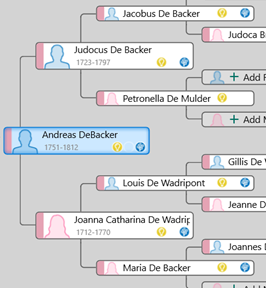
Louis De Wattripont (1681-1743) was born and died in the town of Ronse. Thanks to the efforts of fellow researchers, I was able to connect Louis to line of nobles who held the surname “de Waudripont,” going back six generations to Arnould De Wattripont, squire and lord of Wattripont.
There are some mistakes in the information I examined. For example, an 1882 book published by the Historical Society of Tournai that lists the Lords de Wadripont, mistakenly conflates the Pierre de Wadripont who died in 1390 with his grandson Pierre who died in 1447. Also, there are minor issues with dates for some events. Here is what I can piece together regarding the De Wattripont lineage of Arnould De Wattripont starting with Arnould’s 5th great-grandfather, Guy de Waudripont. According to the Historical Society of Tournai, Guy De Watt Tu Pont, the first known of this family, lived in 1130. He was among the advisers of Count Baldwin IV. He married Mahaut de Renaix, daughter of the Lord of Ronse in 1133.
(This is first time I have come across the name “Mahaut” and it seems to be popular in the South of Belgium – the Walloon region).
Guy and his brother Iwain gave the Abbey of Saint Aubert Oambray twelve mencaudées of land located near Bertre. The same is mentioned by Iwain Outreman died in the years 1139. In 1142 Iwain signed as a witness a charter by which Baldwin confirmed to the abbey of Saint Denis in Brocqueroie the village of that name which he gives privileges include an annual fair. Guy had two sons: 1) Guy and 2) Thierry who was lord of Cordes, Arcs, Ogimont etc.
His son, Guy De Wattripont, knight & lord of Wattripont, accompanied Philip of Alsace to Palestine, he died there about 1191 and his wife Mathilde de Pamele died in 1201.
Son of Guy II, Othon De Wattripont, Lord of Wattripont, Lord of Cordes, of Ronse, etc. swore fealty to laws and ordinances of Baldwin, Count of Hainault in 1200 and was a great friend of Count Ferdinand. It was he who obtained from Thomas, Count of Savoy the weapons of his brother Thierry and father, Guy who died in Palestine. He died very old in 1242 and married Alize de Leuze daughter of a provost of Doornik (Tournai). In 1230 his son Jean de Wattripont was abbot of St. Nicolas des Pres in Tournai.
Gerard De Wattripont, son of Othon (or son of Rass, son of Othon), lord of Wattripont, Amougies, Ruissen, Ronse etc. married Mahaut, daughter of Bauduin de Comines (more on the De Comines family below). In November 1240 he exempted the town of Ronse and all the inhabitants from the sengurial system and granted them the right to marry without his permission. In return he demanded that Renaisiens each year pay tribute to recognize as their former status. It is in memory of the fact that the inhabitants of Ronse perform the annual procession of St. Hermes each Trinity Sunday and provide to the lord of Wattripont a cake which features two hands intertwined. This cake is at once sent to Tournai and thence to Paris where it must appear the day after on the table of the Count of Bethune who as of 1882 owned the old manor of Wattripont. Monsieur Bataille, author of historical research on Ronse, said that the cake is offered to the lord of Wattripont in memory of a serious quarrel that occurred once between the Lord of Wattripont and the Baron of Ronse. The trial ended amicably, and the said lords gave themselves the hug and the hand as a sign of reconciliation and friendship. The opinion of Msr. Bataille was that the Baron wanted simply to prove that the Lord of Wattripont was not the supreme magistrate of Ronse.
Gilles De Wattripont, knight and lord of Wattripont married Mahaut de Trazegnies. In 1282 they ceded to the Pierron de Woulestrade and Henri Minne, bourgeois of Ghent everything that they owned in Ronse, the Abbey of St. Corneille d’Ende. The sale was for the sum of 400 francs. In May 1294, because of the huge debts which their nephew had incurred, Gilles de Wattripont and Gerard, lord of Cordes, both knights, sold to Guy de Dampierre, Count of Flanders, the manor of Ronse and all the rights which belonged to it.
Jean De Wattripont, lord of Wattripont and governor of the chateau de Lille, married Isabeau de Wallincourt, lady of Witham. He died in 1400 and was buried in the church of Récolets in Tournai. The Historical Society of Tournai (1882) has Arnould as the son of Jean and Pierre as the son of Arnould. Yet that is an obvious mistake considering when each the men lived and died.
Pierre De Waudripont, son of Jean (I), was squire and lord of Wattripont. In 1340 he was one of five notable citizens who were assigned the night watch during the siege of Tournai by King Edward III of England. Pierre died in 1390 and left children of his marriages. One of his sons, William (Guillaume), was killed at Agincourt in 1415.
Arnould De Wattripont, a son of Pierre and Catherine Le Musy, was a squire and lord of Wattripont. He married Maria de Vilain on October 6, 1421. He died at Tournai December 12, 1442, and they were buried in the church of Récollets in Tornai. Arnould was Louis de Watripont’s 6th great grandfather.
Another noble line that I discovered is that of Mahaut de Comines, wife of Gerard De Wattripont, and my 18th great grandmother.
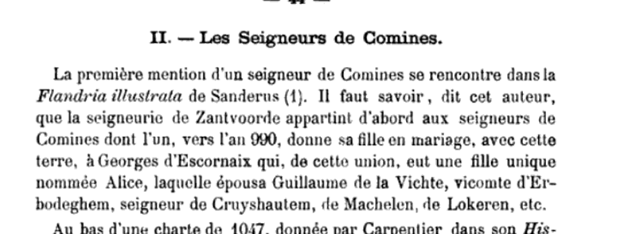
Most of the following information has been translated from the original French.
According to Bulletin de la Commission historique du département du Nord Volume 17, published in 1886, the earliest mention of a lord of Comines is found in Flandria illustrata by Sanderus. The history of the de Comines family before the 12th century is somewhat unclear, but it becomes more evident during the time of a figure referred to as “B. de Comines.” An act from 1129, quoted by Du Chesne, mentions a witness named “B de Cominiis.” Although the “B” may represent Bouchard, it is more likely to stand for “Bauduin” (Baldwin). This individual was Bauduin de Comines I.
Comines is a city in Belgium that straddles the Franco-Belgian border.
B. de Comines was succeeded by his son, Bauduin II de Comines. In 1138, Thierri of Alsace, Count of Flanders, agreed to an exchange of land dependent on his fief, involving the monks of Bas Warneton and Bauduin de Comines. The act, passed in Ypres, was witnessed by Guillaume, Bauduin de Comines’ brother, and Siger, his uncle. Bauduin appears in seven or eight other charters from 1139 to 1163. An act from 1163, recorded in the cartulary of the abbey of Marchiennes (p. 118), is subscribed by Willelmus and Balduinus de Comines.
Bauduin III de Comines married Adele Alix de Bailleul. According to the chronicle of Lambert d’Ardre, reporting the descendants of Guillaume II, châtelain de Saint Omer, and Mélisende de Picquigny, their second daughter, Euphémie, married Bauduin de Bailleul. They had two sons, Gérard and Hoston de Bailleul, and four daughters, the eldest being named Alix de Bailleul, who became the wife of the lord of Comines. The alliance between the houses of Comines and Bailleul was depicted in the coat of arms of the lords of Comines, reflecting the family arms of their mother. In 1180, Bauduin de Comines witnessed a diploma of Philippe d’Alsace, confirming the donations of his predecessors and offering some measurements of land in Houthem to the abbey of Vormeseele, near the aqueduct of Sibald. This is all that is known about this particular Bauduin. Although there is little evidence to prove him as the son of Bauduin II, a more precise indication in the shield of Bauduin IV suggests he was the son of Alix de Bailleul.
Bauduin IV de Comines married Béatrix d’Aire and later Mathilde de Bethune, the widow of the Lord of Houdain. Mathilde is the mother of Mahaut de Comines. Bauduin IV, lord of Comines, had disputes with the abbey of Saint Bertin over land called Obstal located in Bas Warneton. The transaction was confirmed by Philippe, Count of Flanders, in an undated act, but its age can be circumscribed. The agreement was first made at Bas Warneton, with Bauduin’s aldermen and men present, then renewed in Comines with the consent of his wife and heirs.
Several Bauduins of Comines succeeded each other until the end of the 13th century, and the constant repetition of the same first name makes it challenging to attribute certain events precisely. Although alliances provide some distinctions among these figures, the difficulty lies in determining the application of acts that precede or follow those in which women’s names appear. In this case, the need to choose led to attributing the facts related to the act of 1187 to Bauduin IV rather than his predecessor. A similar situation applies to a charter from 1187 signed by Bauduin de Comines, confirming a donation made by Bauduin de Bailleul, châtelain d’Ypres, to the leper hospital in Saint André lez Ypres, and confirmed by Philippe d’Alsace.
That’s it for now. Next, I plan to investigate the branch of Mathilde de Bethune and some other loose ends.
 Gathering Leaves
2 thoughts on “Noblesse Oblige”