After publishing last night, I found yet more books at Google Books that hold new information regarding my ancestor, the insurrectionist, Jan Van Coppenolle. Thanks to the (new?) translation feature in Google Books, I could quickly decode the data from Latin and French.
According to Nouvelle Collection Des Mémoires Pour Servir À L’histoire de France (1853) Ed. Joseph Fr. Michaud
The pension amount paid to Jan Van Coppenolle by the King of France was 600 francs per year. More on this below.
According to Fragments inédits de Romboudt De Doppere découverts dans un manuscrit de Jacques De Meyere (1892) by Romboudt de Doppere:
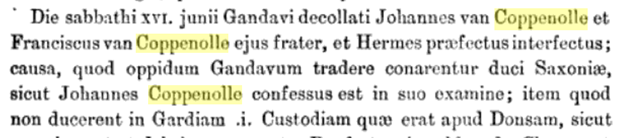
Before his execution (and probably under torture), Jan Van Coppenolle confessed that he conspired to turn over the city of Ghent to the Duke of Saxony. This seems like a false confession considering that Van Coppenolle was supposedly in the pay of the King of France; plus the Duke of Saxony was the enemy. In 1488 Duke of Saxony, Albert the Bold was appointed Governor of the Netherlands and marched with the imperial forces to free the Roman king, Maximilian, from his imprisonment at Bruges, and when, in 1489, the King returned to Germany, Albert was left as his representative to prosecute the war against the rebels. He was successful in restoring the authority of Maximilian in Holland, Flanders, and Brabant.
Also…
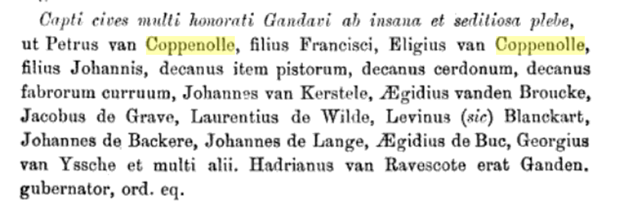
Following the execution of the brothers Jan and Fran, two of their sons along with other citizens were arrested by the mob in Ghent. It lists Peter van Coppenolle as the son of Francis, and Eligius van Coppenolle, the son of John. Eligius van Coppenolle was a brother of my ancestor, William Janz Van Coppenolle. The book does not say what was the fate the Coppenolle cousins. (According to a researcher I quote below, the Van Coppenolle family lost their property in Ghent and they were banished to the town of Ronse – the town from whence the DeBacker’s came to America in 1883)
According to Cours d’histoire nationale (1869) by Alexandre Joseph Namèche:
Before his execution at the hands of a mob, Jan Van Coppenolle was struck down by a plowman named Arnould Declercq after Van Coppenolle had reproached him for not going to fight the Germans at Deynze. Another source says that Van Coppenolle was struck by a plowman with an axe.
Following the first uprising (1483/85), Jan Van Coppenolle was arrested along with the rebel leader, William Rym, but escaped the same fate as Rym when he was freed by a mob and allowed to flee to France.
Namèche also repeats that Van Coppenolle was paid a pension 600 francs and states “Jean de Coppenolle en France où Charles VIII le créa son maître d’hôtel avec six hundred francs de pension.”
Which translate to: “Jean de Coppenolle went to France where Charles VIII created him his butler with a pension of six hundred francs.”
What is interesting about this is that in 1485, Charles VIII was fifteen years old and was under a regency headed by his 24-year-old sister, Anne.
According to Wikipedia, as regent of France, Anne of France was one of the most powerful women in the late fifteenth century, and she was referred to as “Madame la Grande”. Her regency lasted from 1483 to 1491.
So, technically Van Coppenolle was not employed by King Charles but rather by the King’s sister, Princess Anne. It is more than a coincidence that the arrangement ended when it did, and that Jan Van Coppenolle’s decline and fall began when he lost the support of the French crown after Anne’s regency ended.
It is a mystery was to why a middle-aged chaussetier (sock-maker) from Flanders would be made a maître d’hôtel and paid a pension of 600 francs by a French princess. This just makes it even more intriguing.
Here are notes that I copied from a fellow researcher at Ancestry.com and translated from Dutch. He alludes that following the failure of the uprising, the Van Coppenolle family was banished to the city of Ronse, the city that the DeBacker’s eventually left to come to America.
Jan van Coppen(h)olle is mentioned in 1479 as the father of Willem van Coppenolle. He was leader of the Ghent revolt against Maximilian of Austria, (son of Frederick the Third) was appointed in 1477 in rebellious Ghent as a receiver, charged with the recovery of the city funds that the previous rulers had appropriated. He also acted as one of the leaders of the Ghent militias in their fight against the invading French.
As secretary of the bench of aldermen, he was closely involved in the negotiations on the peace of Atrecht (December 23, 1482), which the States of Flanders concluded with Louis XI, despite Maximilian. The anti-Maximilian feelings of Flanders, dominated by Ghent, itself completely under the influence of Coppenhole and his allies, were sharpened when it turned out that Maximilian did not want to accept peace. Brabant, however, was not very compliant and the promised French aid was too little, so that Ghent soon found itself almost alone. In the city itself, the boatmen and the butcher guilds took over in June 1485 and Copenholle was arrested in Aalst on 11 June.
Transferred to Ghent, he was liberated five days later by a riot, but fled to France via Tournai, after Flanders had reconciled with the archduke on 28 June. The French king appointed Coppenhole hotel master, but taking advantage of a new wave of discontent in Ghent, he returned there in September. Master of the city again, he even minted coins (the ‘Copenolen’) and renewed the magistrate in Ypres in the name of the Members of Flanders.
At the initiative of Ghent, the States General submitted a declaration of principle to Maximilian, who had been imprisoned in Bruges, for signature (May 1488). When the duke was released and trampled underfoot, Ghent could count on the support of various Flemish and Brabant cities and, above all, on the cooperation of Philip van Cleves.
However, the initial French aid soon fell away and most of the provinces submitted in 1490. Ghent continued to resist under Coppenhole and Philip van Kleef, but on 14 June 1492 Coppenhole and his twin brother Frans were captured by a rival faction and put on the rack. and beheaded two days later on the Vrijdagmarkt, under the accusation of wanting to surrender the city.
With him, the Ghent resistance collapsed. (Winklerprins encyclopaedia of Flanders) Lit: V. FRIS, J. v. Coppenhole, in Bulletin der Maatschappij v. Geschied- en Oudheidkunde van Gent (1906) After his beheading, his goods are confiscated, his widow and children are banished to Ronse . (see book by: J.H.Bekouw, “Exiles and refugees from Ronse”, published in Haarlem 1941.
That last detail, about the banishment to Ronse, corresponds with another fact that I found, namely that Willem Jansz. van Coppenolle (no. 14 above, so son of Jan van Coppenolle, born in 1464 in Ghent) in 1494 had a son named Stevin Willemsz. van Coppenolle (no. 13) who was indeed born in Ronse.
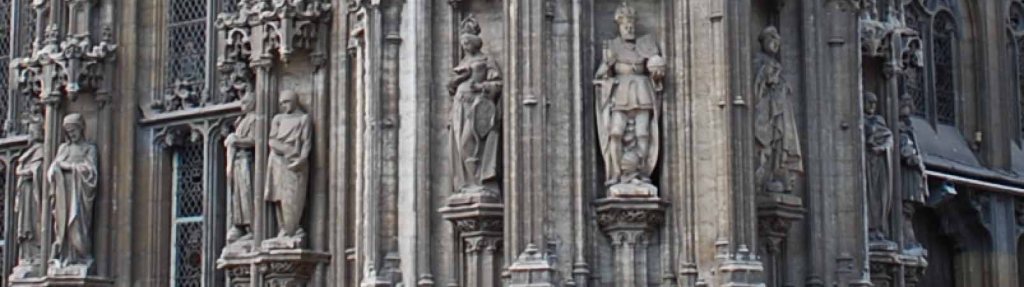
There might be a statue of Jan Van Coppenolle on the city hall’s façade at Butter Market in Ghent. According to a book published by the Historical Society of Ghent in 1913, there was a proposal to remove some statues and replace them with others. The plan called for “the seven statues of the counts of Flanders and the warrior Kryger would be removed and replaced with eight new statues of figures from the history of Ghent prior to the construction of the town hall.”
The eight new figures were listed as follows:
- Ste. Amand évêque 679
- Guillaume Wenemaer guerrier 1325
- Jan Borluut guerrier 1306
- Jacob van Artevelde homme politique 1345
- Philips van Artevelde guerrier 1382
- Frans Ackerman homme politique 1387
- Adrien Vilain van Rasseghem homme politique 1490
- Jan van Coppenolle homme politique 1492
 Gathering Leaves
Bonjour,
A la recherche d’information concernant les “coppenollen” crée par Jan, je suis arrivé a votre publication. Existe-t-elle en français pour plus de simplicité a lire même si l’anglais ne me dérange pas.
Je suis moi même un Van Coppenolle et Jan fait partie de la 23eme génération de la famille. J’étais très heureux d’en apprendre un peu plus sur mes lointain ancêtres.
Je continue a paufiner mes recherches pour compléter mon arbre généalogique.
Bien a vous
Pascal Vancoppenolle
LikeLike
Bonjour, je m’excuse pour le retard avec lequel je réponds à votre message. Merci pour vos gentils commentaires. C’est toujours merveilleux d’entendre des cousins éloignés. Malheureusement, mon livre Gathering Leaves est uniquement en anglais.
Bonne année!
Votre cousin,
David (Mike) DeBacker
LikeLike