Growing up in Texas, I experienced an identity crisis. Because I wasn’t born there, I felt disconnected from the state’s rich history and culture. Looking back, if I had the understanding then that I have now, it would have profoundly impacted my self-perception and my place in the world. While this morning’s discovery may seem trivial, I strongly believe that this knowledge would have made a significant difference.
I did not know then that my grandfather was born in Dallas, Texas. I thought he was from Georgia, but even then I did not know that his father’s family has deep roots in that state. Also, I knew of his mother, Helen “Nellie” Spiegel, But I mistakenly believed that she was born in Berlin Germany. Later, I learned that Nellie was also born in Dallas, Texas, in 1872. That same year, Dallas became a boomtown when two train lines intersected on the windswept North Texas prairie.
Nellie’s parents, George C. Spiegel, and Sophia Schmidt, were married in New York City sometime shortly after the Civil War. I learned from the census record of 1870 that George was born in 1839 in the Kingdom of Saxony in what is now Eastern Germany in the vicinity of Dreseden. I later learned that he immigrated in 1854 along with his family. Sophia was born in NYC in 1846; making her a teenager at the start of the war. (For more details on the past histories of George & Sophia, see The Lost is Found and From Bavaria to New York: An Immigrant Journey)

George C. Spiegel – Savannah, Georgia – 1870
In the past five years – since the death of my mother – I have discovered a lot about my mother’s great-grandfather, George Caspar Spiegel. As I said he was born in Saxony and immigrated when he was in his early teens. I don’t know how much formal education he received. It is believed that he became a cigarmaker (seegarmaker) when he was in his teens and as I noted in previous blog order articles he went from being a cigarmaker to being the owner of a cigar making factory. Following the Civil War, he engaged in the business of cigar making in New York City but because of tough laws being implemented regarding the tenement factory system, George and Sophia left New York City and moved to Savannah.
George was a strong supporter of the cigarmaker’s Union and for a while was the head of his local in Dallas.
George, a Union Army veteran, served as a private in an Infantry regiment of the XI Corps from the fall of 1862 to the late summer of 1863. His unit, the 57th New York Infantry Regiment, earned the nickname “Polish Legion” due to its primary composition of immigrants from Poland, Germany, and Bohemia.
His unit achieved notoriety at the Battle of Chancellorsville, where Confederate General Stonewall Jackson’s surprise “Flank Attack” routed Union soldiers. Despite initial demoralization from the elite New York Press’s criticism, hundreds of German American soldiers gathered at Cooper Union Auditorium in Midtown Manhattan during the winter of 1862/63. Their strong advocacy led the newspapers to apologize, acknowledging the soldiers’ valiant fight against the rebel surprise attack.
George’s unit also fought at Gettysburg, enduring sustained artillery bombardment from the Confederates while guarding Union artillery positions on Cemetery Hill. So far, I have found no record of George joining the Grand Army of the Republic (GAR), or any other fraternal organizations associated with the war.
Instead what I discovered is that for George, cigarmaking was not his only passion – there was, in typical German fashion a pastime that involved singing and vast quantities of beer. George belonged to the oldest singing society in all of Texas. He was a member of the The Frohsinn Choral Society in Dallas.
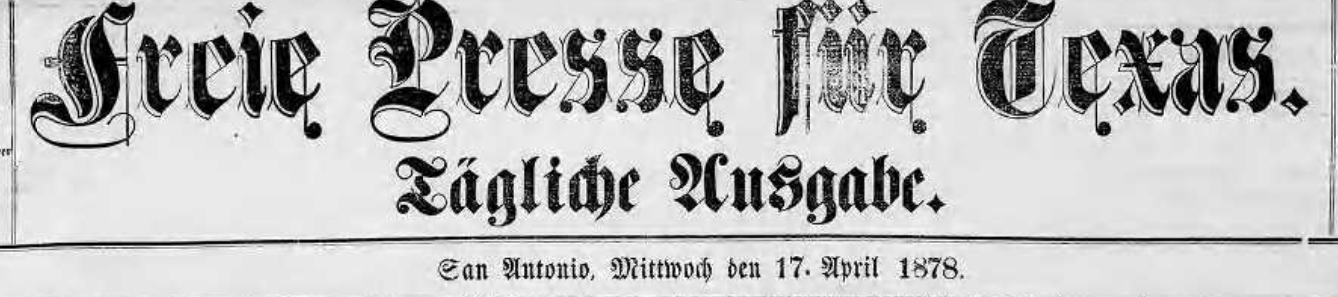
This morning, I found the following item in Texas’s largest German language newspaper, San Antonio Free Press of Texas (San Antonio Freie Presse fur Texas) dated 17 April 1878.
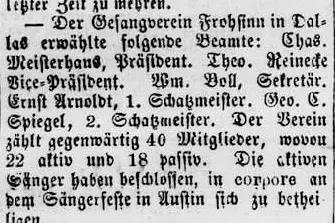
Translated (thanks to Google Lens)…
Time to celebrate. – The Frohsinn Choral Society in Dallas elected the following officials: Chas. Meisterhaus, President. Theo. Heineke, Vice-President. Wm. Boll, Secretary. Ernst Arnoldt, 1st Treasurer. Geo. C. Spiegel, 2nd Treasurer. The society currently has 40 members, of which 22 are active and 18 are regular. The active singers have decided to participate en masse in the choral festival in Austin.
The choral festivals were known as Sangerfests. According to Wikipedia: Sängerfest, also Sängerbund-Fest, Sängerfeste, or Saengerfest, meaning singer festival, is a competition of Sängerbunds, or singer groups, with prizes for the best group or groups. Such public events are also known as a Liederfest, or song festival. Participants number in the hundreds and thousands, and the fest is usually accompanied by a parade and other celebratory events.
Apparently the group that George was a member and officer of, stills exists…
Dallas Frohsinn Singing Society (Dallas, TX): A contemporary German choir that actively participates in Saengerfests and promotes German culture in Texas through regular rehearsals and performances.
I am unsure of George and Sophia’s burial place, though it is likely in the Dallas-Fort Worth area. My grandfather, James M Dobbs, Jr., and his mother, Nellie, are interred in a small cemetery in Holland, Texas, approximately 60 miles north of Austin, deep in the heart of Texas.
 Gathering Leaves