One definition of insanity is doing the same thing over and over again while expecting different results. However, when it comes to slot machines and genealogy, repeating the same actions can sometimes lead to surprising and rewarding outcomes.
That’s why, every year around St. Patrick’s Day, I visit Ancestry.com to continue searching for my Irish ancestors.
On my father’s side, the O’Malley family settled in Minnesota and Kansas, where they worked as farmers and railroad laborers.
On my mother’s side, the Bannon family were general contractors and factory owners in Cincinnati, Ohio, and Louisville, Kentucky.
Due to the socio-economic differences between city dwellers and rural folks, I’ve had better luck finding information about the Bannon family in local newspapers. Today, I made a few discoveries, including articles about a fight between Richard Bannon and his younger brother, Patrick. It was an altercation that led to one brother being arrested for disorderly conduct and the other having to put up a bond to keep the peace.
First, a little background to provide context. The Bannon brothers, Richard and Patrick, came over from Ireland around 1845 and first settled in Cincinnati, Ohio. Four years later, at the height of the famine, the rest of the family, consisting of their mother, Eleanor, a sister, and four half-siblings from Eleanor’s second marriage, arrived. (And the conservatives complain about “chain migration”)
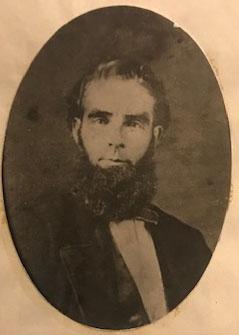
The men, Richard, Patrick, and two half-brothers, were employed as plasterers. Their first big project in the early 1850s was plastering the interior of St Peter in Chains Cathedral in Cincinnati. This led to a job in Louisville, Kentucky, plastering the interior of the Fourth Avenue Baptist Church. It was around this time that Patrick first moved to Louisville, where he owned and operated two factories: one that manufactured vitrified bricks for paving streets and a second that manufactured terracotta building ornamentation that was popular for building facades in the 19th and early 20th century. His older brother, Richard, was a general contractor who owned a construction company in the Cincinnati, Ohio / Coventry, Kentucky area before moving his family to Louisville around 1855.
Before the Civil War, the brothers built a large house on Rowan Street between 23rd and 24th streets in the predominantly Irish neighborhood in Louisville’s West End. According to one of Richard’s daughters: The two brothers built a double brick house in the west end, and drew straws to see which side each one would occupy, and they raised their families there.

And did they live happily ever after? Well, there were bumps along the street of life, and one day in the summer of 1877, something happened to disturb the peace.
I found two small items in the Louisville Courier-Journal. The first item was found in the Thursday, August 9, 1877, edition of the paper. It was on the page where the paper lists Court appearances from the previous day. Under the “Disorderly Conduct” section, one item read “Richard Bannon and James Bannon; continue to Thursday.”
So it appears that my great-great-grandfather, Richard Bannon, and another man named James Bannon were arrested for disorderly conduct. When they appeared before the judge, they were told to return the following week, on the 16th of August.
I am not clear on who James Bannon was. I suspect this might be Richard and Patrick’s younger half-brother, James Campbell, who was also a plasterer by trade.
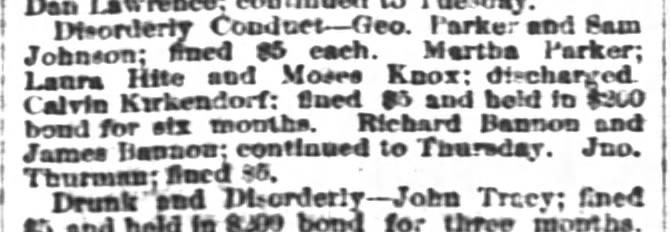
The paper that day provided no details of the men’s arrest. But the Friday, August 19, 1877 edition of the Courier-Journal does give some more context to go on.
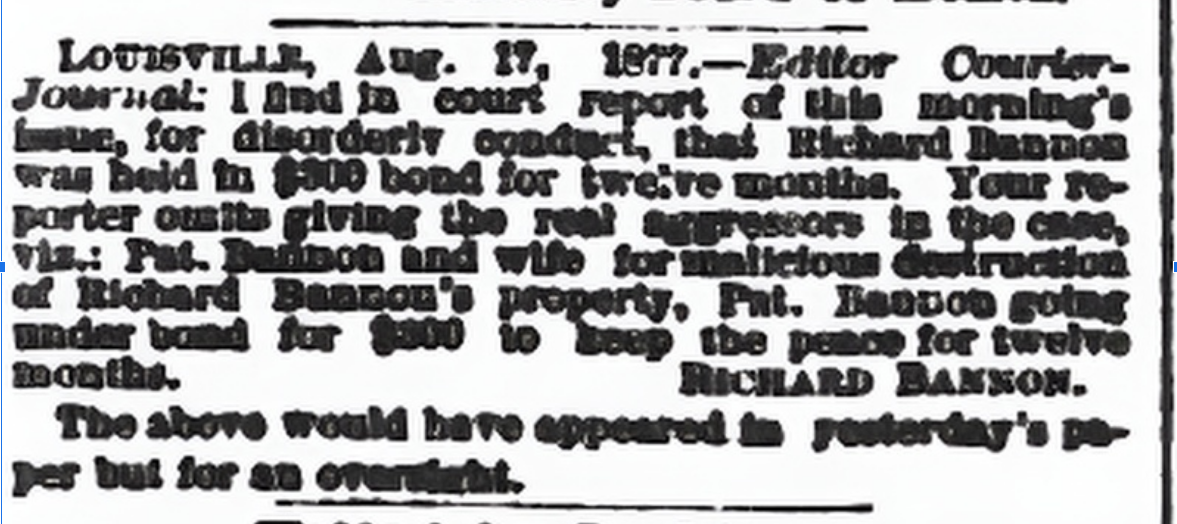
Here is the full text of the 2nd item in the Sunday, August 19, 1877, which appears to be a “letter to the editor” from Richard Bannon
“Louisville, August 17th, 1877- Editor Courier-Journal: I find in court report of this morning’s issue, for disorderly conduct, that Richard Bannon was held in $300 bond for 12 months. Your reporter omits giving the real aggressors in the case viz.: Patrick Bannon and wife for malicious destruction of Richard Bannon’s property, Patrick Bannon going under bond for $300 to keep the peace for 12 months.” Richard Bannon signed it, and the paper added, “ the above would have appeared in yesterday’s paper but for an oversight.”
So it appears that there was some sort of an altercation involving the Bannon / Campbell brothers that resulted in the arrest of Richard and James for disorderly conduct and that when Richard went before the judge, he made an accusation against his brother Patrick and sister-in-law, Louisa Ellen. Instead of Richard being fined $5 for his actions, Patrick was required to put up a $300 Bond “to keep the peace for 12 months.” In other words, if the police were not involved again for a year, Patrick would get his money back. The equivalent value of $300 from 1877 in today’s dollars would be about $10K.
Both men were well-off – lace-curtain Irish, as my grandmother would say. Patrick was a city councilman in Louisville.
Below are some of the other items that I found in the archives of the Louisville Courier-Journal:
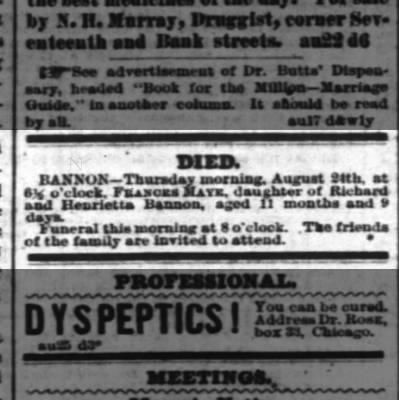
It appears that my great-grandmother, Kate Bannon, whom I knew as Beanie when I was little, had older sister who died when she was just shy of her first birthday. Her name was Frances Maye Bannon. This is from the 25 August 1871 edition:
The 6 Feb 1873 paper edition has a Notice of Incorporation for the “Irish Building and Loan Association.” Richard Bannon is listed along with a dozen other men as an officer of this corporation.

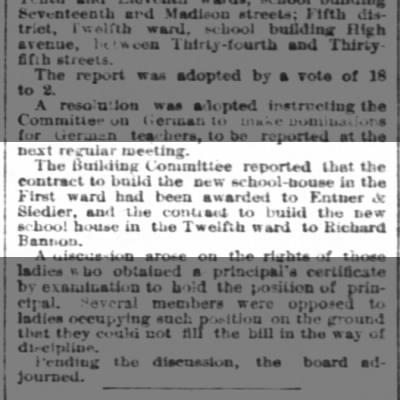
12 June 1877: Richard Bannon is listed as confirmed to build a new schoolhouse in the 12th Ward (aka West End) of Louisville.
27 August 1876: Describes a meeting of the Irishmen of America (Clan na Gael?) at the Masonic Temple to raise a relief fund. They also designated a committee to welcome six escaped Australian Fenian prisoners who had recently arrived in the United States. Further down, it lists Richard and Patrick as being elected as officers representing the 12th Ward.

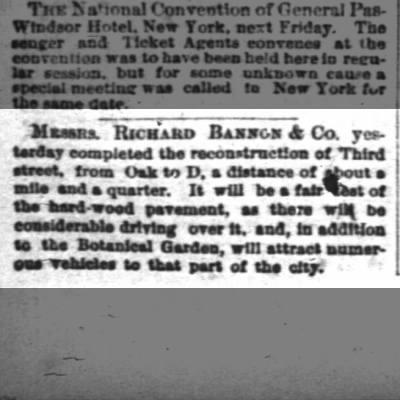
7 September 1879: Notice of completion of street work by Richard’s company. The work was done on Third Street from Oak to D Street, a distance of about a mile and a quarter. The item says, “it will be a fair test of the hard-wood pavement, as there will be considerable driving over it in addition to the Botanical Gardens will attract numerous vehicles into that part of the city.”
According to ChatGPT, in the 19th century, “hard-wood pavement” referred to wooden block paving, a method used in some cities before asphalt and concrete became widespread. These wooden blocks, often made from durable hardwoods like oak, cedar, or pine, were cut into rectangular shapes and laid on a sand or gravel base. They were sometimes treated with tar or creosote to increase durability and resistance to water and rot.
Louisville, like many other cities in the late 1800s, experimented with various paving materials, including brick, stone, and wood. The newspaper article suggests that this street was paved with wooden blocks, and city officials were interested in seeing how well they held up under heavy traffic.
Wooden block pavements were praised for being quieter and smoother for horses and carriages compared to cobblestone. Still, they had drawbacks, such as becoming slippery when wet and being susceptible to decay over time. By the early 20th century, they were largely replaced by more modern materials.
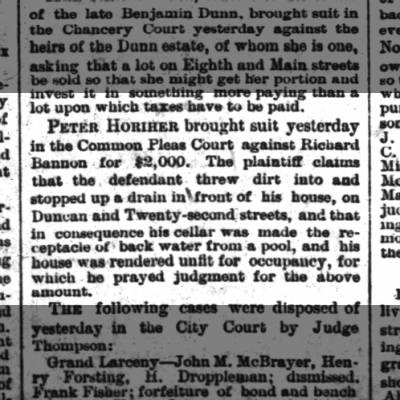
25 July 1883: The notice that Richard Bannon was being sued for $2,000 reads, “the plaintiff claims that the defendant threw dirt into and stopped up a drain in front of his house, on Duncan and 22nd street, and that in consequence his cellar was made the receptacle of backwater from a pool and his house was rendered unfit for occupancy for which he prayed judgment for the above amount.”
I assume this occurred as the result of construction being done on the street and not done intentionally. $2,000 in 1883 is worth $62K today.
This lawsuit occurred approximately a month before my great-great-grandfather suffered a stroke and died.
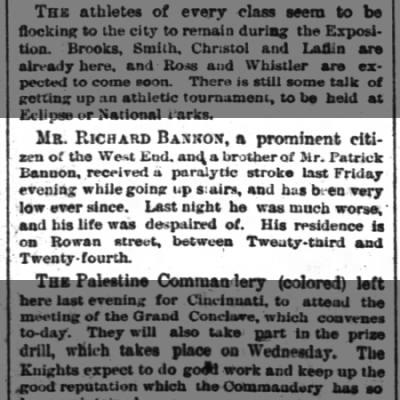
6 August 1883:
Mr Richard Bannon, a prominent citizen of the West End, and a brother of Mr Patrick Bannon, received a paralytic stroke last Friday evening while going upstairs, and has been very low ever since. last night he was much worse and his life was despaired of. His residence is on Rowan Street between 23rd and 24th.
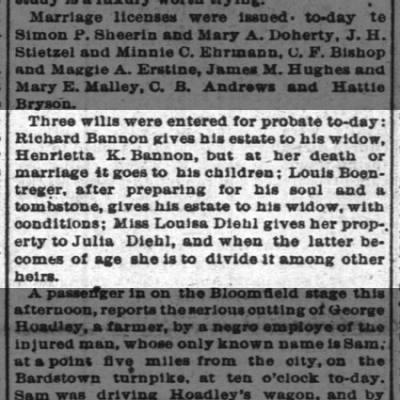
14 August 1883: A notice appeared in the Cincinnati Enquirer.
Richard Bannon gives his estate to his widow, Henrietta K. Bannon, but at her death or marriage it goes to his children.
Happy St. Patrick’s Day!
 Gathering Leaves