A month ago, I wrote an article titled “Massachusetts Ancestors with Wikipedia Articles.” Yet it’s only now, through further study, that I am realizing the significance of what three of those ancestors did when they put their names on a document in the spring of 1638. These men are ancestors on my father’s side of the family, and their names were Philip Sherman,


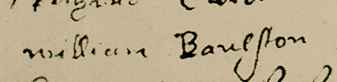
and William Baulston.
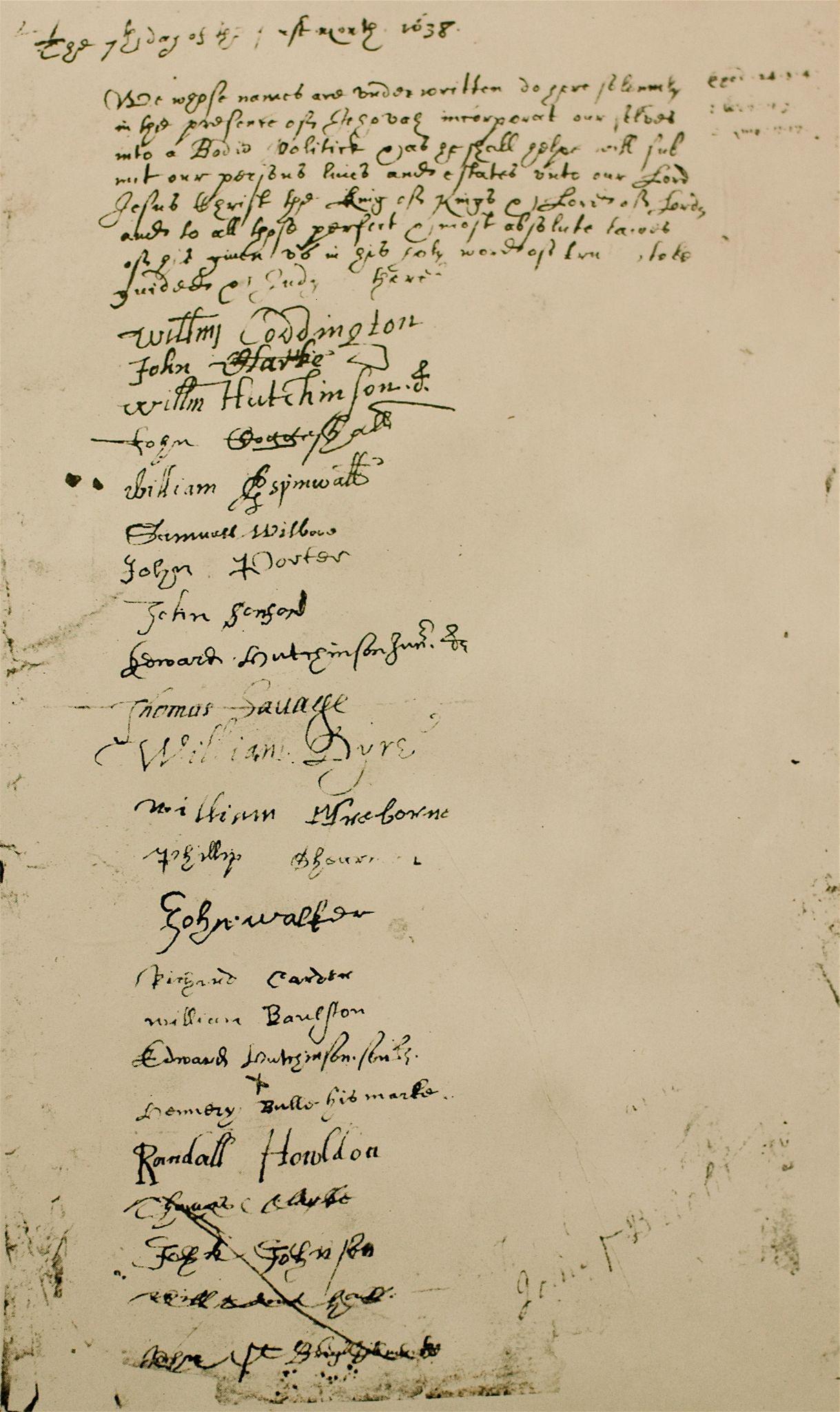
The document that they signed is known as the “Portsmouth Compact.”
The Portsmouth Compact, signed on March 7, 1638, is a historically significant document because it represents one of the earliest examples of a political agreement based on democratic principles in the United States. The document was written and signed by a group of Christian dissidents seeking religious freedom from the governmental oversight of the Massachusetts Bay Colony by moving to Aquidneck Island to set up a new colony. Among this group was Anne Hutchinson, who had been banished from Massachusetts Bay following the Antinomian Controversy there.
The purpose of the Portsmouth Compact was to set up a new, independent colony that was Christian in character but non-sectarian in governance. It has been called “the first instrument for governing as a true democracy.”
How We Are Related
These are all my paternal grandfather Leopold DeBacker’s ancestors through his maternal grandmother, Cordelia Pickering. Further, these are all ancestors of Cordelia’s great-grandmother, Abigail Chase.
Philip Sherman was Abigail’s 2x great-grandfather on her father’s side.
John Coggeshall was her 2x great-grandfather on her mother’s side, and John’s wife, Elizabeth Baulston(e), was the daughter of William Baulston.
William is my father’s 9x great-grandfather, John is 8x great-grandfather, and Phillip, his 9x great-grandfather.
I previously posted about John Coggeshall (here).
William Baulston, Family Guy
Here is what Wikipedia says about William Baulston’s background:
Born by about 1605, William Baulston arrived in Boston with the Winthrop Fleet in 1630, and was made a freeman on 19 October of that year.[1] By 1634 he had become involved with the colonial militia, and was designated as Sergeant.[1] In 1637 he was given a license to keep a house of entertainment, and given permission to “sell such claret and white wine as is sent for.”
During the trial of Anne Hutchinson, William signed a petition in support of Anne’s pastor, the Reverend John Wheelwright, who was censured by the General Court in March 1637.
Following this, William was arrested, fined, stripped of his voting rights, prohibited from bearing any public office, and forced to give up all of his weapons: “guns, pistols, swords, powder [&] shot.” He was then subsequently banished from the Massachusetts colony. All because he was a follower and supporter of Mrs. Hutchinson.
He and others originally planned to go to the Dutch colony of New Amsterdam (Manhattan), but Roger Williams convinced them to settle near the Narragansett Bay, and they soon established Pocasset on Aquidneck Island (also called Rhode Island) in the bay. After moving there, he was permitted to develop a house of entertainment for strangers, to sell wines, and to brew beer.
Now, watching Family Guy will never be the same, knowing that one of my ancestors opened the first bar in Rhode Island.
Key Significance:
- Religious Freedom and Separation of Church and State:
- The signers sought to establish a settlement where they could practice their beliefs freely. The compact reflects a break from the Puritan theocratic rule in Massachusetts, as it emphasized self-governance and liberty in religious matters.
- Foundation of Portsmouth, Rhode Island:
- The compact formally established the settlement of Portsmouth on Aquidneck Island (now part of Rhode Island). This settlement was part of what became known as the Colony of Rhode Island and Providence Plantations, a haven for religious dissenters and one of the most tolerant colonies in early America.
- Early Example of Democratic Governance:
- The compact is an early form of a social contract, reflecting the influence of democratic principles. The signers agreed to form a “civil body politic” and to govern themselves according to their own laws.
- Precursor to Broader Principles in American Governance:
- The Portsmouth Compact and other agreements like the Mayflower Compact helped lay the groundwork for later democratic institutions and constitutional government in the United States.
The document’s language also uniquely expressed a covenant under God to establish a political body, aligning their governance with their spiritual beliefs without imposing a singular religious doctrine. This compact underscores the evolving governance and religious freedom ideas in colonial America.
 Gathering Leaves