I was curious to find information about my father’s Pickering ancestors who moved from Salem to Mendon, Massachusetts in the 1730s. I scoured Google Books and came across a book titled “The Annals of the Town of Mendon 1659-1880.”
Three generations of my Pickering ancestors lived in Mendon for nearly a century. I was uncertain about the exact timing of Edward and Hannah Pickering’s departure from Salem to Mendon, but it appears they made the move in the 1730s while keeping property in Salem/Lynnfield. Their son, Jonathan Pickering, was born in Mendon in 1736.
Edward Pickering and Hannah Bancroft were blessed with eight children, two of whom are my ancestors. Their son, Edward Jr., had a daughter named Alice, who married her first cousin, Jotham Pickering, the son of Edward’s younger brother, Jonathan.
Edward Sr., in keeping with the tradition of his English forebears, was a husbandman who primarily raised sheep. These are the extent of the details I knew about Edward Pickering’s family prior to discovering the Annals of Mendon.
What I learned from the Annals of Mendon [Metcalf 1880] was primarily focused on the military service of the Pickering men.
The Invasion of Canada (Summer of 1759)
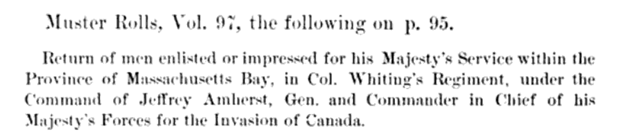
According to a muster roll (pgs 284-285) Edward Pickering, Jr. (1732-1800), my fifth great-grandfather, was a solider in Massachusetts militia during the Seven Years War (aka French & Indian War). The muster roll is described as a “return of men enlisted or impressed for his Majesty’s Service within the Province of Massachusetts Bay, in Col. Whiting’s Regiment, under the command of Jeffrey Amherst, General and Commander in Chief of his Majesty’s Forces for the Invasion of Canada.” It was a three-month enlistment in the summer of 1759. This means that he was either at the Battle of Ft. Ticonderoga (July 26-27) or working on a crew constructing Fort Crown Point, both are located in what is now upstate New York near the Canadian border. At the time, Edward was 27 years old.

The Battle of Lexington (April 19, 1775)
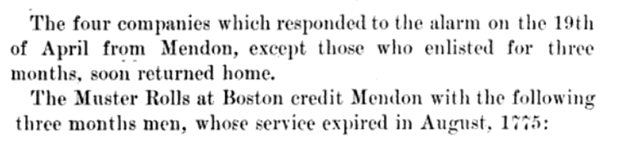
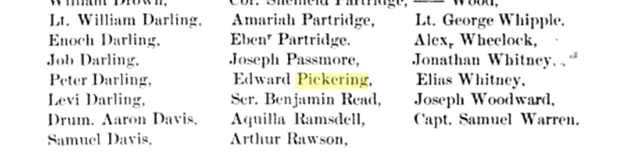
There are two muster rolls from 1775 – one that lists men from Mendon who responded to the alarm on April 19th and another that lists men from Mendon who enlisted for three months service following the general alarm. It appears that Edward’s eldest son, Benjamin was one of the first responders (in other words, a “minute man”) and that Edward was on of the “three months men” of Mendon who service expired August 1775.
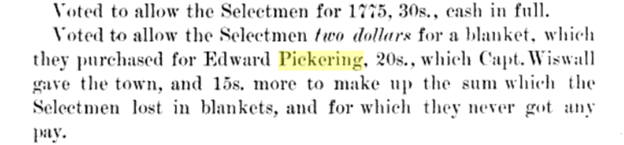
I guess Edward forgot the universal rule “Don’t forget to bring your towel!” because the Annals of Mendon record that in 1775 the Selectmen of the town voted to spend two dollars to buy him a blanket.
Siege of Rhode Island (1778) (pg 376)
In 1778, at least one other son of Edward Pickering served in the Massachusetts militia, my fifth great-grandfather, Jonathan Pickering. He appears on a list of nine month’s men for the “Rhode Island service,” referring to the on-going Siege of Rhode Island. Included on the list is a “John Pickering,,” of whom I am uncertain. According to other sources, Edward did have a son named John, but those sources say that his son died in 1747.
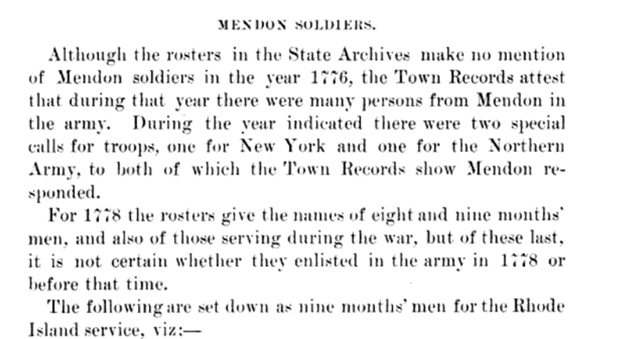
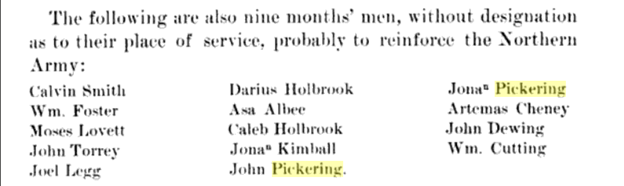
Rhode Island Service
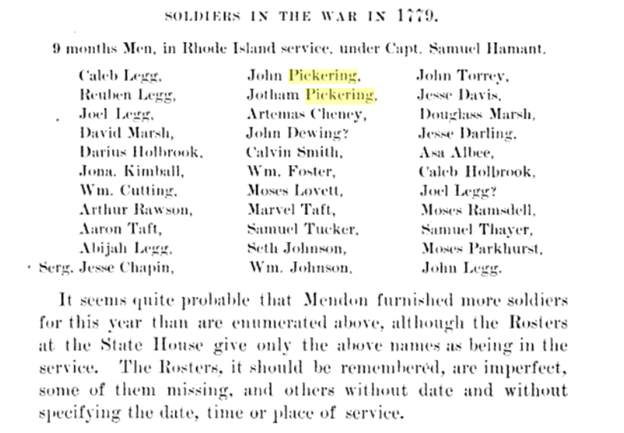
Edward’s grandson, Jotham, was 18 years old in 1779, and now it was his turn to be called up. “Rhode Island Service” may refer to the First Rhode Island Regiment. In addition to my 4th great-grandfather, Jotham, the name “John Pickering” appears on this list and is a muster roll from 1780. This might be Jotham’s father, Jonathan Pickering.
After the Revolutionary War
I know that, after the war, my ancestor, Jotham, left Massachusetts and settled in Pennsylvania. His father, Jonathan, and his family remained in Mendon for many years following the revolution. Jonathan lived a very long time, and when he was in his early sixties, something made it necessary for the town’s elders to appoint a guardian over him. This was in 1798.

In 1821, the Selectmen of Mendon “voted to allow Preserved Pickering [son of Jonathan] forty cents per week for the support of his father.”
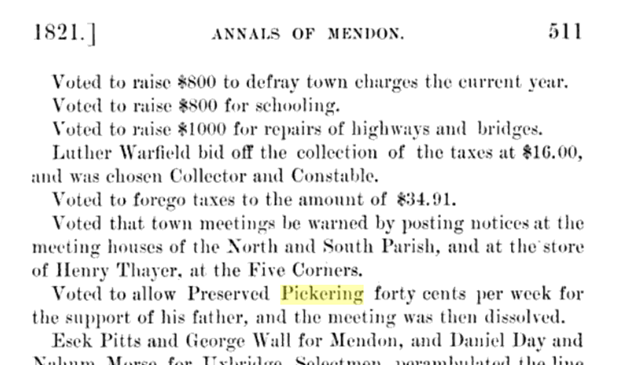
In 1822, the town elders again “voted to allow Preserved Pickering [son of Jonathan] forty cents per week for the support of his father.”

The final entry I found in the Annals of the Town of Mendon told that the Selectmen of Mendon “voted that the town pay Preserved Pickering $15.50 for extra expenses in the late sickness and burial charges of his late father, Jonathan Pickering.” Jonathan was 96 years old when he died in 1823.

 Gathering Leaves