Thanks to the translation feature in Google Books, I was able to learn new information about my ancestor the insurrectionist, Jan Van Coppenolle. He is a 14th great-grandfather on my father’s side who lived and died in the later half of 15th century. Jan is known in some historical accounts as the “Demagogue of Ghent” as he was the bourgeois dictator of that city for a couple of years before getting his head chopped off. (see Dutch language Wikipedia article)
Here is what I learned from books written in Dutch and in French:
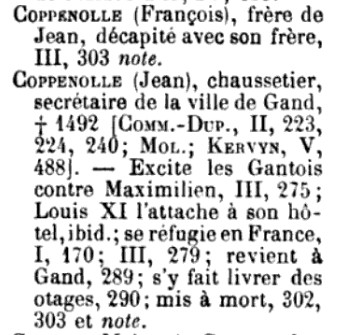
- He had a twin brother, Francoise, who was executed alongside him.
- He is mentioned as a leader of the uprising in a letter from the Archduke Maximilian written in response to the uprising.
- Before becoming the demagogue of Ghent (1487-1492), he led an army during the first phase of the uprising (1483-1485).
A little background is in order…
Flanders, located in northwestern Europe and part of Belgium, comprises three regions today: West Flanders, East Flanders, and a department in northwestern France. The DeBacker family originates from East Flanders. The County of Flanders was established during the reign of Charles the Bald in the 9th century, with the Counts of Flanders ruling the region as vassals of Frankish and later French kings for centuries.
In 1369, Philip the Bold’s marriage to Margaret of Dampierre ended Flanders’ independence as it became part of the House of Valois-Burgundy’s dominion over the Burgundian State.
During the Middle Ages, Flemish cities thrived economically and contributed to the prosperity of their Burgundian rulers. Philip II, also known as Philip the Bold or Philip the Rash, was a powerful and expansionist Duke of Burgundy who vigorously engaged in warfare against his neighbors, utilizing innovative gunpowder artillery.
The city of Ghent revolted against Duke Philip the Good in 1449, and during this uprising, Jan Van Coppenolle, still in his teens, may have been involved in the disastrous Battle of Gavere. The battle ended with a big bang when a Flemish artilleryman accidentally dropped a lit match into a gunpowder magazine killing hundreds Gantois rebels.
After Philip died, his son, John the Fearless became duke and he was followed by Charles the Bold (or Rash). Charles was just as greedy and expansionist as had been his grandfather, and his father. Charles died while trying to rush the gates of Nancy. They had to cut his frozen body out of an icy swamp.
Previously operating as virtual city-states, Ghent and Bruges attempted to reclaim their autonomy after Duke Charles the Bold’s death by securing the Great Privilege from Mary of Burgundy, Charles’ daughter and successor. However, upon her passing due to a hunting accident in 1482, her young son Philip I of Castile, from the House of Habsburg, became the new count, and her husband Maximilian I of Austria took the regent role. The Flemish burgers and guild masters opposed a regency of Maximillan and instead formed a Regency Council meant to rule until Philip reached his majority. There were two revolts during this crisis. The first revolt lasted two years and was from 1483 to 1485. In Ghent, the rebel leader was William Ryn, who was an echevin or alderman of the city of Ghent. During this period, Jan van Coppenolle was clerk to Aldermen of Ghent.
According to Histoire de Flandre: Volume V by Baron de Lettenhove (1850), Jan led an army during the uprising of 1483/85.

“The same day, Jehan de Coppenolle had been instructed to lead reinforcements to garrison of Termonde [Dendermonde: 30km east of Ghent]. He soon leaned that it was too late, and returned to Ghent to announce that Archduke was starting the war.”
One the items discovered was that Van Coppenolle was mentioned in letter written by Maximillan in response to charges made against him by the rebel leaders. He is mentioned along with 9 others (including William Rym) as having made accusations against Maximilian. In his response, the Archduke rejected any mediation on the part of the French king.
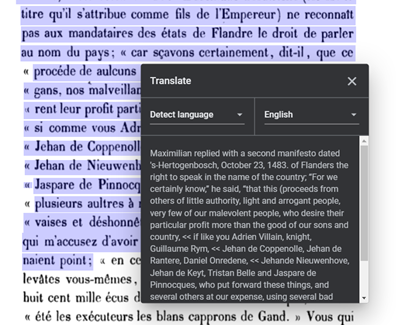
In his letter to the bourgeoisie of Ghent, Archduke Maximilian called out nine citizens of the city as being the ringleaders of the uprising: “Indeed, we are well aware that such notions emanate from individuals of limited authority, those who are conceited and haughty. These malevolent individuals are few in number, but their desire for personal gain surpasses their concern for the welfare of our children and country. Take, for example, Adrien Villain, a knight, as well as Guillaume Rym, Jehan de Coppenolle, Jehan de Rantere, Daniel Onredene, Jehan de Nieuwenhove, Jehan de Keyt, Tristan Belle, and Jaspare de Pinnocques, who propagate these ideas and many others that they accuse us of, resorting to numerous deceitful and malicious words to support their claims against us.”
The response to Maximilan from the aldermen of Ghent was probably composed by Van Coppenolle in his capacity as secretary to aldermen. The letter from Ghent to Maximilan contains the line: “Alas! Those who sought to preserve the harmony between the lands of Brabant and Flanders have unjustly, and without reason, faced immense suffering, contrary to the privileges rightfully granted to these regions. Rest assured, God shall eventually deliver retribution for these wrongs!”
Not exactly “when-in-the-course-of-human-events” but I think it has a nice ring to it.
Following the execution of William Rym in August of 1484, Van Coppenolle escaped to France, where according to multiple sources he began receiving a pension from the King of France.
Maximilan proved to be just as greedy as his in-laws and in 1487 the taxes levied on Flanders doubled. After Maximilan started a war with France, the Flemish cities once again arose in revolt lead by Ghent. Maximillan was taken hostage and was put under house arrest in Brugges. Maximillan’s father, the Holy Roman emperor raised army 20,000 Germans and arrived in Brabant in April 1488.
In Ghent, Jan Van Coppenolle led the resistance of that city, becoming a dictator and at one point minting his own money the “Coppenollen” (see earlier blog posts My Ancestor, the Insurrectionist and More My Ancestor the Insurrectionist).
When Van Coppenolle lost the support of King Charles VIII of France, after the truce between France and Maximilian (Peace of Kadzand, 1489), his opponents gained the upper hand, and he was beheaded at the Friday Market.
According to multiple sources in French, Flemish, and Dutch, Jan Van Coppenolle had a twin brother named Francois who suffered the same fate on 16 June 1492 in the Friday Market in central Ghent.
The 1493 Treaty of Senlis established peace between France and the Habsburgs; per the terms of the treaty, Flanders would henceforth be a territory of the Holy Roman Empire.

Philip the Good after the Battle of Gavere (1453)
As far as I know, there is not a monument or statue of Jan Van Coppenolle. There is however a statue of a Ghent rebel who lived about a hundred years before my ancestor. The statue erected in the 1860s is of Jacob Van Artevelde, a 14th century Flemish political leader, and it stands in the center of Friday Market near the spot where Jan and Fran were executed in 1492. Jacob van Artevelde was best known as Ghent’s rebel leader during an earlier uprising in 1300s. When France, because of the Hundred Years’ War with England, banned all its occupied territories from trading with the English, van Artevelde went against these orders and resumed the wool trade with England. For that reason, he is still seen as a folk hero in Ghent.
For more information, see the following:
 Gathering Leaves